

Fractional Ownership · guide
When Your Flying Drops: The Cost of Underusing a Fractional Share
Model the cost of underusing a fractional share, separate cash expense from capital cost, value rollover realistically and compare staying, downsizing or exiting.


Flying less can reduce your annual bill while making each flight more expensive. When a fractional share is underused, the hourly operating charges fall, but management expense and the economic cost of ownership can continue.
The decision is whether your expected future travel still justifies the share. Start by separating costs that stop from costs that remain, then compare staying, downsizing and exiting over the same period. An already-paid acquisition price should not decide the answer for you.
Separate costs that stop from costs that continue
Build a cost schedule from your agreement and statements. Distinguish management fees, flight-dependent charges, financing payments, expected changes in share value and any costs of changing or ending the arrangement.
NetJets' pricing explanation illustrates the distinction. It describes a fixed monthly management fee, an occupied hourly fee based on flight activity and a variable fuel rate. These are provider-specific components; use your own agreement to establish which charges continue when you fly less.
Do not assume that reducing flight hours reduces a management fee proportionately. If the fee is tied to the size of the share, it may remain unchanged until you resize or exit. Conversely, do not treat an unused allocated hour as though you have necessarily paid every variable charge associated with flying it.
Capital needs separate treatment. The cash you originally paid acquired an asset interest. Its current realizable value matters to an exit decision, while an expected decline in that value contributes to the economic cost of staying. Neither is the same as this month's flight invoice.
For a complete ownership model, see calculating fractional ownership cost over five years. For a near-term utilization decision, concentrate on the costs and value changes that differ between your available options.
Recalculate cost at your likely usage
Use at least three travel cases: normal usage, the level now expected and a further decline. Divide by hours actually expected to be flown, not the allocation printed in the agreement.
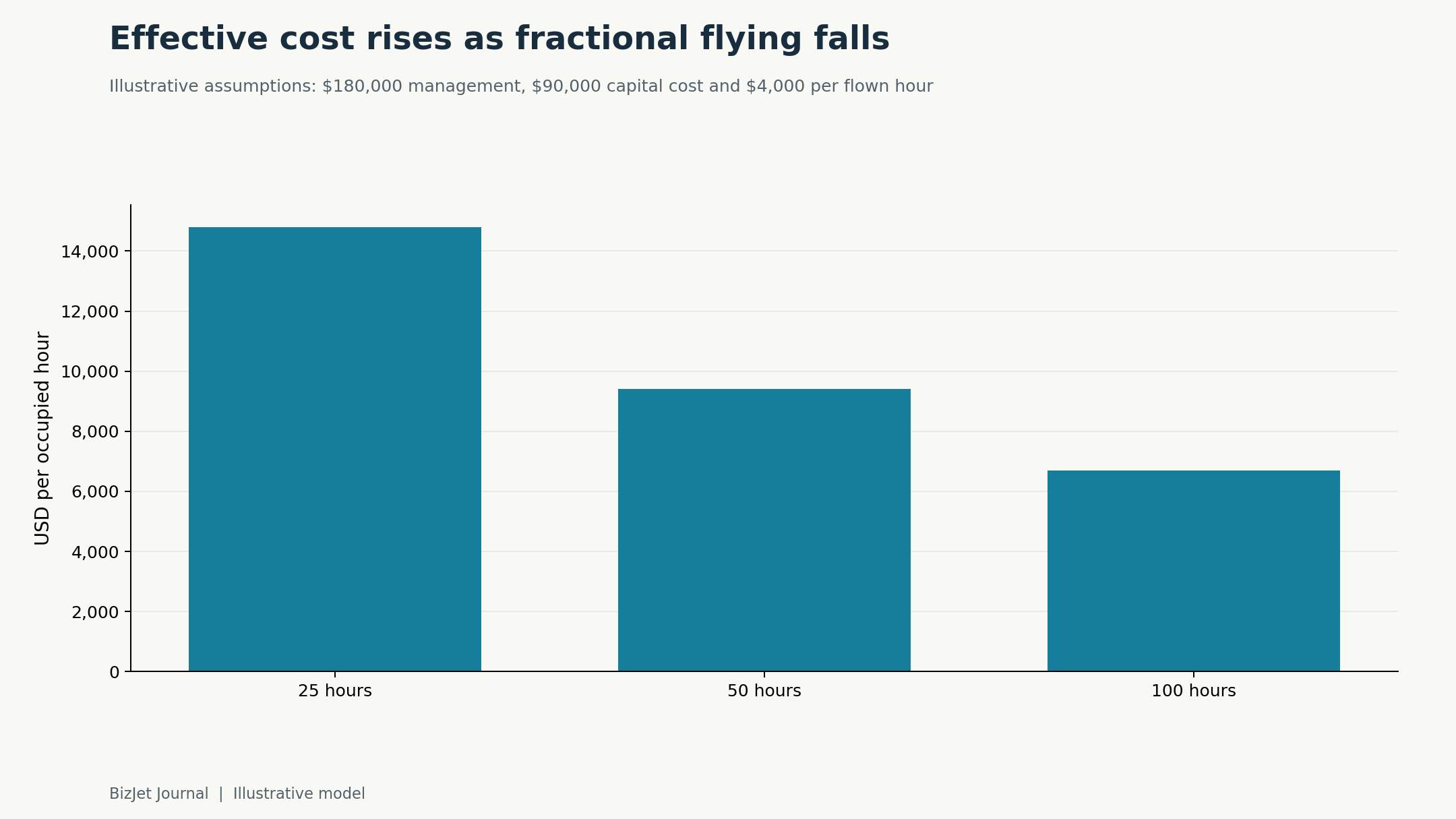
Consider these illustrative assumptions: $180,000 in annual management expense, $4,000 per occupied hour in flight-dependent charges and $90,000 in annualized capital cost. The capital amount comprises an assumed $60,000 decline in share value and $30,000 opportunity cost on equity. It is not an additional $90,000 cash invoice.
The model excludes taxes, acquisition cash flows, actual borrowing and exit fees. It assumes the $4,000 figure includes all variable operating categories being compared, so fuel is not added again.
| Annual hours flown | Management expense | Flight-dependent charges | Operating cash expense | Annualized capital cost | Economic total | Economic cost per hour |
|---|---|---|---|---|---|---|
| 100 | $180,000 | $400,000 | $580,000 | $90,000 | $670,000 | $6,700 |
| 50 | $180,000 | $200,000 | $380,000 | $90,000 | $470,000 | $9,400 |
| 25 | $180,000 | $100,000 | $280,000 | $90,000 | $370,000 | $14,800 |
At fifty hours, annual economic cost is $200,000 lower than at one hundred hours, but cost per hour rises by $2,700. At twenty-five hours, you spend less again while each used hour carries a much larger share of continuing costs.
The formula makes the cause clear: economic cost per hour = $4,000 + $270,000 ÷ hours flown. The $270,000 combines management expense and the assumed annualized capital cost. Changing either assumption changes the curve.
Keep the cash and economic views together. The fifty-hour case requires $380,000 of modeled operating cash expense but carries $470,000 of modeled economic cost. If your share is financed, show actual debt cash flows separately and build a consistent capital-cost calculation; do not add loan principal repayment as an expense on top of a full assumed value decline.
Work out what unused hours are worth to you
Rollover can soften a temporary dip in travel. It cannot make unused entitlement valuable if you will never need it.
NetJets' Share and Card comparison states that unused Share hours roll over for use the following year. Obtain the detailed rules for your agreement: quantity limits, expiry, use order, borrowing, transfer and the treatment of hours when a share is resized or sold. NBAA's fractional ownership FAQ also notes that rollover and borrowing can be restricted across programs.
Value rolled hours by what they let you avoid, after the charges still payable to use them. Suppose, under illustrative assumptions, ten usable rolled hours would replace ten hours of otherwise necessary charter costing $10,000 per hour. If using those hours incurs $4,000 per hour of additional fractional operating charges and no additional fixed expense, the potential saving is $60,000: $100,000 avoided less $40,000 incurred.
That is an upper-bound value for that specific scenario, not a cash balance of $60,000. It requires all ten hours to be usable before expiry and to replace flying you would otherwise purchase. If you would not take those trips, their avoided-cost value is zero.
Also consider the renewal decision. If keeping access to rolled hours requires another expensive year of ownership that you otherwise would not buy, include those continuing costs. Rolled hours should not be valued in isolation from the commitment needed to use them.
Compare staying, downsizing and exiting
Request concrete proposals. For downsizing, obtain the new allocation, management fee, hourly charges, transaction costs and expected proceeds from the portion sold. For exit, request the current valuation method, actual quoted proceeds where available, notice period, deductions and payment timing.
The guide to aircraft depreciation and fractional share cost explains why an original purchase figure is not a reliable substitute for today's exit value. You need the amount realizable under your agreement, not a generalized aircraft market percentage.
The following one-year comparison assumes fifty hours of necessary future travel. All figures are illustrative and before tax. Assume the proposed aircraft and service levels meet your needs; that must be checked in a real decision.
| One-year option | Continuing fixed and capital cost | Flight cost | One-time change cost | First-year economic total |
|---|---|---|---|---|
| Keep existing share | $270,000 | 50 × $4,000 = $200,000 | $0 | $470,000 |
| Downsize to suitable allocation | $135,000 | 50 × $4,500 = $225,000 | $45,000 | $405,000 |
| Exit and buy charter | $0 | 50 × $8,500 = $425,000 | $20,000 | $445,000 |
For the smaller share, assume $90,000 management expense and $45,000 annualized capital cost. Its recurring annual economic cost is $360,000, saving $110,000 against retaining the original share. After the assumed $45,000 transition cost, first-year savings are $65,000.
The exit case is $25,000 cheaper than staying in the first year under these assumptions. It also changes what you own and how you purchase access. A charter budget needs actual itinerary quotations and comparable cancellation and recovery terms before it can support a decision.
Asset sale proceeds are not included as negative travel expense in this table. They release capital and belong in a separate cash-flow schedule. Counting the full proceeds as a saving while also removing future capital costs would confuse an asset conversion with an operating benefit.
Timing matters too. If a change cannot take effect for several months, include the existing fees during the overlap. A full-year saving is not available immediately just because the new quote is lower.
Set a decision date before another year renews
List the travel already booked, the trips with credible reasons to occur and the optional journeys. Use these to build a base case rather than assuming that last year's demand will return.
Then identify the contractual date by which a downsizing or exit notice must be submitted. Work backward far enough to obtain valuations, replacement travel quotes and internal approvals. A review begun after that deadline can leave you paying for another period before a change becomes effective.
Temporary and structural declines deserve different responses. A delayed project may create concentrated demand next year that usable rollover can help meet. A permanently smaller territory, a changed family routine or a new travel policy may make the original allocation excessive for several years.
Compare at least two years when transition costs are material, while keeping longer-term assumptions visible. In the illustrative downsize case, the first-year change cost falls away in year two if all other terms remain the same. But lower recurring fees are useful only if the smaller allocation continues to fit your travel.
Do not book unnecessary trips to “use up” hours. That can add variable expense without creating value. The objective is an appropriate future commitment, not a better-looking utilization percentage.
Frequently asked questions
Do unused fractional hours always roll over?
No. The availability and restrictions depend on the program and agreement. Confirm the limit, expiry date and order in which hours are used, plus what happens when you change or end the share. A general marketing statement is not a complete rollover schedule.
Does flying less reduce your management fee?
Not necessarily. A fixed management fee may continue at the same amount while occupied-hour and fuel-related charges decline with flying. Read the provisions linking fees to share size or usage. A lower flight bill does not prove that your total ownership commitment has fallen proportionately.
Should you downsize your share or wait for travel to recover?
Compare realistic future use, the costs of changing and the terms for carrying unused allocation forward. Waiting can make sense for a temporary decline when returning demand is credible. Downsizing becomes more attractive when lower use is persistent and the recurring savings outweigh transition costs while preserving the access you need.