
Fractional Ownership · guide
How Aircraft Depreciation Affects the Cost of a Fractional Share
Aircraft resale value can change your fractional ownership cost by hundreds of dollars per hour. The buyback formula explains why.


You can put two fractional jet proposals side by side and compare their hourly rates in seconds. Working out which one costs less over five years takes another number: what you get back when you sell your share.
On a $900,000 purchase, a $90,000 change in gross resale value would change your five-year capital cost by $83,700 after a 7% selling fee. Spread over 250 billed hours, that is $334.80 per hour.
Those are assumptions for the calculation below. They show why aircraft depreciation belongs beside the operating rates when you compare fractional ownership proposals.
The buyback price is part of the flight cost
NetJets describes its liquidity arrangement as fair market value on 90 days’ notice. That tells you how an exit can work. It does not promise that your share will retain a particular percentage of its purchase price.
The distinction is clearer in flyExclusive’s 2025 annual report. The company describes repurchase value as the aircraft’s fair market value multiplied by your ownership percentage, less a remarketing fee. It also distinguishes its own repurchase rights from customer rights available under certain contracts.
The money you recover therefore depends on both the aircraft valuation and the agreement. A buyback mechanism can simplify selling without fixing the price.
For budgeting, start with a straightforward calculation:
Capital consumed = purchase price − net sale proceeds.
That capital cost sits alongside management fees, flight charges and any financing costs. It does not appear on the invoice for an individual flight, but it still belongs in the price of using the program.
The distinction starts with what you own when you buy a fractional share. You have an aircraft interest with an eventual sale value, alongside the agreements that provide your flying. Spending less on flight charges does not automatically compensate for getting less back on the aircraft.
Three different meanings of depreciation
| Measure | What it describes | Where it enters your calculation |
|---|---|---|
| Market depreciation | The change in what the aircraft or share would sell for | Expected resale proceeds and capital consumed |
| Book depreciation | The cost allocated as an expense in financial accounts | Your organization’s financial reporting |
| Tax depreciation | Deductions allowed in calculating taxable income | The timing and amount of tax payments |
A share can have a low tax basis and still command a substantial resale price. Equally, a financial statement can show a steady annual depreciation charge while the market value moves unevenly.
These measures answer different questions. For a five-year cash budget, the purchase and eventual sale establish the capital cash flows. Adding a separate depreciation expense to that same purchase-minus-sale calculation counts the loss twice.
A $900,000 share, five years later
Take an example of a fractional share purchased for $900,000 and held for five years. Assume you use 50 billed hours each year, sell at 60% of the original price and pay a remarketing fee equal to 7% of gross resale value.
The 50-hour structure has a real program counterpart: Flexjet lists a 1/16 share as providing 50 annual hours, with a maximum term of 60 months. The purchase price, residual percentage and selling fee used here are model inputs, rather than a Flexjet proposal.
| Item | Calculation | Amount |
|---|---|---|
| Initial share purchase | Assumed acquisition price | $900,000 |
| Gross resale value | $900,000 × 60% | $540,000 |
| Remarketing fee | $540,000 × 7% | $37,800 |
| Net sale proceeds | $540,000 − $37,800 | $502,200 |
| Capital consumed | $900,000 − $502,200 | $397,800 |
| Five-year billed hours used | 50 × 5 | 250 |
| Capital cost per billed hour | $397,800 ÷ 250 | $1,591.20 |
The aircraft-related value loss is $360,000 before the fee. Selling costs add another $37,800, bringing the capital consumed to 44.2% of the original purchase price.
That is why a presentation showing “60% residual value” needs a second line. You receive 55.8% of the purchase price after this assumed fee.
The fee’s basis also matters. Seven percent of the original $900,000 purchase would be $63,000, rather than $37,800. Using the wrong basis would overstate selling costs by $25,200 in this example.
The hourly figure uses billed hours actually consumed. If you use only 40 hours annually and leave the balance unused, the same $397,800 capital cost is spread over 200 hours. It becomes $1,989 per billed hour, before operating expenses.
What a different residual value does to the budget
A single resale estimate hides how much of the result depends on the exit price. Holding the $900,000 acquisition, 7% fee and 250-hour use constant produces the following range.
| Gross residual assumption | Gross resale value | Net proceeds after 7% fee | Capital consumed | Capital cost per billed hour |
|---|---|---|---|---|
| 40% | $360,000 | $334,800 | $565,200 | $2,260.80 |
| 50% | $450,000 | $418,500 | $481,500 | $1,926.00 |
| 60% | $540,000 | $502,200 | $397,800 | $1,591.20 |
| 70% | $630,000 | $585,900 | $314,100 | $1,256.40 |
| 80% | $720,000 | $669,600 | $230,400 | $921.60 |
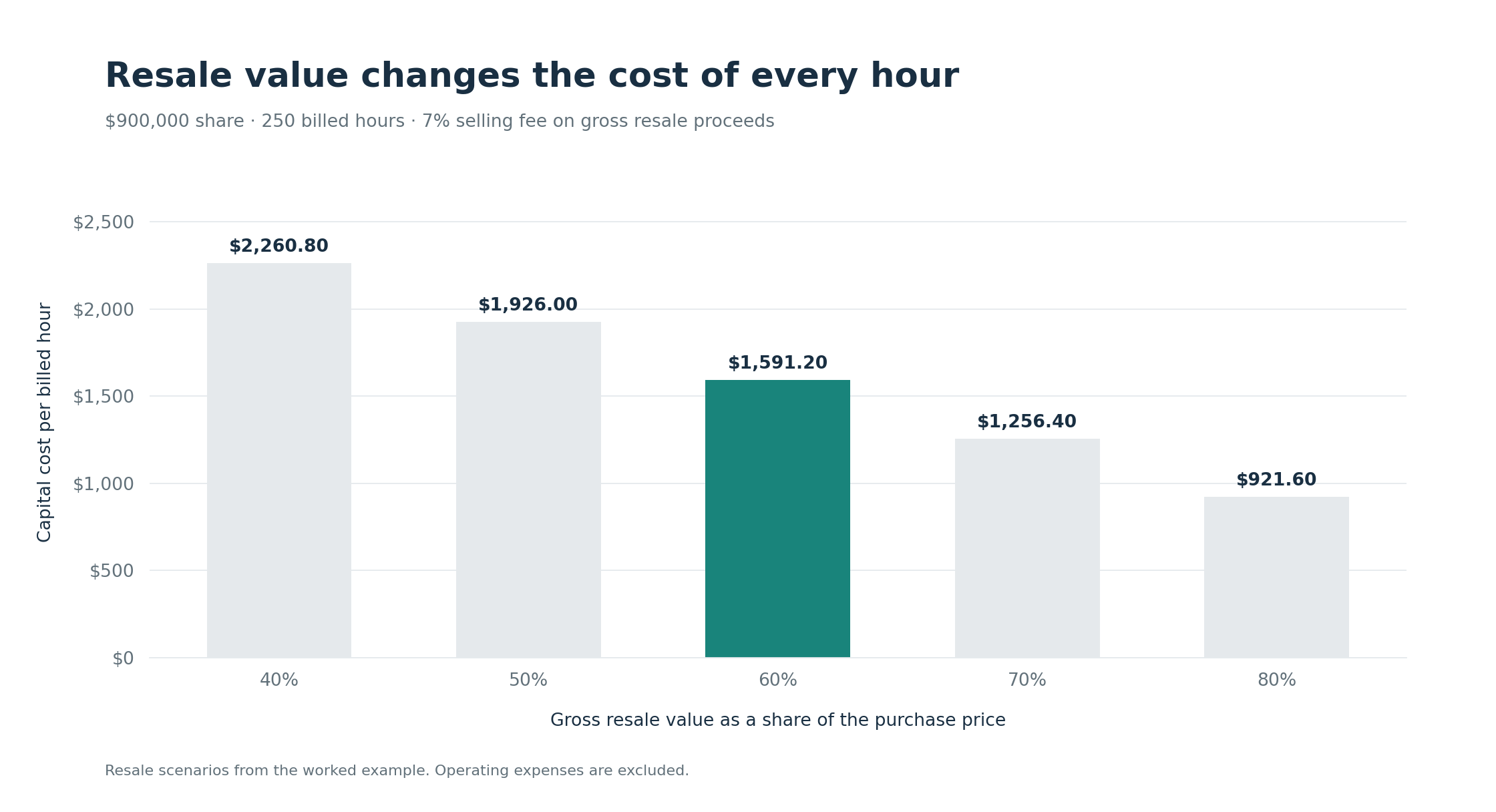
Each row changes one assumption: the gross resale value. The table lets you see what a stronger or weaker exit would do to your budget before choosing a value to put in your proposal comparison.
Each ten-percentage-point change in gross residual value moves the five-year cost by $83,700, or $334.80 per billed hour. Comparing the 40% and 80% cases produces a $334,800 difference without changing a single flight.
Suppose a competing proposal saves you $200 per billed hour on operating charges. Over 250 hours, that is $50,000. A ten-point weaker residual in this example would more than erase that saving.
That gives you a useful question for a proposal containing an attractive hourly rate: how much of the projected total depends on its resale assumption?
There is no universal annual depreciation rate
Aircraft markets do not move as a single fleet. In its second-quarter 2026 market report, AMSTAT reported business jet median values up 5% year over year while asking-price measures declined. The company linked the divergence to younger, higher-value jets trading and less desirable aircraft remaining listed.
That is a market composition issue as well as a pricing issue. An increase in the median does not establish that your individual aircraft appreciated 5%. A fall in average asking prices does not establish its resale loss either.
Aircraft-specific evidence matters. VREF’s appraisal descriptions include equipment, damage history, records, comparable aircraft sales and current market conditions. A model name and manufacture year alone do not provide all of that information.
Age still changes the question you are asking. A new aircraft bought today will be five years old at exit; a ten-year-old aircraft will be fifteen. The purchase price and expected resale value need to describe the same aircraft at those two points, with its maintenance and condition assumptions carried through.
Even the phrase “8% annual depreciation” is ambiguous. Losing 8% of the original $900,000 each year leaves $540,000 after five years. Losing 8% of the remaining value each year leaves about $593,173.
A 60% five-year residual is equivalent to approximately 9.71% annual compound depreciation. That arithmetic describes the endpoints; it does not mean the aircraft’s value will decline smoothly at that rate each year.
Your flying is only part of the aircraft’s usage
Fractional ownership combines an aircraft interest with access to a managed fleet. Flexjet describes the purchase as an undivided interest in a specific aircraft, while also allowing interchange into other fleet types.
Your 50-hour annual allocation therefore does not mean the aircraft you partly own accumulates only 50 hours. Other owners and operational positioning contribute to its use.
NBAA’s fractional ownership FAQ identifies an important contractual distinction: the agreed residual-value method may or may not account for high aircraft utilization.
That makes the valuation definition important. Does it use the aircraft’s actual hours and cycles, an assumed utilization level, or another contractual standard? Does its condition assumption match the aircraft being valued?
The answer also determines whether an independent market appraisal is measuring the same thing as the contractual buyback calculation. Two values can differ because their underlying assumptions differ.
Tax depreciation changes cash timing, not the resale price
The IRS’s January 14, 2026 guidance addresses 100% additional first-year depreciation for eligible property acquired after January 19, 2025. A full deduction can materially reduce the initial tax bill for a qualifying business purchase.
A deduction is multiplied by the applicable tax rate; it is not reimbursement of the aircraft’s purchase price. Under IRS Publication 946, accelerated depreciation for business aircraft also depends on qualified-business-use tests, including the more-than-50% test and a separate 25% test. Use and recordkeeping determine eligibility.
Take the same $900,000 purchase and assume the entire amount is deductible immediately against income taxed at an effective 30%. The initial tax reduction would be $270,000.
Now assume the share is sold for the modeled $502,200 net proceeds with a zero adjusted tax basis. IRS Publication 544 explains depreciation recapture: gain on Section 1245 property is generally ordinary income up to the applicable depreciation amount.
At the same assumed 30% rate, tax on that $502,200 gain would be $150,660. The net tax benefit across purchase and sale would be $119,340, leaving $278,460 of the $397,800 capital cost after tax, before considering the timing value of those cash flows.
The initial $270,000 benefit is therefore only one side of the calculation. Your after-tax model needs the deduction, tax basis, resale proceeds and disposal tax in their respective years.
The exit terms to put beside the purchase price
Before you compare two fractional proposals, place their exit calculations beside each other. Start with the valuation method, the fee percentage and the amount to which that percentage applies.
Then establish the permitted exit date, notice period and payment timing. A valuation at the notice date and a valuation several months later can produce different proceeds in a moving market.
Any refurbishment deduction, transfer charge or early-exit adjustment belongs on its own line if the agreement provides for it. It should not disappear inside a rounded residual percentage.
For the $900,000 example, the operating budget does not change when the gross residual moves from 60% to 50%. The five-year ownership cost rises by $83,700 all the same.
That is the figure an hourly-rate comparison misses. The price of the share matters at entry; the amount you get back completes the five-year ownership cost calculation.
Frequently asked questions
How does depreciation affect the cost of a fractional jet share?
It reduces the amount you recover when you sell, increasing the capital cost of your flying. In the example above, a $900,000 share returns $502,200 after the assumed sale fee. The $397,800 difference adds $1,591.20 to each of the 250 billed hours used, before operating charges.
Does a 60% residual value mean you get 60% of your purchase price back?
Only if that percentage is already net of the selling charges. In the example above, 60% of the $900,000 purchase is $540,000. The assumed 7% remarketing fee then removes $37,800, leaving $502,200. You receive 55.8% of the original purchase price after that fee.
Does a tax write-off mean the fractional share has lost its market value?
No. Tax depreciation determines deductions and tax basis; market value determines what a buyer will pay. In the example above, a share assumed to have a zero tax basis still produces $502,200 in net sale proceeds. You need both calculations to understand the purchase and eventual sale.
Is a fixed annual depreciation percentage enough to estimate resale value?
You first need to know how that percentage is applied. In the article’s $900,000 example, deducting 8% of the original price each year leaves $540,000 after five years. Deducting 8% of the remaining value each year leaves about $593,173. The same stated rate can produce different exit estimates.
Can a lower resale value outweigh savings on fractional flight charges?
Yes. Compare the operating savings with the difference in net sale proceeds. In the example above, changing the assumed gross resale value from 60% to 50% raises the five-year capital cost by $83,700. A proposal saving $50,000 in operating charges would still cost $33,700 more under those exit assumptions.