Fractional Ownership · guide
How to Calculate the Full Cost of Fractional Jet Ownership Over Five Years
Calculate the full five-year cost of a fractional jet share, including operating fees, resale proceeds and the effect of unused hours.


You can know the hourly rate on a fractional jet share and still be a long way from knowing what ownership will cost. There is the share to buy, the monthly bill to pay and, eventually, the question of how much you get back.
NetJets lists a starting annual cost of approximately $360,000 for 50 hours of fractional flying. There is also an initial investment in the aircraft.
That second payment changes the calculation. The company’s published comparison separates the annual flying budget from the price of the share. Your five-year cost has to bring them back together, then account for what you recover when you leave.
You can get to a useful answer without a complicated financial model. Start with the purchase price, add five years of bills, then subtract what the sale returns after exit charges. The work is making sure those three numbers contain everything they should.
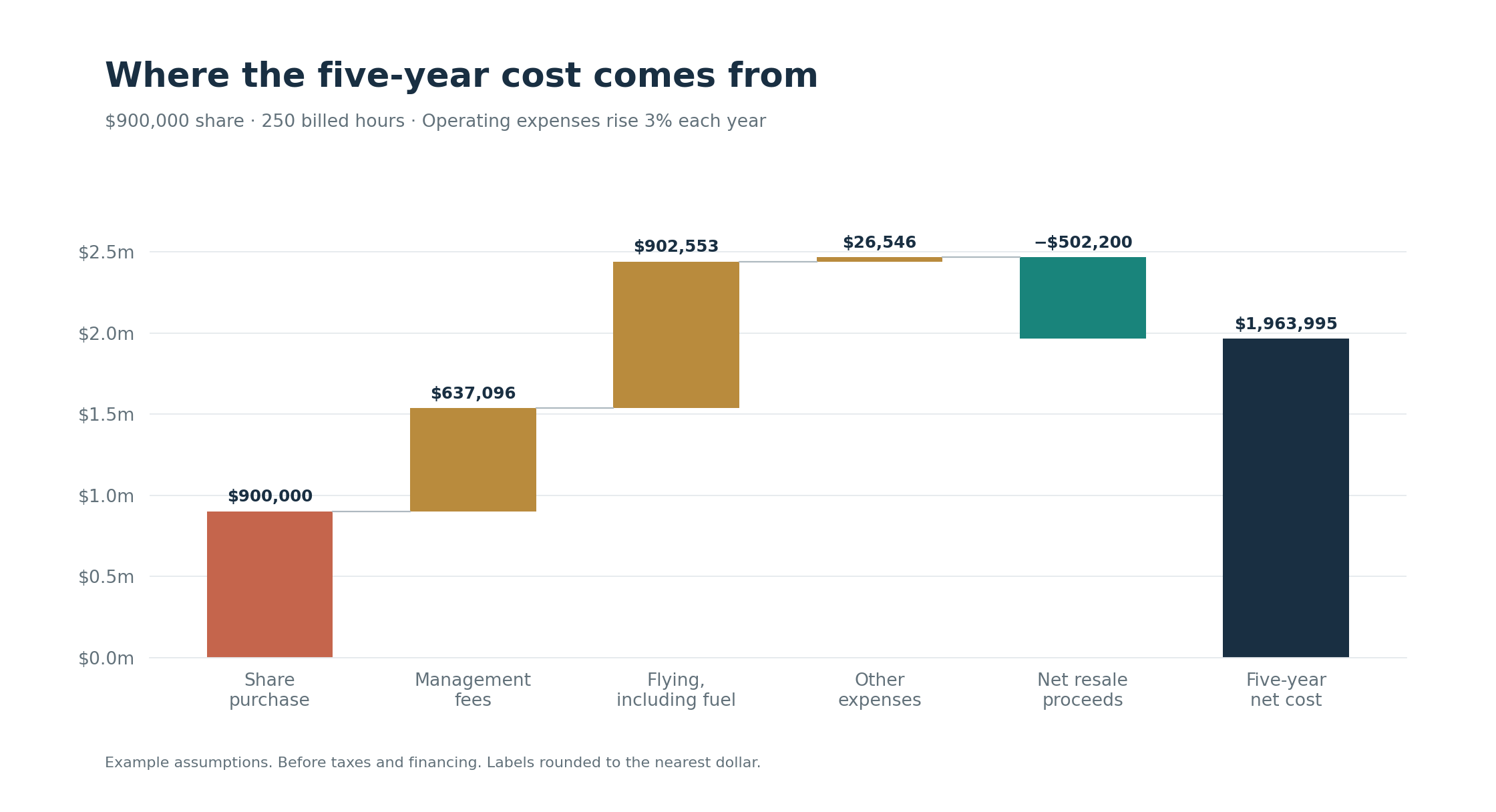
In the example below, a $900,000 share and a first-year operating budget of $295,000 produce a five-year cost of about $1.96 million. At 250 billed hours, that is $7,856 an hour.
The flight rate in the same example is $3,400 an hour, including fuel. Both numbers are correct. They answer different questions.
What belongs in the five-year calculation?
A fractional purchase combines an ownership interest in an aircraft with a service agreement. The share gives you an asset to sell later; the service agreement determines what you pay to use the fleet.
Flexjet’s U.S. program, for example, starts at a 1/16 share providing 50 annual hours and lists a maximum term of 60 months. That makes five years a useful comparison period, although your own agreement determines the dates.
The basic calculation is:
Five-year ownership cost = acquisition cost + operating payments + financing costs + exit charges − gross resale proceeds.
You can instead subtract net resale proceeds, which already include the exit deductions. Use one version consistently. Subtracting net proceeds and then adding the same remarketing fee again overstates the cost.
The acquisition line should include the share price and any purchase expenses. The operating section should separate fixed charges from charges that rise with flying. Financing gets its own line, while taxes and potential tax savings belong in a separate calculation using the same five-year period.
Read the pricing structure before entering the numbers
NetJets describes three recurring components: a monthly management fee, an occupied hourly fee and a variable fuel rate. Its management fee covers costs such as crew salaries, training, insurance and hangar space.
The occupied hourly fee covers flight-related expenses and some fuel consumption; the fuel adjustment is an additional component. Consequently, adding an entire fuel estimate to a rate that already contains fuel can count part of the same expense twice.
Not every program uses that structure. In its 2026 announcement about pre-owned Citation XLS+ shares, flyExclusive advertised prices starting at $695,000, depending on share size, with no monthly management fee.
The announcement does not identify that starting price as the cost of a particular 50-hour share. Its relevance here is the pricing structure: a comparison spreadsheet must accommodate programs that collect their revenue differently.
So a proposal with no monthly fee may be worth a closer look. You still need the acquisition price, the daily or hourly flight charges and the eventual resale to know how it compares.
A five-year fractional ownership example
Take an example of a share purchased for $900,000, providing 50 billed hours a year. The owner uses all 250 hours over five years and sells at the end of year five.
The following figures are calculation assumptions, separate from the provider prices above. They show how to build the budget rather than estimate a particular aircraft proposal.
| Input | Example assumption |
|---|---|
| Share purchase | $900,000, paid at the start |
| Annual use | 50 billed hours |
| Year-one management fee | $10,000 a month; $120,000 a year |
| Year-one base flight rate | $2,500 per billed hour |
| Year-one additional fuel component | $900 per billed hour |
| Year-one other expenses | $5,000 |
| Annual increase in operating costs | 3%, compounded |
| Gross share resale value | 60% of purchase price: $540,000 |
| Remarketing charge | 7% of gross resale proceeds: $37,800 |
| Purchase financing | None |
The $5,000 allowance represents expenses outside the assumed management and flight rates. Replace it with the charges your travel would actually generate, rather than adding a generic allowance on top of services already included.
The model is in U.S. dollars, before taxes and tax savings. It assumes no additional acquisition or sale costs beyond those listed. Adding those items to a real proposal makes the total specific to your purchase.
Build each year separately
In year one, flight charges are 50 × ($2,500 + $900), or $170,000. Management fees add $120,000 and other expenses add $5,000, bringing the operating budget to $295,000.
For subsequent years, multiply each operating category by 1.03 for every year since purchase. Year three therefore uses 1.03 squared, not a single 3% adjustment.
| Year | Management | Flying, including fuel | Other expenses | Operating total |
|---|---|---|---|---|
| 1 | $120,000 | $170,000 | $5,000 | $295,000 |
| 2 | $123,600 | $175,100 | $5,150 | $303,850 |
| 3 | $127,308 | $180,353 | $5,305 | $312,966 |
| 4 | $131,127 | $185,764 | $5,464 | $322,354 |
| 5 | $135,061 | $191,337 | $5,628 | $332,025 |
| Five years | $637,096 | $902,553 | $26,546 | $1,566,195 |
Figures are rounded to dollars; totals use the unrounded calculations.
Simply multiplying $295,000 by five would produce $1,475,000. The assumed annual increases add another $91,195.
A real agreement may increase management fees and base flight rates on different schedules. Fuel may move monthly. Give each component its own formula; the uniform 3% increase here makes the example easy to follow.
The sale determines your capital cost
The $900,000 purchase is a cash outflow. It is not automatically a $900,000 ownership expense over the five years, because the owner still has a share to sell.
At the assumed 60% residual value, gross sale proceeds are $540,000. A 7% remarketing charge takes $37,800, leaving $502,200.
The capital consumed is therefore $900,000 − $502,200 = $397,800.
That calculation includes both the $360,000 decline in the share’s value and the $37,800 sale charge. Adding another depreciation expense to it would count the value decline twice.
The exit formula is a contract term, not a universal industry percentage.
In its 2025 Form 10-K, flyExclusive describes repurchases based on the aircraft’s fair market value multiplied by the ownership percentage, less a remarketing fee. The filing also distinguishes its repurchase right from owner exit rights available under certain contracts.
For your own spreadsheet, enter the valuation method, the fee’s calculation base and the date on which cash is expected back. An estimate of market value and a contractual promise to pay a fixed sum are different inputs.
The result: $1.96 million over five years
| Five-year calculation | Amount |
|---|---|
| Initial purchase | $900,000 |
| Operating payments | $1,566,195 |
| Cash paid before selling | $2,466,195 |
| Less net sale proceeds | −$502,200 |
| Net five-year ownership cost, before taxes | $1,963,995 |
| Average annual cost | $392,799 |
| Cost per billed hour: 250 hours | $7,856 |
The average annual cost is a comparison measure, not the annual cash requirement.
The owner needs $900,000 at acquisition, then pays operating bills through the term. The $502,200 comes back only after the assumed sale.
That timing matters when comparing ownership with a jet card, a lease or charter. An equal five-year total does not mean an equal amount of cash must be committed on day one.
Use the right number of hours
Before dividing by 250, make sure you know what those hours measure. This example uses billed hours, including any taxi time or minimums counted within the agreement’s allocation.
Flexjet’s published U.S. cost structure specifies flight time plus 0.2 hours for taxi time. Take an example of a flight lasting 2.3 hours in the air: that convention produces 2.5 billed hours.
At the example’s $3,400 combined rate, its variable charge would be $8,500. Management fees and the capital cost sit outside that trip calculation.
Twenty such flights a year would use 50 billed hours but deliver 46 airborne hours. Across five years, the same $1,963,995 cost would be $7,856 per billed hour or $8,539 per airborne hour.
That distinction can get lost when two proposals arrive with different hourly prices. Compare billed hours with billed hours, or price the same set of actual journeys under each agreement.
Flying less can make each hour more expensive
Now change annual use from 50 billed hours to 40. Keep the share, management fees, ancillary budget, escalation and exit assumptions unchanged.
The flight charges fall by 20%, from $902,553 over five years to $722,042. The other costs remain in place.
| Five-year comparison | 50 hours a year | 40 hours a year |
|---|---|---|
| Hours used | 250 | 200 |
| Flight charges, including fuel | $902,553 | $722,042 |
| Total ownership cost | $1,963,995 | $1,783,484 |
| Cost per billed hour | $7,856 | $8,917 |
You save $180,511 overall, but each hour you use costs 13.5% more. You have fewer flights over which to spread the same ownership commitment.
This scenario assumes the unused entitlement produces no refund and is not flown later. If rollover lets you use those hours during the term, include that later flying and its charges. A deferred trip is different from a permanently unused hour.
Test the resale assumption
A second useful test changes the exit value while holding the travel schedule constant. The percentages below are scenarios for the same $900,000 share, with the same 7% remarketing charge.
| Gross residual value | Net sale proceeds | Five-year cost | Cost per billed hour |
|---|---|---|---|
| 40% of purchase price | $334,800 | $2,131,395 | $8,526 |
| 50% | $418,500 | $2,047,695 | $8,191 |
| 60% | $502,200 | $1,963,995 | $7,856 |
| 70% | $585,900 | $1,880,295 | $7,521 |
Every ten-percentage-point change in gross residual value changes this owner’s net proceeds by $83,700. Spread over 250 hours, that moves the cost by $334.80 an hour.
If a proposal looks attractive only at the highest resale value, you now know what is doing the work. Its advantage depends heavily on how much the share brings back five years from now.
Add financing and tax effects without counting them twice
If you finance the fractional share, interest and loan fees increase the cost. Principal payments repay the acquisition funding; they are not another purchase expense on top of the share price.
One method keeps the $900,000 acquisition line and adds the financing costs. A cash-flow version instead records the down payment, loan payments and any balance repaid at sale. Both should reconcile to the same total when they cover the same dates.
Tax depreciation is a separate calculation from the share’s market-value decline.
The IRS rules for business aircraft tie accelerated depreciation to qualified business use and recordkeeping, with recapture rules when applicable conditions cease to be met.
An after-tax model therefore needs dated tax savings and tax payments, including the consequences of sale. Subtracting an assumed first-year deduction from the purchase price, while omitting later tax effects, does not produce a five-year after-tax cost.
For the purchase decision, keep three figures visible: the cash required at acquisition, the operating budget for each year and the net cost after exit. Then run the same travel schedule through the alternatives. That gives you a price for the flying you intend to buy, with the ownership commitment included.
Frequently asked questions
How do you calculate the total cost of fractional jet ownership?
Add the share purchase, operating payments and any financing costs, then subtract what you receive from selling the share after exit charges. In the example above, $900,000 upfront plus $1,566,195 in operating payments, less $502,200 returned at sale, produces a five-year pretax cost of $1,963,995.
Why is the true hourly cost higher than the advertised flight rate?
The flight rate pays for one part of ownership. Your management fees, other expenses and the capital lost between purchase and sale still need to be covered. In the example above, the initial flight rate including fuel is $3,400, while the full five-year cost works out to $7,856 per billed hour.
What happens to the cost if you do not use all your fractional hours?
You can spend less overall while paying more for each hour you use. In the example above, flying 40 rather than 50 billed hours a year reduces total spending to $1,783,484, but raises the cost per hour to $8,917. That calculation assumes the unused hours are neither refunded nor flown later.
Should you compare fractional ownership costs using billed hours or flight time?
Use the same measure for every proposal. Billed hours can include taxi allowances or minimums beyond the time spent airborne. In the example above, 250 billed hours deliver 230 airborne hours. The same ownership budget therefore works out to $7,856 per billed hour or $8,539 per airborne hour.
Can you estimate five-year costs by multiplying the first annual bill by five?
Only if those charges stay unchanged. In the example above, a $295,000 first-year operating budget rising 3% annually totals $1,566,195 over five years. Multiplying the first year by five gives $1,475,000 and misses $91,195. Your calculation should follow each charge’s actual increase schedule.