

Fractional Ownership · guide
Days-Based vs Hours-Based Fractional Ownership: Comparing the Two Models
Compare fractional ownership allocations using flying days, occupied hours and overnight patterns, then test operating costs under concentrated and dispersed travel.


Eighty flight hours can mean twenty busy travel days or forty separate two-hour trips. Those calendars use the same amount of flight time, but they may require very different fractional ownership allocations.
The days-based vs hours-based decision starts with how you concentrate flying. Count the days on which you need an aircraft, the hours you fly on those days and the time it must wait between legs. Then price the complete schedule, including ownership costs and the charges incurred whenever you fly.
Count travel days alongside occupied hours
Reconstruct a representative year one itinerary at a time. Record flight legs, expected occupied hours, departure and return dates, intervening stops and whether you need the aircraft to remain available throughout the trip.
Do not simply count calendar days away from home. A week at a destination may require flights only on the first and last day. Conversely, a single day with several meetings can require the aircraft and crew over a long elapsed window despite relatively little flight time.
Use three measures: annual occupied hours, annual flying days and average occupied hours per flying day. Add the longest elapsed travel day as a separate constraint. These numbers reveal whether your schedule is concentrated, dispersed or operationally demanding.
| Illustrative travel pattern | Annual flying days | Hours per flying day | Annual occupied hours |
|---|---|---|---|
| Concentrated travel | 20 | 4 | 80 |
| Dispersed travel | 40 | 2 | 80 |
| Frequent short trips | 60 | 1 | 60 |
The first two patterns both total eighty hours. A twenty-day entitlement might fit the first pattern but would need a different allocation or additional arrangements for the second. An hours-based entitlement also needs review, but the basic sizing variable is different.
Separate your regular pattern from occasional exceptions. One unusually long international trip should not automatically determine the structure for the rest of your year if supplemental flying can handle it more effectively.
Understand what a day allocation provides
Airshare's fractional program is a useful current example. It publishes a one-sixteenth share with twenty program days annually and no hour limitation within its stated constraints, including a maximum fourteen-hour crew duty day. Its pricing also includes acquisition cost, a monthly management fee and a variable hourly rate.
That last point is essential. A day allocation measures access; it does not make the flying free. You can have room to fly additional hours within a program day while still paying an operating charge for each hour used.
Ask the provider to define a program day. Determine how it treats an early departure, a flight crossing midnight, a date change and two aircraft required on the same date. Those are contract questions, not details to infer from the word “day.”
Also distinguish having an aircraft available between meetings from having unlimited authority to change the itinerary. The crew's available duty time, airport access and operational planning still need to support the revised trip. Give the provider a realistic schedule with the likely waiting periods, rather than asking it to approve only the flight legs.
Before evaluating the economics, confirm what you own when you buy a fractional aircraft share. The allocation of travel rights and the ownership interest are related, but they are not the same number.
Understand how an hours allocation is consumed
NetJets describes its Share program using twenty-five-hour increments and offers both asset ownership and lease arrangements. That provides an hours-based comparison point, but it does not tell you the complete terms of the proposal suitable for your calendar.
Ask how occupied time is measured and deducted. Confirm taxi treatment, any minimum charges, aircraft interchange adjustments and the treatment of trips exceeding the annual allocation. An hour on a larger aircraft may consume more than one hour of your base entitlement if the agreement uses interchange factors.
Then examine rollover and borrowing. These provisions can help with uneven travel, but they require exact limits and dates. Hours you may use next year are not automatically a cash refund for hours unused this year.
Keep access conditions in the comparison. Having hours available does not by itself answer booking notice, peak-date rules or the availability of multiple aircraft. Ask the same questions of the days-based proposal, so a difference in allocation units does not obscure a difference in service.
| Contract question | Days-based proposal | Hours-based proposal |
|---|---|---|
| What consumes the allocation? | Definition of a program day | Definition of an occupied or billed hour |
| What happens during an overnight stay? | Day-use and aircraft-retention rules | Flight debits and any related trip charges |
| How is heavier use handled? | Additional days and duty constraints | Additional hours and annual usage limits |
| How does a different aircraft affect usage? | Day and operating-rate adjustments | Hour conversion and operating-rate adjustments |
| What happens to unused allocation? | Carryforward, transfer or expiry terms | Rollover, borrowing or expiry terms |
Stress-test multi-stop and overnight itineraries
Take an example of a flight schedule with three stops and four occupied hours in one day. It might be an attractive use of a day allocation if the aircraft can support the full schedule. Now add a long meeting delay and a late final departure. The flight-hour total may be unchanged while the crew's elapsed workday becomes the binding constraint.
Use the actual planned duty start and finish supplied by the operator. Under an illustrative fourteen-hour maximum, a duty period from 6 a.m. to 8 p.m. already uses the full window. A proposed finish at 10 p.m. cannot be evaluated as merely “two more hours of waiting.” Ask whether a revised schedule, another crew or an overnight is feasible and how it changes charges and allocation. This example applies an assumed program limit, not a universal rule for all fractional flights.
For overnight travel, distinguish leaving the aircraft with you from releasing it between the outbound and return flights. Airshare's published example says a week away uses two program days under its standard hourly rate, with the intervening days at the destination not charged as program days. Confirm the treatment of your own itinerary, especially if you require the aircraft available during the stay.
Price the same three test trips with each provider: a dense multi-stop day, a weekend away and a week with changing return plans. Request the allocation consumed and the total operating charge. That is more revealing than asking which model is “better for business travel.”
Price the complete year before choosing
Use separate columns for acquisition cash, annual management expense, hourly operating charges, extra allocation and expected exit proceeds or costs. Ownership economics also require an explicit view of capital tied up and changes in share value. Do not count the entire purchase price as an annual operating expense while also assuming that no resale value remains.
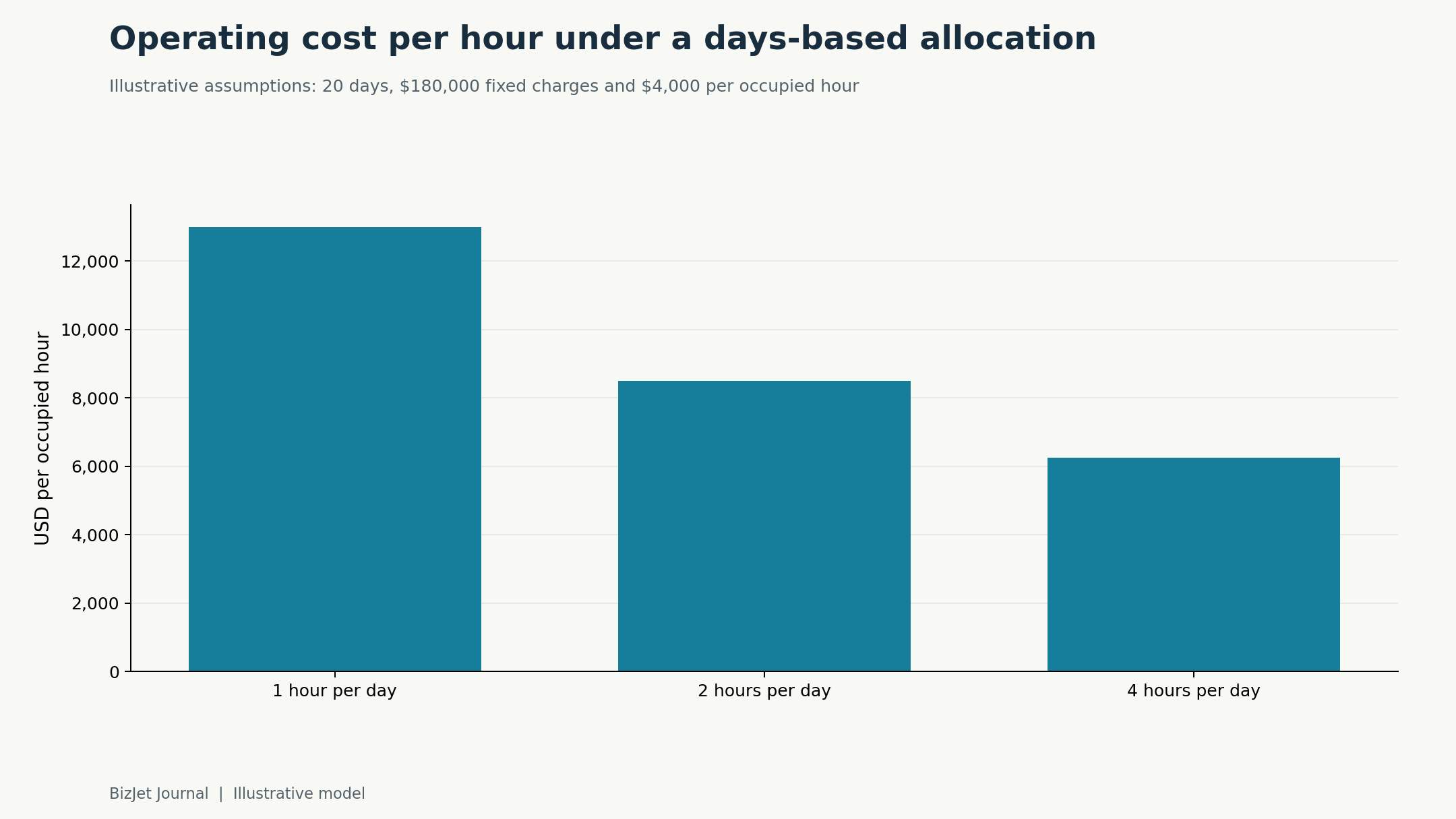
The following example isolates operating costs. Assume a twenty-day allocation, $180,000 in annual fixed charges and $4,000 per occupied hour. These are illustrative assumptions, not Airshare or NetJets quotations. Capital costs, taxes and additional-trip charges are excluded.
| Use of the same twenty-day allocation | Annual occupied hours | Fixed charges | Hourly charges | Operating total | Cost per occupied hour |
|---|---|---|---|---|---|
| 1 hour each day | 20 | $180,000 | $80,000 | $260,000 | $13,000 |
| 2 hours each day | 40 | $180,000 | $160,000 | $340,000 | $8,500 |
| 4 hours each day | 80 | $180,000 | $320,000 | $500,000 | $6,250 |
The eighty-hour case costs $240,000 more than the twenty-hour case, but its effective hourly cost is much lower because the fixed expense is spread over more useful flying. That is a utilization effect, not evidence that additional hours are free.
An hours-based proposal should go through the same calculation using its own fixed costs, variable charges and actual allocation requirements. The winning structure cannot be determined from this table alone because it contains only one assumed cost model.
Our guide to fractional ownership costs, providers and aircraft supplies the broader ownership framework. For your final comparison, use the same aircraft capability and service requirements on both sides.
Test the ordinary year after the first year
Separate introductory benefits from continuing terms. Airshare currently advertises bonus usage during the first year for new customers. A temporary allocation increase can help initial value without changing the number of days you receive later.
Run three calendars: the year you expect, a quieter year and a year with more dispersed trips. For each, show whether you remain inside the allocation and what additional flying costs. A program can look excellent at eighty hours concentrated into twenty days and fit poorly when those same hours spread across forty dates.
Choose the model that supports the pattern you are likely to repeat. If your calendar is changing rapidly, the ability to resize or supplement the allocation may be more valuable than a small difference in the first year's projected hourly cost.
Frequently asked questions
Does days-based ownership mean free flight hours?
No. A program may allow substantial flying within a day allocation while charging a separate hourly operating rate. Review acquisition costs, management fees and hourly charges together. The entitlement tells you how access is measured; the rate tells you what using the aircraft costs.
How do overnight trips use your day allocation?
It depends on the agreement and whether the aircraft stays available to you. Some itineraries may consume only outbound and return flying days. Ask for a written calculation for your actual trip, including any aircraft-retention requirement or change to the return date.
Which model suits several short flights in one day?
A days-based allocation can suit concentrated travel, but only if the itinerary fits operational limits and its operating costs are competitive. An hours-based program may also work well. Compare the complete multi-stop schedule, including waiting time, minimums, aircraft requirements and any additional charges.