

Fractional Ownership · guide
NetJets vs Flexjet: A Framework for Comparing Fractional Ownership Proposals
Compare NetJets and Flexjet on the same trips, usable hours and holding period. A practical framework exposes differences hidden by headline hourly rates.


Two fractional proposals can look similar until you price the same year of travel. Give NetJets and Flexjet one mission list, then compare the access commitments, hour deductions and full costs behind each offer.
A useful NetJets vs Flexjet fractional ownership comparison does not begin with a brand score. It begins with your requirements. A lower operating subtotal has little value if the proposal cannot accommodate your important journeys or requires more capital than you want to commit.
Keep the comparison specific to fractional ownership. A jet-card starting price, lease payment or occasional charter quote represents a different purchase. Our fractional ownership guide explains the structure before you work through individual proposals.
Give both providers the same travel brief
Prepare a list of the trips you expect to take during a representative year. For each, record departure and arrival airports, likely dates, passenger count, baggage, departure flexibility and whether a fuel stop would be acceptable. Distinguish trips you must complete from trips you might add if access were convenient.
Include the difficult missions. A proposal built around four passengers traveling between major cities does not answer what happens when eight people take skis to a mountain destination during a holiday. If a particular trip drives your aircraft requirement, put it near the top of the brief.
Give both providers the same assumptions about growth and uncertainty. If travel could fall from 100 to 60 hours, ask how the proposed commitment would work in that lower-use year. If two executives sometimes travel separately on the same day, describe the simultaneous-aircraft requirement explicitly.
Ask each provider to return the brief with a response for every mission. This makes omissions visible. A general presentation about fleet breadth should accompany, rather than replace, the actual trip analysis.
Match the cabin and service you need
Comparable proposals need equivalent capabilities, though they do not necessarily need identical aircraft models. Specify minimum seating, baggage fit, sleeping arrangements, cabin accessibility and any service requirement that materially affects your choice.
Use your real missions to choose the aircraft. Brochure range or maximum passenger capacity cannot settle every trip question. Ask each provider to identify the aircraft category proposed for the routine flights and the category required for the exceptions.
Document substitution terms as carefully as the nominal aircraft. If another type is supplied, which cabin features are preserved? A replacement with greater range may still have a different sleeping layout. A larger aircraft may not be suitable for the same airport under the same conditions.
Separate preferences from requirements. Cabin colors or a favored seat design can reasonably influence a decision after both proposals meet the essential brief. They should not outweigh a missing response on passenger capacity or a required departure date.
Normalize the flight-hour assumptions
The NetJets Share page advertises 25-hour increments. Flexjet's fractional program lists shares starting at 50 hours with additional hours in 50-hour increments. Compare the actual offered entitlement and price, because convenient increments do not by themselves establish the right share size.
Ask both providers to calculate identical itineraries using their contractual time rules. Keep airborne time, chargeable time and annual-allowance deductions in separate columns. Taxi allowances, minimums and interchange can make those three figures different.
Take an example of 40 flights averaging 1.8 airborne hours. That is 72 airborne hours. Under illustrative assumptions, adding 0.2 chargeable hours per flight produces 80 charged hours. If some trips then use an interchange factor, the allowance deduction can change again. The example demonstrates the calculation; it is not a statement that both programs apply that rule.
Ask what happens to unused allowance, what additional flying costs and whether borrowing or carrying hours between periods is permitted. An allowance of 100 hours is not equivalent to 100 hours you will actually use. Evaluate the annual commitment against likely use, while preserving the access you need.
Compare access at the dates that matter
Test the program with dates and conditions, not just a request for “guaranteed availability.” Identify notice requirements, peak-day provisions, departure windows, service-area boundaries and category-specific restrictions in the proposed agreement.
| Test mission | Question for each proposal | Evidence to record |
|---|---|---|
| Holiday departure with eight travelers | Which aircraft and notice conditions apply? | Contract clause and written mission response |
| Short-notice business trip | When can departure actually be requested? | Applicable notice and scheduling provisions |
| Two aircraft on one day | Is simultaneous access included at this share size? | Entitlement and additional charges |
| International itinerary | Which service area and operating arrangements apply? | Routing response and applicable fees |
| Disrupted trip | What replacement process and commitments apply? | Recovery terms and communication process |
Keep operational feasibility distinct from a commercial access promise. A provider's ability to supply an aircraft does not make weather, airport operating restrictions or an unsuitable runway disappear. Ask what practical alternatives would be offered for the difficult destinations in your brief.
If one proposal requires a wider departure window, reflect that as a service difference rather than forcing it into an arbitrary dollar value. You may accept that flexibility for discretionary trips and reject it for a recurring board meeting.
Build a complete cash-flow comparison
Create separate lines for acquisition, fixed recurring charges, flight charges, fuel adjustments, other trip costs and eventual sale proceeds. NetJets' pricing explanation distinguishes monthly management, occupied hourly and variable fuel components. Flexjet also lists an hourly fuel variable separately from its occupied rate. Do not compare one proposal's base rate with the other's rate including fuel.
Start with a simple operating calculation, then expand it. The following illustrative proposals are unrelated to either provider and do not represent market quotes.
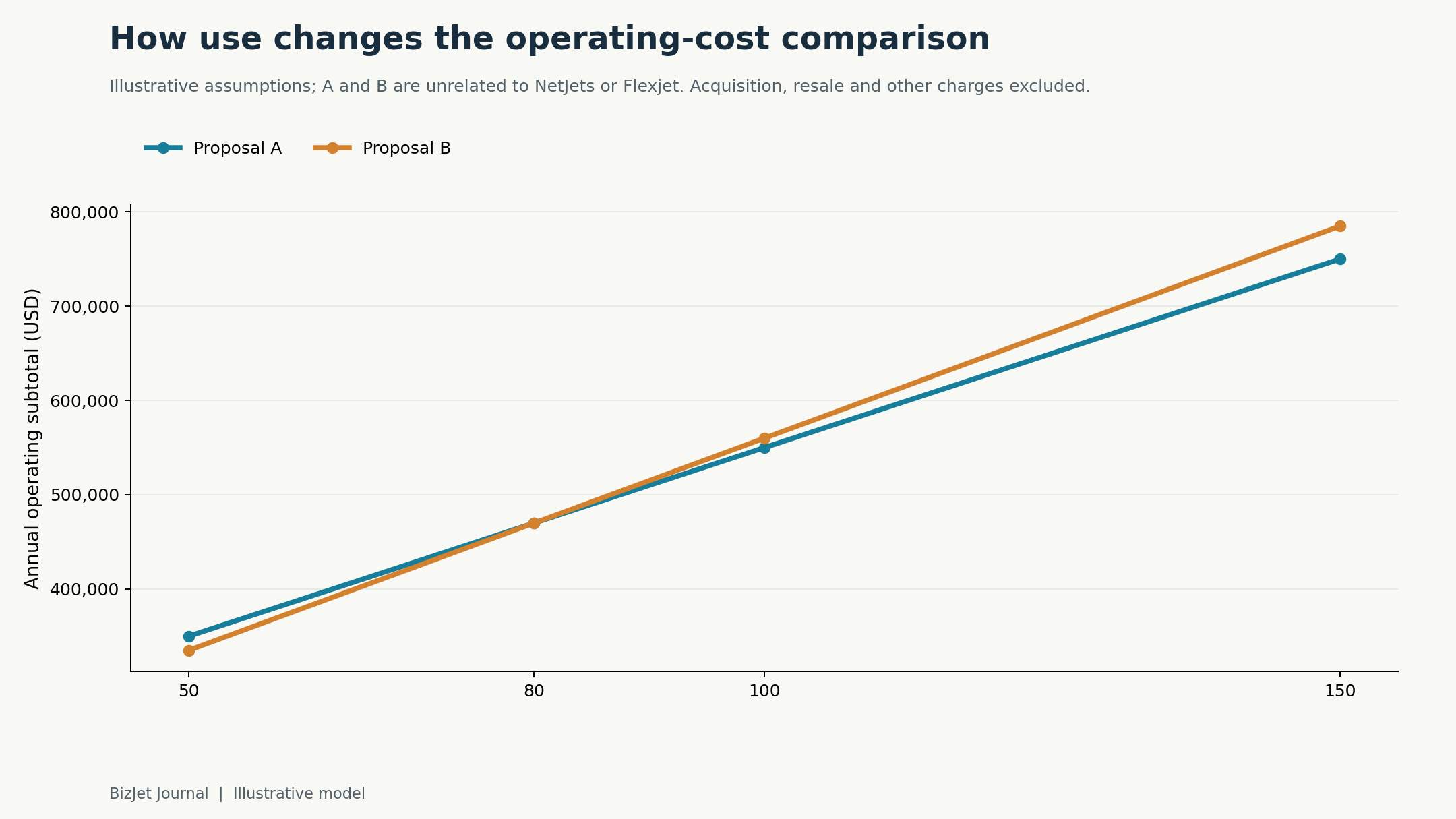
Proposal A has $150,000 of annual fixed costs plus $4,000 per charged hour; B has $110,000 plus $4,500 per charged hour. The model assumes those charges remain constant across the displayed utilization levels.
| Annual charged hours | Proposal A operating subtotal | Proposal B operating subtotal | Lower subtotal |
|---|---|---|---|
| 50 | $350,000 | $335,000 | B by $15,000 |
| 80 | $470,000 | $470,000 | Equal |
| 100 | $550,000 | $560,000 | A by $10,000 |
| 150 | $750,000 | $785,000 | A by $35,000 |
The fixed-cost difference is $40,000 and the hourly-rate difference is $500. Their ratio gives an 80-hour operating break-even point. Below it, B's smaller fixed commitment wins this limited comparison; above it, A's lower variable rate wins.
Actual proposals may change share size, entitlement and fixed charges at different utilization levels. Requote where that happens. A smooth sensitivity calculation is an analytical tool, not evidence that a provider will sell every point along the line.
Next add the ownership period. At 100 charged hours annually for five years, those operating subtotals would be $2.75 million for A and $2.8 million for B, before escalation and excluded costs.
A has a $50,000 operating advantage. If its acquisition cost less net sale proceeds is $80,000 greater, B becomes $30,000 cheaper on that combined measure.
That is why the capital line matters. Acquisition is an initial cash outflow, while the portion ultimately recovered through sale is not consumed as an expense. Show both the cash needed and the capital lost over the holding period.
Apply the same financing, residual-value and tax assumptions to both proposals; do not grant one an optimistic resale scenario and the other a conservative one.
Resolve the terms that could change your decision
Before scoring service preferences, identify any failed requirements. If one offer cannot accommodate a critical trip, a high score for other features should not conceal that result.
Then review exit rights, valuation, notice periods, unused-hour treatment and fee escalation. Compare the same holding period and at least one lower-use scenario. Ask for a dated written response wherever a salesperson's explanation is not clear in the documents.
Preserve the proposal version and assumptions used in your final comparison. If a revised offer changes the aircraft, share size or price, rerun the affected missions and totals. The decision should rest on the package you can actually accept, rather than a mixture of attractive terms from several drafts.
Frequently asked questions
Can I compare fractional programs by hourly rate alone?
No. Hourly charges omit acquisition, recurring fixed costs, possible fuel adjustments and the effect of eventual sale proceeds. They also say little about the number of hours deducted for your itinerary. Compare the same travel plan over the same ownership period.
Should both proposals use the same aircraft category?
They should meet the same mission requirements. Similar categories make comparison easier, but different models can be appropriate if their proposed configurations and service terms meet your needs. Record the differences that affect passengers rather than assuming category labels are identical.
How do I compare availability promises on peak dates?
Give both providers the same dates, airports, passenger requirements and departure window. Request the applicable notice rules and contractual commitment in writing. Separate confirmed rights from requests that depend on availability.
Which provider is cheaper for 100 hours a year?
Your actual proposals determine that answer. The cost depends on aircraft, ownership interest, chargeable-time rules, trip mix, financing and holding period. A generic 100-hour figure cannot establish a reliable brand winner without matching those inputs.