Why Advertised eVTOL Range Is Different From Usable Passenger Range
A long eVTOL test flight does not establish an equivalent passenger route. Learn to compare payload, mission energy, reserves and charging, with a clear illustrative energy-budget calculation.
An electric air taxi can complete an impressive distance demonstration while being designed for much shorter passenger trips. Those statements can both be true. A maximum flight, a development target and a repeatable commercial mission measure different things.
The useful question is not simply “How far can it fly?” It is how far the aircraft can carry the intended passengers and baggage, under the applicable conditions, while retaining the required energy and supporting the next flight. Without those assumptions, an eVTOL range figure is difficult to use for travel planning or comparing aircraft.
This distinction also explains why drawing a circle around a proposed vertiport using a headline range can exaggerate the destinations that a practical service might connect.
Identify which range claim you are reading
First establish what happened, or what is being promised. A design target describes an objective. A test flight records an achievement under particular conditions. An approved operating capability must fit the aircraft, operation and applicable limitations. A proposed network adds further questions about locations, infrastructure and service availability.
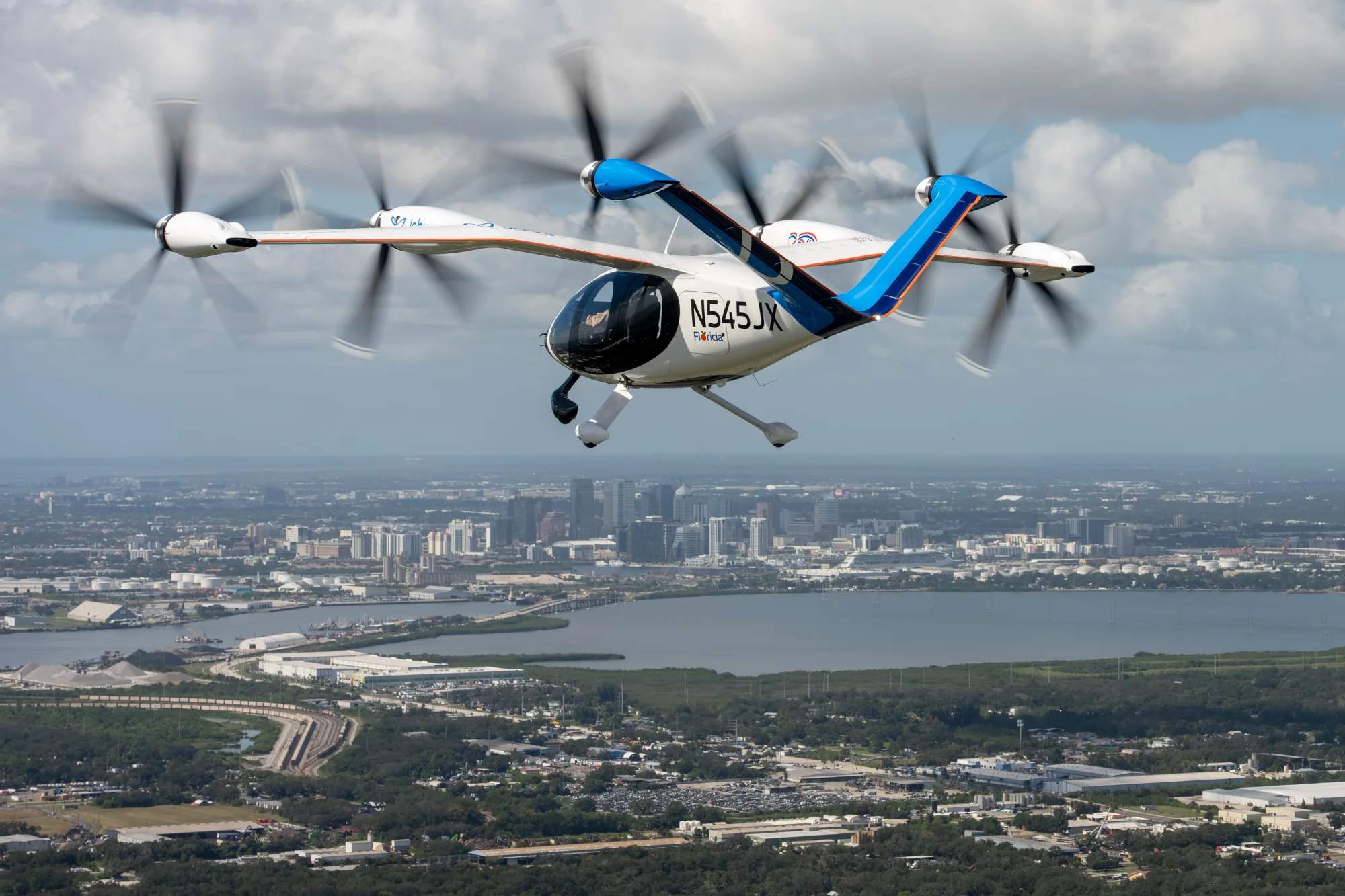
A useful historical example is Joby's July 2021 distance flight. The company reported that a remotely piloted prototype flew 154.6 statute miles, completing 11 laps of a circuit with vertical takeoff and landing. That was a specific test accomplishment, not proof that a paying passenger could book a 154.6-mile nonstop service with any load in any conditions.
The unit matters too. A statute mile is not a nautical mile. Before comparing two headlines, verify that both use the same distance unit, then check whether one describes total distance around a circuit and the other describes a proposed route between locations.
Joby raised its 2026 revenue outlook after a $55.1 million quarter. We examine what Blade’s growth, the latest FAA milestones, airport demonstrations and the proposed $500 million Resonant deal mean for its electric air taxi plans.
Explore the aircraft, vertiport capacity, journey times, charging demand, and seat occupancy behind a practical advanced air mobility network.
Oct 25, 202612 min read
Development range target
The manufacturer's intended objective
Whether the target has been demonstrated and approved
Recorded test distance
Performance achieved during that test
Payload, conditions, profile and remaining energy
Published passenger mission
A proposed or supported operating use
Aircraft approval, operator capability and actual service status
Repeatable route schedule
Intended frequency and journey pattern
Charging, ground handling, weather limits and recovery options
A range number becomes more informative as its supporting assumptions become more complete. A larger number with less context is not necessarily a stronger basis for your decision.
The full mission consumes energy
For a winged eVTOL concept, the journey can include vertical lift, transition, climb, cruise, descent and arrival. These phases do not place identical demands on the energy system. The aircraft must finish the whole mission; cruise distance alone does not represent the full requirement.
Research by Yang and colleagues in Joule examines the distinct battery energy and power demands of eVTOL profiles, including the high power required during vertical phases. The important distinction is between energy, which describes an amount available to do work, and power, which describes how quickly it must be delivered. Enough total energy is not the only requirement.
The destination also is not necessarily reached along the shortest line on a map. A useful trip assessment includes the actual route and conditions. A longer path or a headwind can change the energy needed to connect the same two endpoints.
Take an example of a flight between an airport and a city-edge vertiport. The map distance tells the traveler where the service goes. It does not explain the departure profile, the route the aircraft will follow or the energy needed for arrival. Those details are part of the operator's mission assessment.
This is one reason the difference between an eVTOL and a helicopter should not be reduced to whether each can rise vertically. Aircraft configuration and the way the whole trip is flown matter to the comparison.
Passenger load and battery condition matter
A meaningful range statement should disclose the load assumption. “Four seats” tells you something about accommodation; it does not establish the performance of every possible combination of passengers and luggage. A test without a representative passenger load cannot be silently converted into a full-cabin service promise.
Battery condition matters as well. Nameplate capacity, usable energy for the present mission and approved aircraft performance are separate concepts. Temperature, aging and operating demands affect the battery assessment. A percentage indication alone does not tell a passenger how many miles remain available for a particular trip.
The Joule research illustrates why battery performance must be considered across operating conditions and life, rather than only when new. Its modeled examples are not certified performance figures for a current production aircraft. The useful principle is that a range comparison needs a stated battery condition and mission, not an assumed universal deduction for aging or cold weather.
For a buyer evaluating a fleet proposal, ask whether the advertised route capability is intended to hold across the operator's approved battery service life and expected passenger loads. Otherwise, an attractive demonstration could be doing more work in the commercial case than the evidence supports.
For a passenger, the simpler question is whether the provider accepts your group and luggage on the actual route. Do not turn an aircraft development specification into a booking assurance.
Reserve energy is not sellable range
Energy retained to satisfy reserve requirements cannot also be counted as energy routinely available to extend the advertised passenger trip. The FAA's powered-lift operating guidance, AC 194-1, addresses operating requirements in relation to applicable rules and aircraft capability. It does not support one universal percentage deduction for every eVTOL mission.
Requirements depend on the operation and approved capability. A blanket assertion that every aircraft needs the same number of extra minutes, or that every range figure should be reduced by a fixed percentage, misses those distinctions.
A simple allocation example shows the arithmetic without pretending to calculate aircraft performance. Use illustrative assumptions of 100 available energy units, with 20 assigned to noncruise phases and 25 retained at the end. That leaves 55 units for cruise: 100 minus 20 minus 25.
Illustrative allocation
Base case: energy units
Higher noncruise allocation: energy units
Noncruise phases
20
30
Retained energy
25
25
Available for cruise
55
45
Total available at start
100
100
Increasing the noncruise allocation by 10 units reduces the cruise allocation from 55 to 45, an 18.2% reduction in that portion. It does not prove an 18.2% reduction in any aircraft's range. The example explains competition within an energy budget; the units are invented, the retained amount is not a legal reserve and no miles are implied.
The sensitivity matters because the headline total has not changed. Two missions can begin with the same assumed energy while leaving different amounts for the portion that covers most of the distance. A traveler who sees only the starting percentage would miss that difference.
Both cases begin with 100 units. Increasing noncruise allocation by 10 units leaves 45 instead of 55 for cruise. No range in miles is implied. · BizJet Journal
A repeatable route can be shorter than a maximum flight
A passenger network has to do more than finish one long flight. It needs a workable pattern of boarding, flying, arrival and preparation for the next service. Charging capability at the location and the energy needed for the next departure belong in that pattern.
Archer's August 2024 Los Angeles network announcement described Midnight as designed for repeated flights of 20–50 miles with limited charging time between them. That is a dated design-mission statement. It should not be read as confirmation that every announced route is operating today or that the stated mission is a universal certified range.
The commercial logic is straightforward. A shorter route may serve a substantial travel need while allowing the aircraft to return to service on a useful schedule. Maximum distance is only valuable when it helps the network deliver trips that people want at times they can use.
Imagine two proposed services using the same aircraft. One connects two locations with strong demand and suitable charging at both ends. The other stretches toward the edge of a claimed range and has less operational flexibility at arrival. The longer route is not automatically the better service simply because it demonstrates more of the aircraft's distance capability.
This is the connection between aircraft performance and the numbers behind a useful advanced air mobility network. Range defines part of the opportunity; repeatability determines how much of that opportunity can become a dependable timetable.
When comparing claims, keep five items together: date and status, payload, environmental assumptions, retained energy and turnaround. If several are missing, describe the number as a limited claim rather than filling the gaps with favorable assumptions.
FAQs
Does a record flight prove passenger-carrying range?
It proves the reported flight under its reported test conditions. A passenger mission needs its own load, operational and energy assumptions. A remotely piloted prototype circuit should not be presented as an equivalent scheduled passenger route.
Why might an air taxi fly short routes despite longer advertised range?
The operator may be designing a repeatable service around demand, turnaround and infrastructure. Carrying passengers on a useful short route can be commercially valuable even when the aircraft has demonstrated a longer flight. Maximum distance is not the only measure of service quality.
Can battery percentage be converted directly into miles?
No universal conversion works. The remaining mission, aircraft configuration, load, battery condition and required retained energy all matter. A simple percentage-to-mile calculation cannot replace the aircraft's approved performance and the operator's assessment.
Should I subtract a fixed reserve percentage from advertised range?
No. First identify what reserve assumptions the published figure already includes. Then determine the relevant operating basis. Applying an arbitrary deduction can either double-count an existing allowance or miss requirements that the original claim never addressed.
Understand urban and regional air mobility, where electric aircraft could help, and how distance, airports, charging and economics shape useful routes.