
eVTOL Updates · guide
Urban vs Regional Air Mobility: Where Electric Aircraft Could Fit
Understand urban and regional air mobility, where electric aircraft could help, and how distance, airports, charging and economics shape useful routes.


Urban air mobility is concerned mainly with moving people or goods around metropolitan areas. Regional air mobility looks further across the map: connections between communities, smaller airports and places poorly served by existing transport. Both can involve electric aircraft, but they describe transport missions rather than a single aircraft design.
That distinction matters. An aircraft suited to a short city transfer may be a poor choice for a longer regional route. A regional service may benefit from an existing runway instead of needing vertical take-off. The useful question is where new aviation technology can deliver a dependable improvement to the whole journey.
UAM, RAM and AAM describe different parts of the problem
Advanced air mobility, or AAM, is the broad discussion around new aircraft and operating concepts. Urban air mobility, usually shortened to UAM, focuses on urban environments. Regional air mobility, or RAM, considers links between and beyond those environments. The boundaries overlap, so a route should not be assigned to one category simply because it falls on one side of an arbitrary distance threshold.
EASA describes UAM as an air transport system for passengers and cargo integrated with other modes in urban areas. That integration is central. A useful urban service has to connect with the airport, railway, street network or destination buildings around it.
NASA’s regional air mobility work explores the potential of regional airports to improve connectivity. The concept is not restricted to taking helicopters and replacing their engines. It can include aircraft that take off and land conventionally, using infrastructure communities already have.
Which urban journeys could benefit?
The best-known proposal is an airport transfer. A passenger leaves a city location, boards an aircraft at a nearby landing site and avoids a congested road journey to the airport. Other possible uses include crossing a metropolitan area, connecting separated business districts or transporting time-sensitive goods.
Each proposal needs a strong comparison with surface transport. A congested road can create an opportunity, but a frequent direct airport railway might already offer a predictable journey at a much lower fare. The air service must explain its value against the alternative passengers can actually use.
Landing sites also matter more than a straight line on a map suggests. If a passenger must spend 30 minutes reaching the departure site, a very short flight may not save much total time. At the other end, an aircraft landing near an airport is not necessarily delivering passengers directly into their airline departure process.
Urban cargo and medical logistics may have different priorities. A consignment can value predictable delivery without needing a comfortable cabin. A passenger service must accommodate boarding, assistance, baggage and acceptable waiting conditions as well as the flight itself.
Regional mobility addresses a different access gap
A regional journey can be awkward even where the distance is modest. Geography, indirect roads, ferries or the need to connect through a large airport can make travel slow. A direct link between smaller airports could serve a business trip, connect a community to a regional centre or carry urgent freight.
It is important to separate a useful route from a large market. A route may save several hours yet have too few customers willing to pay enough to support frequent departures. An operator might need a schedule built around particular demand, a charter model or a combination of passenger and cargo work.
Existing regional aviation already addresses some of these needs. Electric aircraft would enter a market with established operators, aeroplanes and surface alternatives. Their commercial case has to demonstrate an improvement in appropriate missions, rather than assuming a new propulsion system creates demand by itself.
Electric does not necessarily mean vertical take-off
The US Government Accountability Office’s May 2026 review distinguishes electric aircraft with vertical, short and conventional take-off capabilities. It also discusses fully electric and hybrid-electric designs. That variety is important when assessing what could fit a particular route.
An eVTOL avoids the need for a conventional take-off run at an appropriately approved site. A short-take-off design may offer access using a small operating area while still relying on a wing in forward flight. A conventional electric aeroplane requires a suitable runway but can use an airport environment already organised around aeroplanes.
Propulsion introduces another distinction. A battery-electric aircraft stores its mission energy onboard in batteries. A hybrid-electric design combines electrical propulsion elements with another energy source or power-generation arrangement. Those choices affect weight, range, charging or fuel logistics, maintenance and the environmental assessment.
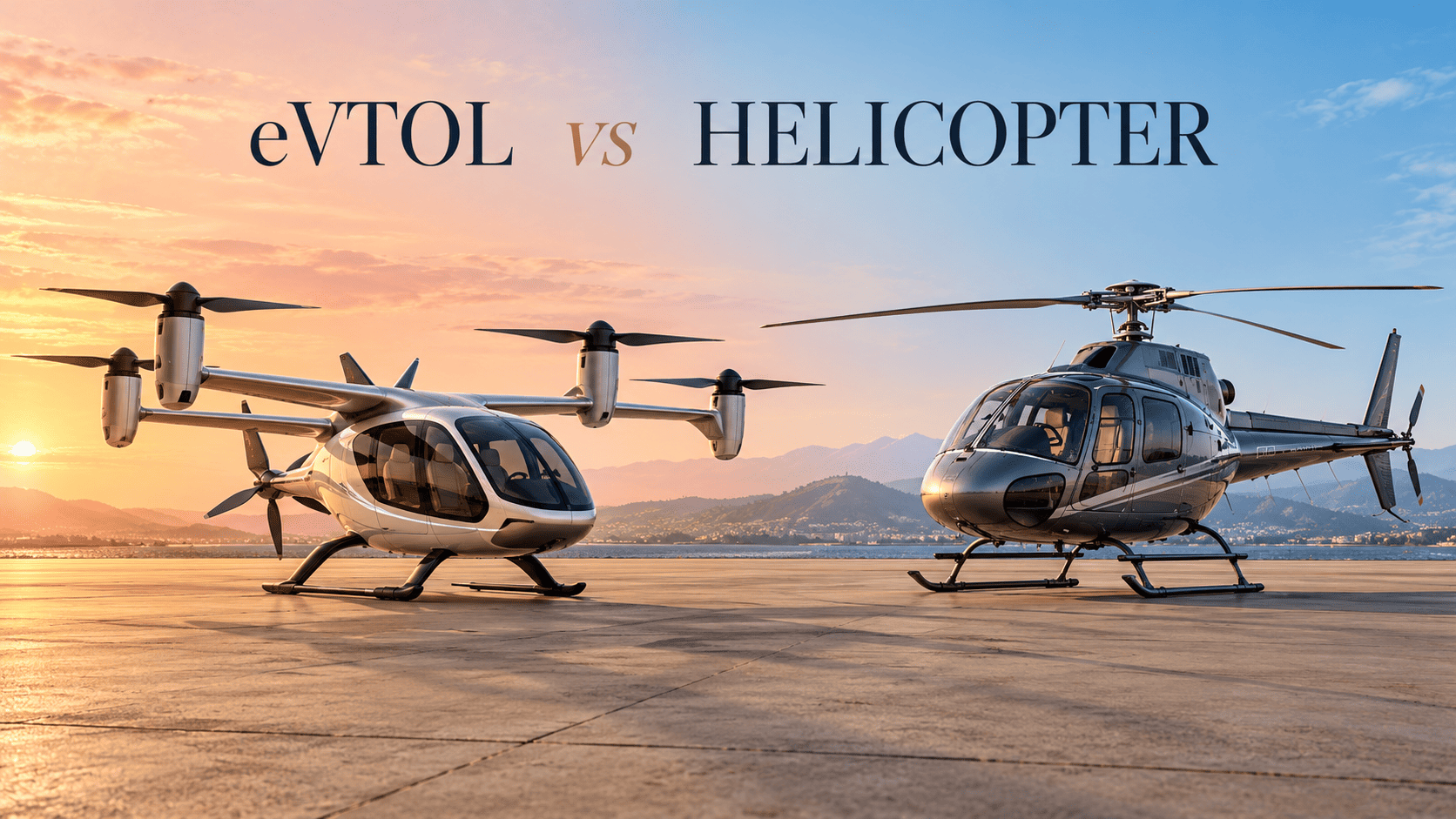
These are design trade-offs. Neither vertical take-off nor fully electric propulsion should become a prerequisite before considering the route. Our eVTOL and helicopter comparison explains why the aircraft configuration and the passenger mission need to be assessed together.
| Planning question | Urban mission | Regional mission |
|---|---|---|
| What problem is being solved? | Congestion or an inconvenient city connection | Weak direct links between communities or regions |
| What can undermine the benefit? | Slow access to landing sites and additional transfers | Low demand, indirect airport access or infrequent service |
| What infrastructure may help? | Well-connected, approved landing sites | Existing regional airports with suitable facilities |
| What aircraft should be considered? | The designs suited to the actual sites and mission | Vertical, short or conventional take-off designs as appropriate |
| What should customers compare? | The entire journey against road and rail | The entire journey against direct surface travel and existing air services |
The infrastructure has to support repeated operations
A landing area and a charging cable do not create a dependable transport network. The operator needs appropriate electricity supply, compatible equipment, safe aircraft servicing, trained personnel and a plan for disruptions. Passengers need somewhere accessible to wait and a workable connection to the next stage of their trip.
Grid connection capacity can affect how many aircraft a site can support and how quickly they can be prepared. A charging installation that works for a demonstration may need expansion for a peak-hour schedule. Planners also need to consider equipment outages and the effect of losing one important site in a small network.
GAO’s 2026 review identified limited supporting infrastructure at US airports and uncertainties around costs, demand and reliable electricity. Its findings are a reminder that aircraft development and network development must progress together. They are not evidence that every proposed route faces the same obstacle or timetable.
Approvals are equally important. The FAA’s AAM work covers multiple elements of introducing these operations into the airspace system. An approved aircraft does not remove the need for an authorised operator, qualified personnel, suitable facilities and permission to conduct the intended service.
Measure the complete journey, not just flight time
Consider a hypothetical airport transfer. The road journey takes 75 minutes. The air option requires 12 minutes to reach the landing site, 15 minutes for preparation and boarding, a 12-minute flight and 15 minutes to reach the appropriate airport departure area. Its total is 54 minutes, a 21-minute saving under those assumptions.
Now add a 20-minute wait for the next available flight. The advantage nearly disappears. None of those figures describes a particular operator or city; the example shows why the timetable and connections belong in the calculation.
A hypothetical regional trip could work differently. Suppose a road journey takes four hours. The air option involves 20 minutes to the local airport, 25 minutes before departure, a 55-minute flight and 20 minutes to the final address. The total is two hours. Even with extra contingency, that could be valuable, provided a suitable service exists when the traveller needs it.
The comparison should include the same beginning and end points, realistic waiting times and a disruption allowance. Travellers also value predictability. A smaller average saving may be more useful if the journey reliably delivers them before an important meeting.
What has to work commercially?
A service needs enough revenue to support the complete operation. Energy is only one cost. Aircraft financing, staff, insurance, maintenance, battery management, facilities, software and spare capacity all belong in the business model.
Occupancy matters because costs must be supported by the seats actually sold. A forecast based on every seat being occupied on every flight leaves little room for uneven demand. Repositioning flights and quiet periods also affect how productive the aircraft can be.
Pricing needs careful interpretation. A proposed fare is not the same as a fare demonstrated by a sustainable operating business. It may depend on future aircraft production costs, network scale, automation or other assumptions that have not yet been achieved. Readers should ask which assumptions are needed for the price to work.
What would show that a route is ready?
A useful readiness test brings together the aircraft, operating approvals, infrastructure and demand. There should be evidence for the actual passenger load and route, a realistic schedule, trained teams, suitable sites and an understandable recovery policy.
For passengers, the service also needs to explain what is included. Does the fare cover the transfer to the next terminal? What baggage is permitted? How does a cancellation affect the onward airline flight? Can a passenger who needs assistance make the complete journey?
Electric aircraft could add useful choices where those questions have good answers. Urban and regional air mobility will be judged most clearly through dependable services on specific routes, rather than through a single forecast for an entire new transport category.
Frequently asked questions
Is regional air mobility always electric?
No. Regional air mobility describes the connection being provided. Electric and hybrid-electric aircraft are part of the development discussion, but the term should not be treated as a universal propulsion requirement.
Are UAM and AAM the same thing?
They are related, but AAM is the broader concept. UAM concentrates on urban environments. Regional links and other emerging aviation uses can fall within wider AAM discussions without being urban services.
Does regional flying require new airports?
Not necessarily. Existing regional airports may offer suitable runways and access. They still need assessment for the intended aircraft, energy supply, servicing, passenger facilities and operating permissions.
Could electric aircraft replace short airline routes?
Potentially on suitable missions, but the outcome depends on approved payload, range, reliability, cost and demand. Some services could complement larger airline networks or provide connections that do not currently support conventional scheduled service.