
Jet Cards · guide
Jet Card vs On-Demand Charter: Comparing Costs Across Your Real Travel Schedule
Price the same annual travel calendar as a jet card and on-demand charter, then compare minimums, difficult dates, committed funds and the premium for service.


Your cheapest private flight of the year may come from on-demand charter, while your most difficult departure may favor a jet card. Comparing a card's advertised hourly rate with one attractive charter quote will not tell you which option suits the other eleven months.
The useful jet card vs on-demand charter comparison prices the same travel calendar under both arrangements. It also identifies what changes when you cancel, book late, need a different cabin or travel on a peak date. Once you have those answers, any premium becomes a decision you can explain rather than an impression about value.
Build a trip list you can actually quote
Start with your last twelve months of travel, then adjust for known changes in the coming year. Record each departure separately, including the date, airports, preferred departure time, passenger count and baggage. Add whether the return is the same day, several days later or still undecided.
Be specific about flexibility. A flight that can depart anytime on Tuesday is a different purchasing problem from one that must leave after a Wednesday board meeting and arrive before an evening event. If you can use two departure airports, identify both and include the extra ground travel in your assessment.
Cabin requirements belong in the same worksheet. Six passengers with golf bags may require a different aircraft from six passengers carrying overnight bags. Requiring usable Wi-Fi, a particular lavatory arrangement or enough space to work can also narrow the acceptable options. Comparing a larger card category with a smaller charter aircraft creates a misleading price difference.
Label trips as committed, likely or optional. Obtain complete quotations for the committed calendar, then test the other groups separately. Funding a program around optimistic travel forecasts can leave you with an excellent hourly rate and an unnecessarily large balance.
Turn both offers into comparable trip totals
Ask the card provider for the expected debit for every itinerary, including billed time, minimums, applicable taxes and separately charged items. Ask the charter seller for an equivalent total and a clear list of anything still subject to adjustment. A quoted flight price is not fully comparable until both sides explain their treatment of positioning, deicing, airport charges, catering and requested ground services.
For a wider cost checklist, see how much it costs to charter a private jet. The comparison should use the aircraft and itinerary you need, not a generic hourly estimate for a cabin class.
Also establish what kind of card you are evaluating. Paramount's jet card membership describes pricing based on the operator's cost plus a disclosed management fee. That is a different arrangement from purchasing a guaranteed hourly rate: prepayment does not itself remove exposure to market pricing.
By contrast, Sentient's SJ25 Light card advertises fixed hourly rates locked for twelve months, with fuel surcharge and federal excise tax additional. Its stated 15% discount applies to qualifying round trips. You therefore need both the eligibility test and the charge base receiving the discount before applying it to your calendar.
Keep discounts on their proper rows. A benefit available on four qualifying trips should not reduce the cost of all twelve. Likewise, do not assume a quoted charter aircraft will remain available for months while you deliberate; record quotation dates, validity and booking conditions.
Price the complete year, then find the differences
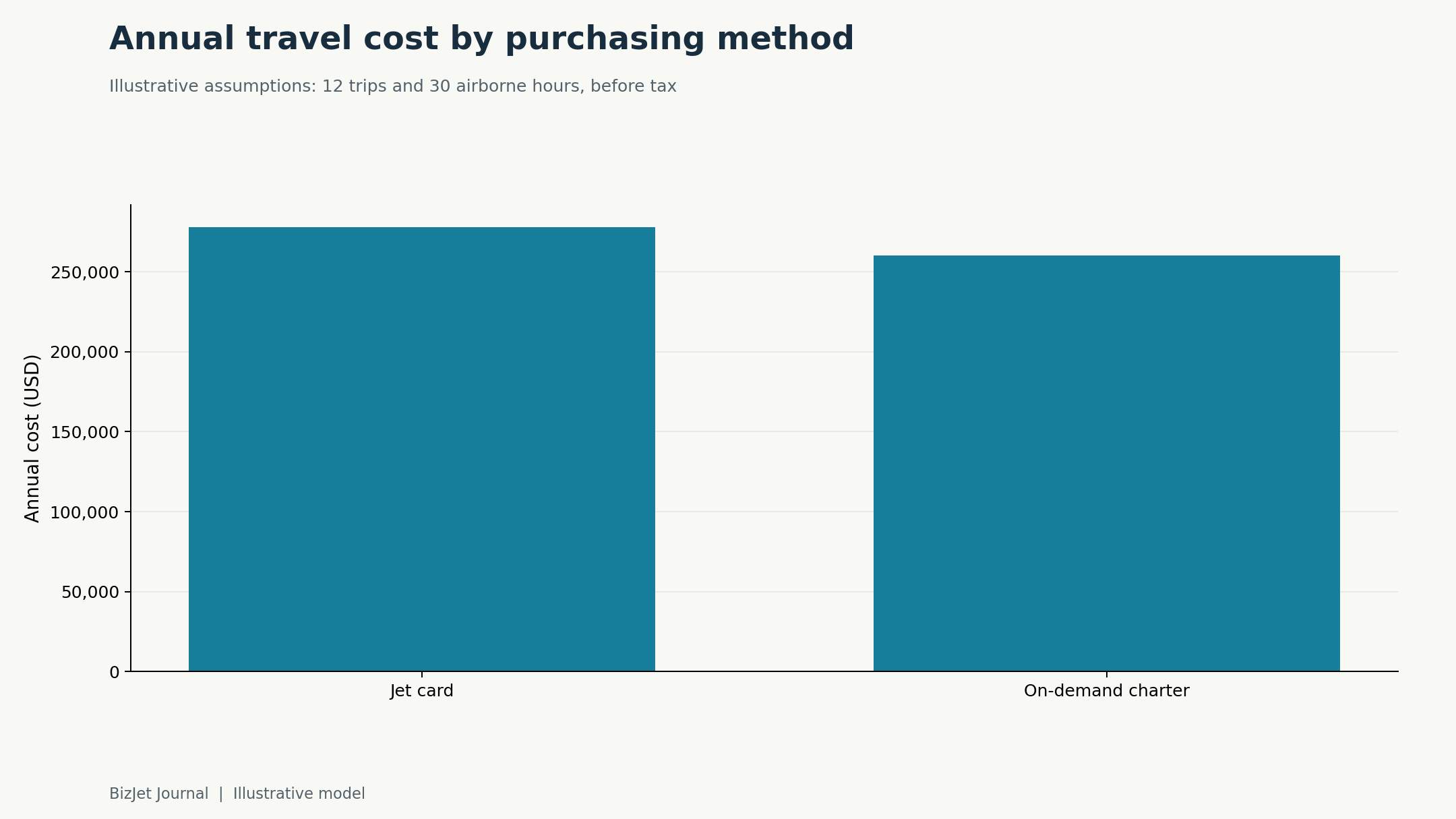
Take an example of twelve trips totaling 30 airborne hours. Under illustrative assumptions, minimums and other time rules produce 34 card-billed hours. The card costs $8,000 per billed hour, with another $6,000 covering modeled non-tax charges. Comparable charter quotations total $260,000 using those same cost categories. Both sides of this example are before tax. Add the actual applicable taxes consistently to both quotations before making a purchasing decision; this example does not calculate a jurisdiction-specific tax liability.
The groups below summarize a trip-level worksheet. All amounts are before tax and are assumed prices for a comparison exercise, not market quotations or a provider's offer.
| Travel group | Trips | Airborne hours | Card-billed hours | Card flight debit | Other card charges | Card total | Charter total |
|---|---|---|---|---|---|---|---|
| Short, flexible trips | 4 | 6 | 8 | $64,000 | $1,000 | $65,000 | $48,000 |
| Longer, routine trips | 5 | 15 | 16 | $128,000 | $3,000 | $131,000 | $125,000 |
| Time-sensitive trips | 3 | 9 | 10 | $80,000 | $2,000 | $82,000 | $87,000 |
| Year total | 12 | 30 | 34 | $272,000 | $6,000 | $278,000 | $260,000 |
The before-tax card premium is $278,000 minus $260,000, or $18,000. Dividing by the charter total gives a 6.9% premium, rounded. Dividing by actual airborne hours produces $9,267 per hour for the card and $8,667 for charter, also rounded.
The annual totals conceal the buying opportunity. The card saves $5,000 on the three time-sensitive trips, but costs an additional $17,000 on the short trips and $6,000 on the routine ones. Short-flight billing rules account for much of the gap. A lower headline card rate alone would not explain it.
A mathematical combination—charter for the first two groups and the card for the third—totals $255,000. That is not automatically an available purchasing strategy. Ten billed card hours may fall below the minimum purchase, and benefits could require a larger funded balance. Treat $255,000 as a screening result until the seller confirms a program that supports that usage.
Test the dates that could change your decision
The next step is to vary the assumptions most likely to move. If the comparable charter total increases 10%, it becomes $286,000, and the card's $278,000 is $8,000 lower. If charter falls 10%, its total becomes $234,000, making the card $44,000 more expensive. These scenarios describe price sensitivity, not a forecast.
Then test your actual difficult dates. Ask whether the card's quoted rate, access promise and normal booking notice apply. A program can offer ordinary-day availability while imposing different peak-date deadlines, departure windows or cancellation terms.
Compare cancellation exposure using the trips most likely to change. If a meeting routinely moves within forty-eight hours, a cheap nonrefundable departure may carry more risk than its initial quote suggests. Do not put a made-up annual value on flexibility. First model an explicit event: one canceled trip, the charge under each contract and the price of rebooking.
Apply the same discipline to mechanical recovery. Identify who must arrange a replacement, who pays any price difference and what happens if the offered aircraft cannot meet your itinerary. Charter contracts differ, so “charter” should not be treated as one uniform service standard. Our jet card comparison guide provides the broader framework for matching contractual benefits.
Separate flight spending from money committed
An advance payment is a cash requirement. It is not necessarily an expense equal to the amount paid.
To isolate the funding arithmetic, suppose you deposit $300,000, consume $278,000 on completed trips and finish the year with $22,000 available for future use or refund, with any taxes settled separately. The completed-trip cost is $278,000. Adding the original $300,000 payment to that expense would count the same money twice. Treat the remaining $22,000 according to its actual refund, expiry and use restrictions.
Cash still has a cost while committed. If you choose to use a 4% annual opportunity-cost assumption and estimate an average funded balance of $160,000, the additional economic cost is $6,400. Keep this separate from the travel bill: the card's modeled economic burden would be $284,400, while consumed flight expense remains $278,000. This simple calculation assumes the average balance is representative and ignores tax effects.
Use the same principle for charter deposits. Compare how much money each arrangement holds and for how long, rather than assuming that only one side requires advance funding.
Decide whether the premium earns its place
A premium can be reasonable when it buys benefits you will use: predictable eligible-trip pricing, workable notice periods, a clear replacement obligation or less time arranging recurring travel. The relevant question is whether those benefits justify the difference on your own schedule.
Choose charter throughout when itinerary flexibility and individually competitive quotations outweigh the value of prearranged terms. Choose a card throughout when your trips fit its service area, billing rules and access conditions consistently. Combine them when recurring eligible trips support the card commitment and unusual journeys are better purchased separately.
Before funding, rerun the model with the minimum travel you reasonably expect. A program that remains acceptable under that case gives you more room for the calendar to change.
Frequently asked questions
Can a jet card save money on one-way flights?
Yes, when its eligible-trip debit is below the comparable charter total. The result depends on the card's minimums and service area and the aircraft available for charter. A card's one-way pricing structure is useful only after you confirm which charges it includes.
Should you compare deposits or completed-trip costs?
Compare both, for different purposes. Completed-trip costs measure travel spending; deposits measure cash committed. Show unused refundable money separately, then add any chosen financing or opportunity cost as its own calculation. Restricted or expiring balances require an additional assessment of whether you will use them.
Can you combine a jet card with charter?
Yes, provided your card terms allow the purchasing pattern and its minimum commitment still makes sense. Reprice the smaller card allocation before assuming a combination saves money. A theoretical saving can disappear if you must fund significantly more flying than you expect to consume.