

Jet Cards · guide
How to Calculate a Jet Card's Effective Hourly Cost
Reconcile flight statements, minimums, fees and unused balances to calculate what each billed and airborne hour really costs. Includes a short-flight sensitivity table.


An $8,000 hourly rate does not necessarily mean each hour in the air costs $8,000. Your provider may bill a different amount of time from the time you actually fly, and some charges may sit outside the rate entirely.
Calculating a jet card's effective hourly cost means reconciling those differences. You need a consistent time measure, a complete expense total and a clear treatment of unused money. The result should tell you both whether the invoices are correct and whether the program fits your travel pattern.
Choose the denominator before doing the math
Start by distinguishing three measures. Airborne time runs from takeoff to landing. Occupied block time generally includes time associated with moving from departure parking to arrival parking, but you should confirm the exact definition used in your records. Provider-billed time is the quantity deducted under the agreement, which can include projected times, taxi allowances, rounding and minimums.
These measures answer different questions. Cost per billed hour helps reconcile the rate to the statement. Cost per actual airborne hour shows what you paid for the flight time you used. Cost per occupied block hour can be useful when comparing another proposal expressed that way, provided you calculate both using the same definition.
Do not divide this year's spending by the hours you purchased if some remain unused. That spreads completed-trip costs over flying that has not happened. Likewise, do not compare a card using airborne hours with a charter proposal using block hours and call the difference a saving.
Obtain trip statements and flight records for a defined period. A full year is useful when the program charges an annual membership fee or your travel is seasonal. For a new purchase, label all projected flight times and usage assumptions, then replace them with actual results as flights occur.
Rebuild the billed hours for each leg
Read the billing definition before opening the calculator. Determine whether the agreement uses estimated or actual flight time, whether it adds taxi time and how minimums interact with those amounts.
For example, Air Partner's published JetCard terms define block time using projected flight time plus six minutes for taxi at each end. This is an example from a published Air Partner Limited agreement; it does not establish the terms of every card sold in every market.
A different structure appears on flyExclusive's Jet Club page, which advertises no taxi-time charge and describes a combination of hourly and daily rates. Removing a taxi charge does not make the entire price comparable until you include the daily component.
Take an example of ten flights lasting 1.2 airborne hours each. Under illustrative terms, add 0.2 hours of taxi allowance and then apply a 1.5-hour minimum to each flight. Each leg is billed at 1.5 hours, producing 15 billed hours from 12 airborne hours.
| Time calculation | Per flight | Ten flights |
|---|---|---|
| Actual airborne time | 1.2 hours | 12 hours |
| Assumed taxi allowance | 0.2 hours | 2 hours |
| Time before minimum | 1.4 hours | 14 hours |
| Additional time from minimum | 0.1 hours | 1 hour |
| Provider-billed time | 1.5 hours | 15 hours |
The order matters. Applying a 1.5-hour airborne minimum first and then adding taxi would produce 1.7 billed hours per flight instead. Never choose the sequence that looks most reasonable; reproduce the contract's sequence.
Daily minimums require a separate check. Two short flights on the same date may consume less time under a daily rule than under two segment minimums, but that depends on how the agreement groups the legs. Our guide to daily vs segment minimums explains why the distinction matters.
Add every charge once
Build an expense ledger from the flight debits and separate invoices. Include charges paid out of your account balance and amounts paid by another method. Deduct refunds and credits actually applied to those flights.
Use explicit categories: flight-time charges, nonrefundable membership fees, daily charges, separately billed fuel, airport charges, catering, ground services and applicable taxes. A category should have either an amount or an explanation that it is included elsewhere. Blank cells make double counting harder to detect.
For the ten-flight example, assume an $8,000 rate per billed hour, $6,000 in fees allocated to the period and $9,000 in separately assessed taxes and other charges. The $9,000 is an illustrative aggregate, not a stated tax rate or a calculation of any particular jurisdiction's tax liability.
| Expense component | Calculation | Cost |
|---|---|---|
| Flight-time charges | 15 billed hours × $8,000 | $120,000 |
| Fees allocated to the period | Assumed total | $6,000 |
| Taxes and other separate charges | Assumed total | $9,000 |
| Consumed travel expense | $120,000 + $6,000 + $9,000 | $135,000 |
Do not add fuel again if the hourly rate already includes it. Do not add a card debit to an invoice when the invoice merely documents that same debit. The guide to jet card add-on charges provides a useful checklist for the items that can otherwise escape the ledger.
Handle membership fees consistently. If the full $6,000 were an annual nonrefundable fee, include the full amount in an annual analysis. A first-quarter calculation could allocate $1,500 for a run-rate view, while separately showing that the cash was paid upfront. If you expect to cancel after that quarter without a refund, the full unavoidable fee belongs in the decision about those three months.
Calculate two useful effective rates
The two core formulas are straightforward:
Cost per billed hour = consumed travel expense ÷ provider-billed hours.
Cost per airborne hour = consumed travel expense ÷ actual airborne hours.
In the example, $135,000 divided by 15 gives $9,000 per billed hour. Dividing the same expense by 12 gives $11,250 per airborne hour. Both are valid. They describe different quantities.
The $11,250 result is 40.6% above the advertised $8,000 rate, rounded. That does not mean a provider charged the wrong rate. The difference arises from three extra billed hours and $15,000 of modeled charges outside the time rate. The calculation makes those effects visible.
If you also want an economic-cost measure, add funding costs separately. An assumed average unused balance of $75,000 at a 4% annual opportunity cost adds $3,000 for a full year. The economic total becomes $138,000, or $11,500 per airborne hour. It does not change the $135,000 consumed travel expense.
Keep this distinction even if a balance is refundable. Refundability affects access to the principal; it does not eliminate the time during which your money is committed. Conversely, the entire unused principal is not an expense simply because it remains in the account.
Find the trips inflating your average
Group flights by duration and purchasing conditions. Short flights often reveal the effect of minimums. Peak-date flights may reveal surcharges or different billing rules. International trips can bring additional handling or passenger charges. A single blended average will not show which change would help.
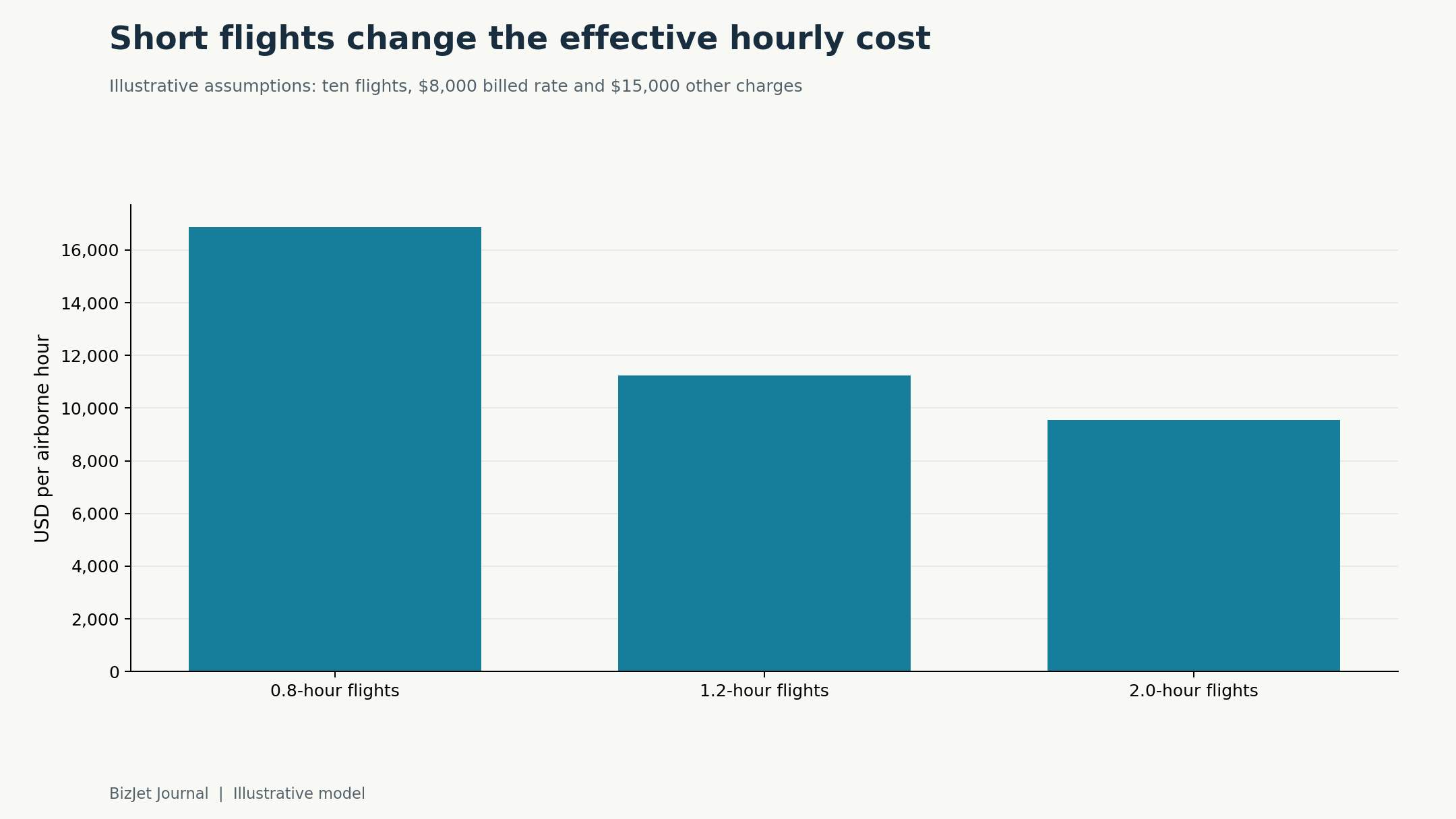
The ten-flight example demonstrates this sensitivity. Hold the $8,000 hourly rate and $15,000 of additional charges constant, and keep the same 0.2-hour taxi allowance and 1.5-hour minimum. Change only the airborne duration of each leg.
| Ten-flight scenario | Airborne hours | Billed hours | Total expense | Cost per airborne hour |
|---|---|---|---|---|
| 0.8-hour flights | 8 | 15 | $135,000 | $16,875 |
| 1.2-hour flights | 12 | 15 | $135,000 | $11,250 |
| 2.0-hour flights | 20 | 22 | $191,000 | $9,550 |
This controlled exercise shows how short flights can raise the effective rate even when the invoice rate never changes. The longer-flight case costs more overall, yet each airborne hour costs less. In a real proposal, reprice the other charges too; holding them fixed here isolates the billing-time effect.
Do not schedule unnecessary flying to improve an average. The purpose is to select suitable terms for trips you already need. A card with a higher headline rate and gentler minimums may fit short routes better; another structure may suit longer legs.
Keep a statement you can reproduce
Maintain one row per flight with the departure date, flight identifier, aircraft category, airborne time, billed time and expense categories. Keep adjustments on a separate line tied to the original trip so a later credit does not disappear into a different reporting period.
Reconcile beginning balance plus deposits and credits minus debits and refunds to ending balance. This verifies the cash account, while your expense worksheet explains the cost of travel. The two totals need not match because deposits and unused balances have different roles.
A useful result is reproducible: another person should reach the same effective rate from your statements without guessing which hours or charges you included.
Frequently asked questions
Should taxi time count in your comparison?
Yes, in billed time when your agreement charges for it. Keep it separate from airborne time so you can calculate both rates. When comparing providers, apply each provider's billing rules to the same itinerary, then use one consistent denominator for the final comparison.
Do unused refundable funds increase effective hourly cost?
They do not increase consumed flight expense simply by remaining unused. Show the balance separately. You may add an explicitly assumed financing or opportunity cost to an economic comparison, but counting the unused principal as a flight expense would overstate your cost.
How should you allocate a membership fee?
Use the period the fee buys and show your method. For annual program comparisons, use the full annual fee and expected annual flying. For interim reporting, distinguish an allocated expense from the upfront cash payment. If the fee is unavoidable and nonrefundable after early cancellation, reflect that in the cancellation scenario.