

Jet Cards · analysis
What Really Happened to ONEflight International?
ONEflight International’s history, flight suspension and customer lawsuits explained, with the BAJIT financial disputes and practical lessons for jet-card buyers.

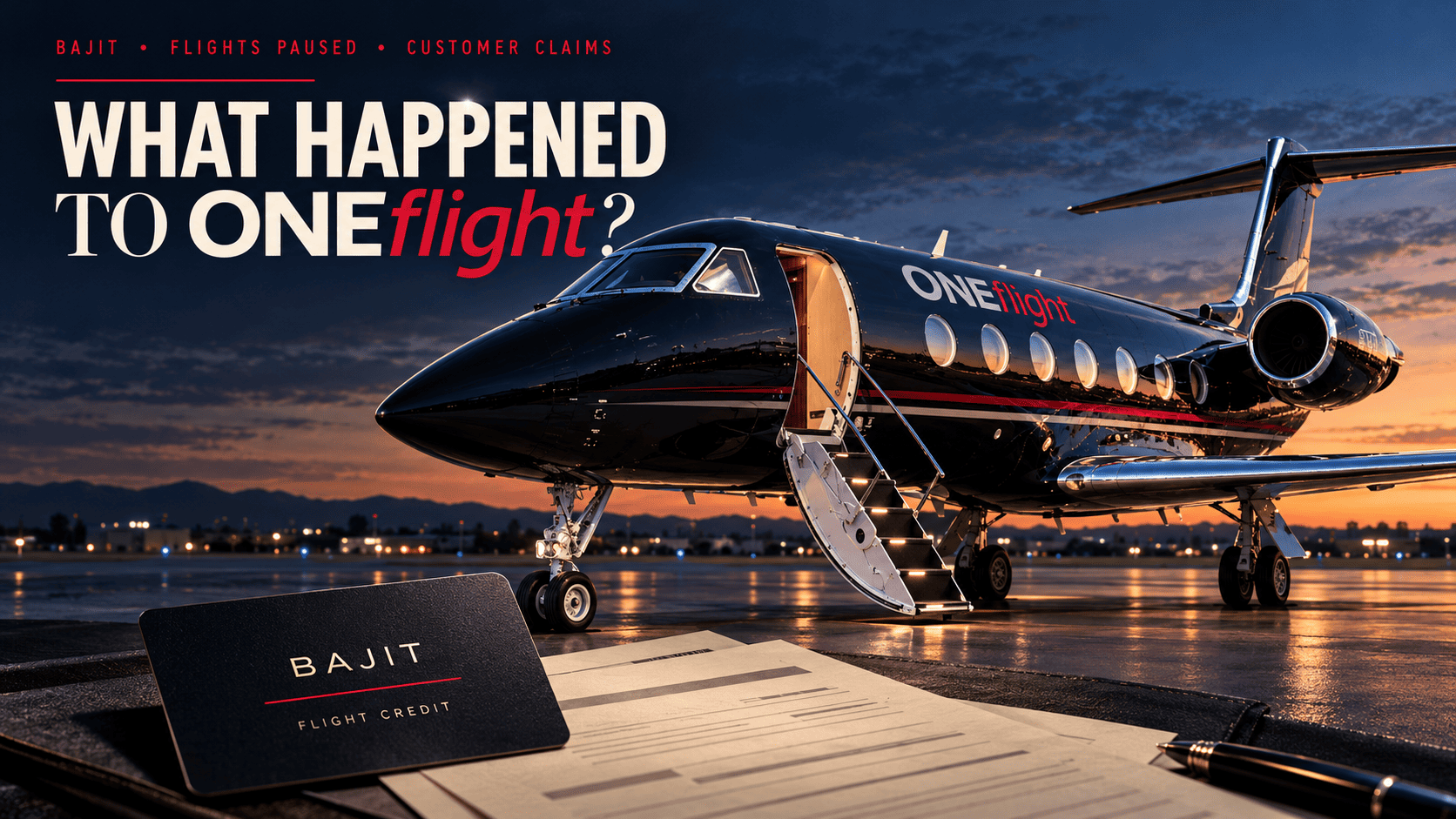
ONEflight International, also known as OFI, entered 2026 announcing record revenue and a new Formula 1 partnership. By September, the private aviation company behind BAJIT had suspended flight activity. Customers who had paid substantial sums for future travel began suing, and the 30-day pause passed without a publicly verified return to normal service.
ONEflight sold access to private flights alongside prepaid accounts and increasingly generous promotional offers. Once it stopped arranging travel, customers needed answers about the cash they had transferred, the flight credits they had been promised and who remained responsible for delivering flights or refunds.
The shutdown followed payment concerns and triggered a growing group of civil claims. The disputes center on how ONEflight funded its commitments and what customers were told while it continued accepting deposits.
What happened to ONEflight International?
The immediate turning point was the company's September 2026 notice suspending flight activity “for the next 30 days, or until further notice” while it assessed its operations and financial position. Private Jet Card Comparisons reported the notice, confirmed on 16 September.
The notice left the reopening date open. For customers with prepaid travel, the interruption quickly became a question of how to use or recover their remaining balances.
By 28 October, 12 federal customer lawsuits had been identified. They include claims against ONEflight entities, founder and chief executive Ferren Rajput, and various executives. One also names television personality Robert Herjavec, who denies the alleged equity relationship and knowledge of the company's finances.
The company's advertised service stopped, its public-facing presence diminished, and customers moved to litigation. By 28 October, neither a completed restart nor an agreed customer repayment program had been publicly verified.
How ONEflight started, and who Ferren Rajput is
ONEflight dates its launch to 2010. In a 2020 interview with entrepreneur and author Sramana Mitra, Rajput put the company's first flight on 14 December 2010. A 2012 federal court order identifies an earlier business as BALCC Holdings LLC doing business as ONEFlight International.
Rajput came to aviation from finance. In his own account of his career, he described stockbroking, investment banking and a move into mortgage lending. He also described becoming a pilot. After a prison sentence, he said he rebuilt his working life through car sales, membership sales and software work before developing the aviation business from a small airport office.
The previous tax conviction
The historical criminal case is documented. On 26 October 2006, the US Department of Justice announced that Ferren S. Rajput had pleaded guilty in Colorado to failing to collect and pay employee taxes and failing to pay employer taxes. The case concerned Altus Financial, a mortgage brokerage he controlled. The stipulated conduct covered seven quarters in 2002 and 2003, with a tax loss exceeding $1.1 million.
A contemporaneous sentencing announcement republished by LawFuel records an 18-month federal prison sentence on 15 June 2007. It also records approximately $260,000 in restitution already paid and an additional $868,980 ordered.
Rajput discussed the mortgage tax case and imprisonment in the 2020 interview, describing prison as a turning point before starting again in aviation.
What BAJIT was, and what OFI was selling
BAJIT, usually styled BAJit by the company, stood for Book-A-Jet. It was ONEflight's aircraft-search and booking platform. Company materials date its launch to 2017 and describe a service through which users could compare and arrange charter flights.
ONEflight was the business behind the platform; OFI is the abbreviation used in its materials and many court filings.
Its broker disclosure described an indirect air carrier arranging transportation performed by certificated operators. This distinction separates the company selling the trip from the operator exercising operational control over the aircraft. Its advertised network of hundreds of operators and thousands of aircraft was access through commercial relationships, not an owned fleet of that size.
The FAA registry lists Gulfstream N510FR as registered to ONEflight International Inc. Aircraft ownership sat alongside ONEflight's brokerage business.
Membership fees, flight deposits and bonus credits were different purchases
ONEflight's product range changed over time. Its 2026 BAJCard brochure advertised Silver, Gold and Platinum access tiers associated with 25, 50 and 100 hours, carrying annual dues of $15,000, $25,000 and $40,000 respectively. Those dues were not an all-inclusive purchase of that many flight hours. Funding the flights was additional.
The company also marketed deposit-based JetCards without the same annual-dues structure. A 2023 product launch described a $100,000 minimum deposit, a 12-month rate lock and a credit incentive for early buyers.
International ambitions brought another offer. In its August 2025 Global BAJ announcement, ONEflight advertised a $250,000 initial deposit and two one-way flights between the US and Europe at $40,000 each, with no additional international fees.
Later customer complaints describe combinations of cash deposits, matched flight credits, upgrades and complimentary hours. Take an example of a $250,000 deposit paired with $250,000 of bonus flight credit: the account shows $500,000 of spending power, while the business receives $250,000 in cash.
The seller still has to pay the aircraft operator when you use the promised benefits. Funding a promotion requires margins, supplier terms or a marketing budget that can cover the difference between the cash received and the cost of providing those flights.
The Shark Tank connection was through its personalities
ONEflight's association with Shark Tank came through individual personalities. The company announced Robert Herjavec as a brand ambassador in December 2019. Kevin O'Leary followed in June 2022, joining a roster that also included John Elway.
The documented Shark Tank connection was an endorsement relationship with its personalities. The announcements did not identify ABC or the television program as an investor or commercial partner.
By October, the relationship had changed. Bloomberg reported that Herjavec said he was no longer an ambassador and had demanded that ONEflight stop using his name and likeness.
O'Leary's representative told the same outlet that he had never invested in ONEflight and had been unable to recover prepaid flight credits.
For you as a buyer, an endorsement describes a spokesperson's association with the service. Financial due diligence requires separate information about cash reserves, obligations and the handling of prepaid money.
What happened to the McLaren Racing and golf partnerships?
The McLaren Racing agreement was real. On 23 January 2026, McLaren announced ONEflight as the official private aviation partner of its Mastercard Formula 1 team under a multi-year collaboration. The announcement contemplated travel services and promotional exposure.
Public activity followed. An April announcement connected the Myrtle Beach Classic pro-am with a McLaren race-car display and appearances by team figures. Visit Myrtle Beach's May event wrap-up recorded Lando Norris's participation.
The partnership's financial terms and commercial return remain undisclosed. The Denver Business Journal reported on 25 September that McLaren had suspended the sponsorship, cutting short the relationship's public momentum.
Golf had become another prominent part of the company's marketing. TGL announced ONEflight as its private aviation partner in October 2024, and the PGA Tour announced it as a Myrtle Beach Classic co-title sponsor in February 2025.
On 15 October 2026, golf reporter Alan Blondin reported that the PGA Tour had separated from ONEflight, citing a Tour official. The Myrtle Beach event was to continue in 2027.
The warning signs before the 30-day pause
The public deterioration developed over several weeks. In August, ONEflight announced a 35% surcharge for contracted-rate cardholders and withdrew it within hours following customer feedback.
The reversal preserved the previous pricing, but also showed how quickly the economics of a purportedly fixed-rate product could become a point of dispute.
A September investigation by the PJCC described operator-payment concerns and an employee resignation. Rajput disputed the employee's interpretation, said marketing spending was being reduced after building recognition, and defended promotional offers as limited loss leaders intended to retain customers over several years.
That report also described a July transaction selling $2.29 million of future receipts to Swift Funding Source for $1.65 million, before fees and deductions, followed by an August UCC filing. Rajput characterized the filing as retaliation over a predatory-lending complaint.
The principal developments were:
| Date | Development |
|---|---|
| 8 January 2026 | ONEflight announced $232 million in 2025 revenue, including flight revenue and membership sales. |
| 23 January | McLaren announced the multi-year private aviation partnership. |
| August | A 35% surcharge was announced and quickly rescinded. |
| 16 September | The flight-activity pause was confirmed, for 30 days or until further notice. |
| 20 September | Jeremy Ricks filed the first customer case identified in this review. |
| 30 September | Delayed payroll was paid, according to subsequent reporting and employee confirmation. |
| 15 October | The PGA Tour's separation from ONEflight was reported. |
| 22 October | Mark Heimbouch filed a case also naming Robert Herjavec. |
It was also reported that delayed pay had been issued on 30 September, with employees confirming receipt. The payment addressed the payroll delay as customer claims continued.
Former CFO Hanno Uys's side of the story
Management's September response attributed problems partly to the former chief financial officer's leadership. Johannes “Hanno” Uys subsequently told Private Jet Card Comparisons that he had served as CFO from July 2023 until September 2026 and feared being made a scapegoat.
Uys said he had warned Rajput in August 2024 and June 2025 about the treatment of prepaid flight deposits and promotional obligations. His account challenged treating nonrefundable deposits as already-earned revenue while the company still owed customers future service. He also questioned spending and the scale of promotional commitments.
Uys said he had believed BAJit and outside funding could help stabilize the business.
The disagreement centers on how ONEflight recorded, reserved for and funded its future obligations.
Why the $150 million, $300 million and $400 million figures differ
The headline figures measure different parts of the business: annual revenue, prepaid exposure, deferred revenue and new sales commitments.
| Figure | What it describes | How to read it |
|---|---|---|
| $232 million | ONEflight's company-reported 2025 revenue, including flight revenue and membership sales. | Annual sales combining flights and memberships. |
| More than $150 million | An early estimate of prepaid exposure in reporting around the pause. | An initial exposure estimate published around the pause. |
| Approximately $300 million | Deferred revenue reported by Private Jet Card Comparisons from documents it reviewed. | Reported obligations for service yet to be delivered. |
| Approximately $403 million | Reported 2026 sales-period cash and promotional amounts combined, before considering opening balances and subsequent usage. | A sales-period total; remaining obligations depend on opening balances and subsequent use. |
The $232 million figure comes from ONEflight's January announcement. The early exposure estimate appeared in the pause coverage; the later deferred-revenue figure appeared in the September investigation.
A separate analysis of sales records by PJCC reported approximately $226.3 million in cash received during 2026 through early September, alongside approximately $176.4 million in bonuses, credits and waivers. Together, those entries approached $402.7 million. The analysis challenged the company's characterization of discounted offers as limited exceptions.
The sales records show the scale of the commitments created. Calculating what remained outstanding requires starting balances, completed flights, refunds and the treatment of each credit type.
Your cash exposure is the unused money you paid; the retail value of complimentary hours measures an additional service promise.
A business can record strong sales while creating future service commitments faster than it builds the resources to meet them. The lawsuits focus on how ONEflight managed that gap and represented its financial position to customers.
The ONEflight lawsuits: what the court documents actually allege
Customers' civil complaints describe contracts, sales assurances and specific transfers of money. Several allege fraud, theft, conspiracy or a Ponzi-like scheme. The filings below show the transactions behind those claims.
Repeated top-ups and credits
In Ricks v. ONEflight International, filed on 20 September, Jeremy Ricks alleges that assurances about the company's finances encouraged repeated deposits. His complaint identifies $780,000 paid and a claimed remaining cash balance of $580,461.42. Those are different amounts because some travel had already been purchased.
Five-Star AudioVisual's complaint, filed on 22 September, alleges a remaining prepaid balance of $223,078.58 and the need to replace September flights. Its BAJ100 agreement separated $160,000 of membership dues, plus initiation and maintenance charges, from the actual cost of flights.
The Jinnah complaint, filed on 25 September, alleges $745,000 in payments and an unused account value of $815,834.57 including promotional credits.
Davin Pokoik's 5 October complaint separates the categories more explicitly. It alleges $465,000 in cumulative payments, including a July $200,000 payment. At the pause, he says $100,244.68 of cash and $427,333.44 of flight credits remained, together with ten unused Gulfstream hours.
The same distinction appears in Robert Klimasewski's complaint: the requested minimum of $954,164 comprises $464,164 of remaining cash deposits and $490,000 of promotional credits.
Deposits allegedly taken immediately before the shutdown
The timing of later sales is a central issue. In Robert Milam's Texas complaint, he alleges wiring another $250,000 on 15 September after a fresh offer, one day before the pause was confirmed. His case was transferred from the Dallas to the Abilene division of the Northern District of Texas and appears under both case numbers in the table below.
The Fuchs and Helix Enterprises complaint likewise describes transfers shortly before the suspension, including $95,000 on 11 September and $200,000 on 14 September.
Daniel and Sherrie Dwyer's complaint, filed on 16 October, brings federal civil RICO and Colorado organized-crime claims. It alleges $637,500 paid and $597,750 unused, with at least $607,750 sought in damages including approximately $10,000 of replacement airfare. The Dwyers also seek multiplied damages through the civil action.
Why Robert Herjavec was named, and his response
In Mark Heimbouch's complaint, filed on 22 October, the plaintiff alleges reliance on Herjavec's endorsements and describes an equity relationship with ONEflight. The complaint also alleges a $95,000 wire on 15 September, bringing the claimed unreturned balance to at least $741,456.23.
Herjavec expressly disputes the ownership allegation. In a response reported on 26 October, he said he had no equity participation in OFI and no knowledge of its finances or the alleged misconduct. He said he had also been deceived and was preparing his own lawsuit.
The 12 identified federal customer cases
| Plaintiff | Filed in 2026 | Court and case number |
|---|---|---|
| Jeremy Ricks | 20 September | Colorado, 1:26-cv-04624 |
| Five-Star AudioVisual | 22 September | Colorado, 1:26-cv-04685 |
| Kamran and Sharri Jinnah | 25 September | Colorado, 1:26-cv-04761 |
| Davin Pokoik | 5 October | Colorado, 1:26-cv-04973 |
| Robert Hillin Jr. | 9 October | Colorado, 1:26-cv-05136 |
| Robert Klimasewski | 9 October | Colorado, 1:26-cv-05143 |
| Gregory Deal | 13 October | Colorado, 1:26-cv-05191 |
| Victor and Lana Fuchs; Helix Enterprises | 15 October | Colorado, 1:26-cv-05257 |
| Daniel and Sherrie Dwyer | 16 October | Colorado, 1:26-cv-05269 |
| Aaron Hildebrand | 16 October | Colorado, 1:26-cv-05296 |
| Robert Milam | 19 October | Northern Texas, 3:26-cv-03658; transferred as 1:26-cv-00546 |
| Mark Heimbouch | 22 October | Colorado, 1:26-cv-05403 |
The remaining records include the Hillin complaint, Deal complaint and Hildebrand docket. Klimasewski's case began on 9 October; the available complaint was entered on 13 October.
What jet-card buyers should check before transferring money
When choosing a jet card, assess both how the service fits your trips and how much money you are committing in advance. Compare rates and booking convenience alongside the financial protections in your agreement.
Identify the company that owes you the flights
Read the legal name on your agreement, invoice and bank instructions. Establish whether the seller acts as a broker, an operator or an agent, and which entity owes your flights and any refund. Where several related companies appear, ask for a written explanation of each one's responsibilities.
For your trip, identify the operator. US air-charter broker rules under 14 CFR Part 295 require disclosures including the carrier in operational control, the broker's capacity and specified insurance information.
The FAA's operator and aircraft records can help you verify Part 135 authority. Assess the seller's handling of your prepaid funds separately.
Ask what legally protects the prepaid cash
Ask for the documents behind any dedicated-account, segregated-funds or escrow arrangement. Establish who holds the account, who owns your money, when it can be released, who reconciles it and what happens if the seller stops trading.
The FDIC explains that deposit insurance does not protect against the insolvency of a nonbank intermediary. Ask how the account structure protects your funds if the jet-card seller fails, as well as which bank holds the deposit.
Separate cash, credit and hours on every statement
Require an account statement that separates the money you paid, money spent on completed flights, promotional credits and complimentary hours. Check which balance is used first, whether credits expire or transfer, and what you retain when you cancel.
Read your cash balance and promotional balance separately. The first records your unused payments; the second records additional travel benefits. Each may have different refund, expiration and transfer terms.
Understand the economics of the promotion
Ask how an unusually large deposit match is funded and how much more cash the deal requires you to commit. Compare the effective price of the trips you actually expect to take, including dues, minimums, taxes and surcharges. Extra hours have little practical value if you would not otherwise use them.
Base the amount you prepay on the financial information and protections available to you. If those leave you uncomfortable with a large balance, consider a smaller deposit, fewer prepaid months or individual-trip payments.
Read the refund and interruption clauses
Non-expiring credit and refundable cash are different benefits. Establish when you can terminate, which fees are retained, whether bonus credits disappear and how refunds are calculated. Look for provisions addressing a suspension of service, changes to rates and the failure to provide an aircraft.
Part 295 includes refund requirements where transportation cannot be performed or a refund is otherwise due. For your unused card balance, establish the applicable refund terms, payment deadline and process before you fund the account.
Treat endorsements and safety credentials as evidence of their actual scope
Evaluate each credential for what it covers. Sporting partnerships concern marketing, testimonials describe customer experience, and operational audits assess defined standards. For deposit protection, request the account and contract documents.
A broker can provide valuable access to third-party aircraft. Focus on the entity receiving your money and the resources supporting the flights it promises you.
Read a “balance recovery” offer as a new purchase
A replacement provider may offer a useful incentive without repaying the original deposit. For example, FLYUSA's published recovery program offers eligible customers promotional credit equal to 20% of qualifying new flight spending. Earning $100,000 in credits therefore requires $500,000 of new qualifying spend, subject to approval and program limits.
Its terms describe promotional flight credits, with no cash redemption or assumption of the previous provider's debts. You retain your existing claim. Compare the new flight prices, spending requirements and credit restrictions before deciding whether the offer fits your travel plans.
What customers need next
Customers still need a reconciled account of outstanding cash, promotional obligations, assets and creditor claims. They also need clarity about the representations made during the final sales period, the treatment of their deposits and any realistic route to recovery.
A restart would need dependable flight arrangements, customer support and a clear plan for honoring existing balances. A repayment process would need to specify who owes each balance and how the payments will be funded.
ONEflight's public visibility grew much faster than the financial information available to customers. Before you buy a jet card, establish who owes you the flight, what resources support that promise and what happens to your money if service stops.
Sources
Research completed on 28 October 2026, drawing on 11 court-stamped complaints, the docket for a twelfth federal customer case, official announcements, DOJ and FAA records, federal regulations and the reporting linked throughout the article. Responses from Rajput, Uys, Herjavec and O'Leary's representative are included alongside the relevant claims.