
Market & Finance · analysis
Maintenance-Adjusted Aircraft Values: What a $700,000 Price Gap Buys
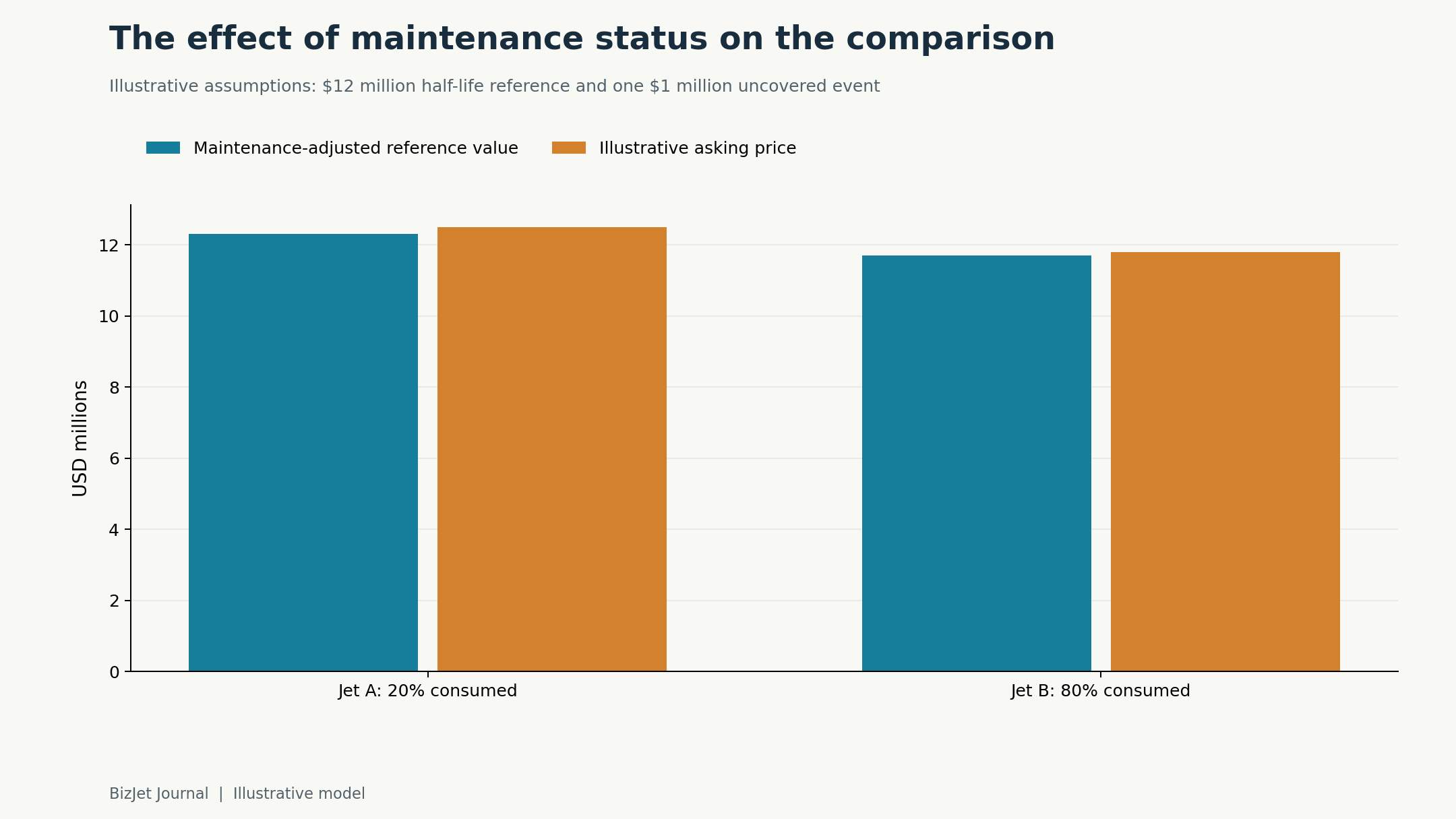
Two jets can sit $700,000 apart on asking price and just $100,000 apart after one inspection adjustment. When that inspection comes due changes the buyer’s cash requirement again.


One jet is listed at $12.5 million and another at $11.8 million. Both have the same hypothetical $1 million inspection on a 5,000-hour interval. The more expensive jet has 4,000 hours left. The cheaper one has 1,000. At $200 of inspection value per hour, that 3,000-hour difference accounts for $600,000 of the $700,000 asking-price gap.
That is what maintenance-adjusted aircraft values can show a buyer. Putting both jets at the same point in the inspection cycle isolates the portion of the asking price that still needs an explanation. Predicting the date of the next shop bill takes a second calculation, using the hours, cycles and calendar time the buyer expects to accumulate.
How maintenance-adjusted aircraft values use a half-life reference
A half-life reference assumes an aircraft’s relevant maintenance events are halfway through their intervals. From that common starting point, an event with more than half its interval left contributes value. One with less than half reduces it. The International Society of Transport Aircraft Trading’s maintenance valuation seminar explains why a scheduled overhaul can be valued this way. A component that stays in service until its condition warrants removal has no comparable fixed interval.
The records have to identify what the next event buys. An estimate for opening and inspecting a component can leave the cost of repairing what the shop finds to the owner. A calendar limit can bring an aircraft into the shop even when it has flown few hours. A cycle limit can arrive sooner for an owner making short trips. Those distinctions change either the cost, the interval remaining or both.
| Worksheet field | What you need to establish | Why it changes the comparison |
|---|---|---|
| Event and required scope | Exact inspection, overhaul or replacement | Similar labels can conceal different work |
| Controlling trigger | Calendar time, hours, cycles or condition | Low flight hours may not postpone the event |