

Market & Finance · analysis
How Maintenance Capacity and Parts Shortages Shape Business Jet Supply
Follow maintenance delays from the hangar to usable fleet supply, with a downtime model and a clear distinction between current support capacity and future projects.


An aircraft can remain on the register while disappearing from the flying schedule. A delayed component, unavailable specialist or inspection finding can remove usable business jet capacity without a single retirement. That matters when you are booking charter, managing a fleet or choosing which aircraft to buy.
Business jet maintenance capacity is therefore more than hangar space. It is the combined ability to inspect, diagnose, source eligible parts, complete repairs and release aircraft. The relevant question is how reliably that chain returns a particular jet to service when its owner or passengers need it.
Separate aircraft inventory from usable capacity
Registered aircraft, active aircraft, aircraft advertised for sale and aircraft available for a specific trip are different populations. A jet can appear in several counts while remaining unavailable next Tuesday. The distinctions in registered versus active business jet fleets are the starting point for interpreting supply.
For an operator, aircraft-days provide a useful first measure. One serviceable aircraft available for one day contributes one aircraft-day. Multiplying fleet size by calendar days gives theoretical capacity; subtracting maintenance downtime produces a more realistic technical-availability measure.
Even that result is not automatically charter capacity. The aircraft may be reserved for an owner's trip, positioned in the wrong region or without an available crew. Its runway requirements or cabin configuration may also make it unsuitable for the requested mission. Measure technical availability first, then apply the operational constraints relevant to the customer.
Keep the time period consistent. An annual average can hide a cluster of heavy inspections in the busiest month. A fleet with an acceptable annual downtime total may still struggle when multiple aircraft need the same scarce component at once.
Follow the maintenance queue
A maintenance visit typically has several connected stages: securing a slot, preparing the work package, inspecting the aircraft, resolving findings, obtaining components, completing work, testing and returning it to service. Delays can arise before the aircraft enters the hangar or after the visible inspection work is largely complete.
The schedule depends on the slowest required task. If an inspection takes ten days but a necessary component cannot arrive until day twenty, finishing the inspection early does not make the aircraft available. Likewise, a delivered component does not solve a shortage of the personnel, tooling or approved capability needed to install and test it.
Consider an illustrative visit planned for 20 days. A finding on day eight requires a part expected on day eighteen, followed by three days for installation and completion. The revised finish is day twenty-one if everything else is ready. If the same part arrives on day thirty, the completion date moves to day thirty-three. The useful procurement question is the credible delivery date for the required part, not whether sourcing activity has begun.
This also explains why shop workload is not measured well by floor area alone. An open bay cannot replace a needed specialist or test capability. Conversely, a component repair bottleneck can be eased outside the main aircraft hangar if the necessary workshop capacity becomes available.
Understand why parts are not interchangeable inventory
A component must be eligible for installation on the specific aircraft and supported by the required condition and documentation. A physically similar item in a warehouse is not automatically a substitute. The FAA's guidance on replacement-part eligibility and traceability explains why quality, identification and installation eligibility must be established together for US type-certificated products.
Possible supply routes have different practical consequences:
| Supply route | What it can change | What still needs checking |
|---|---|---|
| New component | May avoid waiting for repair of the removed unit | Correct configuration, eligibility and delivery date |
| Repair of your component | May preserve the existing unit and its records | Findings, repair scope and achievable turnaround |
| Exchange component | Can provide a serviceable unit before yours is repaired | Core-return terms, condition and applicable charges |
| Temporary loaner | Can bridge a defined period where suitable | Availability, installation requirements and return deadline |
These options do not have identical economics. An exchange quote can depend on returning a qualifying core. A loaner can introduce additional removal and installation work later. A low quoted repair price may be less useful than a faster alternative if the aircraft's downtime is costly.
Ask the maintenance provider to identify the component that controls the release date and the alternatives that are actually available. “Parts ordered” is a status update, but it does not tell you whether all release-critical items have confirmed delivery dates.
Connect downtime to charter and sale decisions
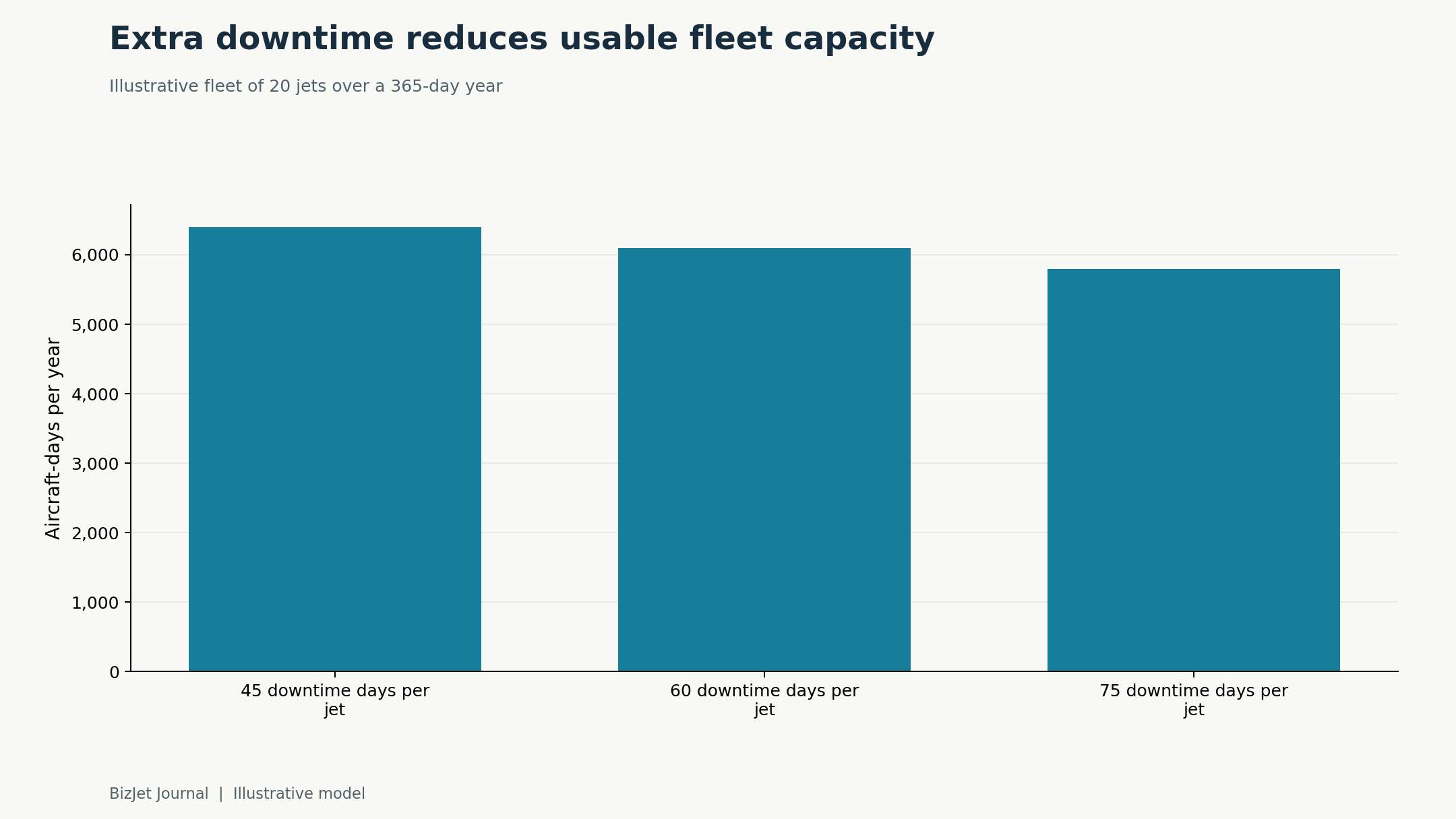
Use illustrative assumptions to quantify the capacity effect. A fleet contains 20 jets, each unavailable for 45 days in a 365-day year. Technical availability is:
20 × (365 − 45) = 6,400 aircraft-days.
An extra 15-day delay for every aircraft removes 300 aircraft-days, leaving 6,100. That is a 4.69% reduction from the baseline. An extra 30 days removes 600 aircraft-days, a 9.38% reduction.
To translate those days into an economic scenario, assume demand would support three paid hours per recovered aircraft-day and each hour would produce $3,000 of contribution after its incremental costs.
| Annual downtime per jet | Available aircraft-days | Days lost versus baseline | Conditional paid hours lost | Conditional contribution forgone |
|---|---|---|---|---|
| 45 days | 6,400 | 0 | 0 | $0 |
| 60 days | 6,100 | 300 | 900 | $2,700,000 |
| 75 days | 5,800 | 600 | 1,800 | $5,400,000 |
The contribution figures require unfilled, economically useful demand. If the aircraft would otherwise sit idle, those amounts are not lost earnings. If another aircraft completes the trips, the effect may instead be replacement cost or lower margin. Do not add the full forgone contribution and the full cost of replacement flying without reconciling the revenue retained and costs avoided.
For a charter customer, the consequence can be less choice, a different departure time or a more expensive substitute. It does not follow that every aircraft category or route must become more expensive: demand, alternative supply and positioning still matter.
For an aircraft buyer, downtime can delay a prebuy, acceptance flight or delivery. A jet with relevant maintenance already completed may offer valuable immediate usability. That benefit belongs alongside its purchase price and remaining maintenance exposure; a completed inspection is not proof that all future findings have disappeared.
Judge whether announced expansion solves the bottleneck
Distinguish an operational investment from a future project. On June 9, 2026, Bombardier announced a planned Singapore expansion, described in its release hosted by project partner JTC. The approximately 250,000-square-foot facility was expected to begin operations in the second half of 2028. Its planned capabilities included maintenance and component repair and overhaul.
As of that announcement, those future capabilities were not extra slots available for an immediate maintenance requirement. Staffing, equipment, approvals and operating readiness determine when a building becomes useful capacity. The same distinction between a future commitment and delivered supply applies to aircraft orders and backlogs.
A different example concerns inventory already expanded. In an October 19, 2026 announcement, Gulfstream reported more than $3 billion invested in dedicated spare-parts inventory and described expansion of distribution and component repair capabilities. That supports the conclusion that the manufacturer was investing in the support network. It does not establish that every needed part is available or that every aircraft's turnaround has improved.
The useful follow-up is specific: does the investment address your aircraft model, the component or inspection causing your delays, and the region where you operate? Inventory close to a customer can reduce transport time, while an added repair capability can reduce dependence on another workshop. Either can matter more than a headline increase in total square footage.
Build availability indicators you can monitor
Track the maintenance process in terms that support decisions. Start with the elapsed time from requesting a slot to the confirmed induction date. Then compare planned and actual downtime, separating added work from delays on the original work package.
For repeated component issues, measure turnaround from removal to a serviceable replacement being available, including transport and documentation. Record the reason for extensions. A recurring shipping delay needs a different response from repeated inspection findings or a repair provider's capacity constraint.
| Indicator | Decision it supports |
|---|---|
| Slot lead time by aircraft type and work scope | When to reserve scheduled maintenance |
| Planned versus actual downtime | How much schedule buffer is justified |
| Release-critical part delivery reliability | Whether an alternative sourcing route is worthwhile |
| Repeat delays by component or provider | Where to investigate a persistent bottleneck |
| Unfilled trips during downtime | Whether recovered capacity has economic value |
| Replacement-flight cost and retained revenue | Actual financial effect after mitigation |
Gulfstream's customer-support description includes parts distribution, component repair and predictive maintenance services. Those are different interventions in the same chain. Your records should show which intervention improves the constraint you face, rather than treating every support service as equivalent.
Use the resulting history to plan inspections and temporary lift together. A realistic return-to-service window is more useful than an optimistic single date when your travel commitments cannot move.
Frequently asked questions
Does fleet growth always improve charter availability?
No. New aircraft increase potential supply, but usable capacity also depends on maintenance, crews, location and the owner's availability commitments. Growth can be partly offset by longer downtime elsewhere in the fleet. Availability for your trip is more specific than the industry's registered aircraft count.
Can a parts program eliminate downtime?
A program can change payment responsibility and access to support, subject to its terms. It cannot make every component immediately available or remove the time needed to diagnose, repair, install and test equipment. Review the actual service commitments and options for substitutes or loaners rather than equating coverage with uninterrupted flying.
Why might a service-center expansion take years to affect supply?
Construction is only part of the project. The facility also needs equipment, qualified personnel and the capabilities and approvals required for its work. A published opening target describes expected future capacity; it should not be counted as an operating maintenance slot before the service is available.