

Market & Finance · analysis
Aircraft Loan-to-value Ratios, Amortization and Balloon Payments Explained
See how an aircraft loan’s advance rate, repayment schedule and maturity interact, with a full payment calculation and refinancing cash-gap scenarios.


A manageable monthly payment can leave a large balance waiting at maturity. Before you finance a jet, connect three numbers: the loan-to-value ratio at purchase, the amortization schedule that reduces principal, and the balloon that must be repaid when the loan ends.
Those numbers answer different questions. Loan-to-value measures debt against the lender's accepted aircraft value. Amortization determines how quickly you repay principal. Maturity determines when the lender can require the remaining balance. Comparing only the interest rate or monthly payment leaves the largest funding decision until later.
Find the value underneath the LTV
Aircraft loan-to-value ratios use a simple calculation:
LTV = loan principal ÷ accepted collateral value.
An $8 million loan against an accepted $10 million aircraft value starts at 80% LTV. If you also pay $10 million for the jet, the purchase-price equity contribution is $2 million. That does not include transaction costs, initial maintenance spending or liquidity the lender requires you to retain.
The denominator matters. Suppose you agree to a $10 million purchase price, but the lender accepts a collateral value of $9.5 million and advances 80% of that amount. The loan is $7.6 million, leaving you to fund $2.4 million of the price. An “80% financing” conversation has produced a 24% cash contribution relative to what you actually pay.
AOPA Finance's discussion of LTV explains why collateral risk influences lending terms. It also illustrates that lenders assess multiple factors. Do not treat a quoted advance rate as an industry entitlement or assume an additional down payment will automatically secure a particular rate.
For each proposal, record the purchase price, accepted aircraft value, advance percentage and dollar loan amount separately. Ask whether a later appraisal, inspection finding or change in aircraft condition can alter the commitment before closing. The financing timeline should fit the diligence and delivery steps in buying your first private jet.
Separate amortization from loan maturity
A 15-year amortization schedule does not necessarily give you 15 years to repay the debt. A loan can calculate monthly payments over 180 months while requiring the unpaid principal after month 60 to be repaid immediately.
AOPA's explanation of aircraft loan terms distinguishes the amortization schedule from the contractual term. When those periods match and the scheduled payments retire the balance, the loan is fully amortizing. When the term ends earlier, the remaining principal becomes the balloon.
An interest-only structure goes further: scheduled interest payments do not reduce principal. Using an illustrative $8 million balance at 7% nominal annual interest, monthly interest would be $46,666.67 before fees. The $8 million principal remains outstanding unless you make additional repayments.
Lower required payments preserve cash during ownership, but they preserve debt too. Consider three hypothetical structures with the same $8 million principal, 7% fixed rate and five-year maturity:
| Amortization assumption | Monthly payment | Principal after payment 60 | Interest paid over 60 months |
|---|---|---|---|
| 10 years | $92,886.78 | $4,690,967.73 | $2,264,174.73 |
| 15 years | $71,906.26 | $6,193,024.16 | $2,507,399.86 |
| 20 years | $62,023.91 | $6,900,530.04 | $2,621,964.93 |
These are calculations, not lender offers. Longer amortization reduces the monthly obligation but increases both the remaining balance and interest paid in this comparison. Whether keeping that cash is worthwhile depends on its use and the risk you can absorb at maturity.
Calculate the payment and remaining principal
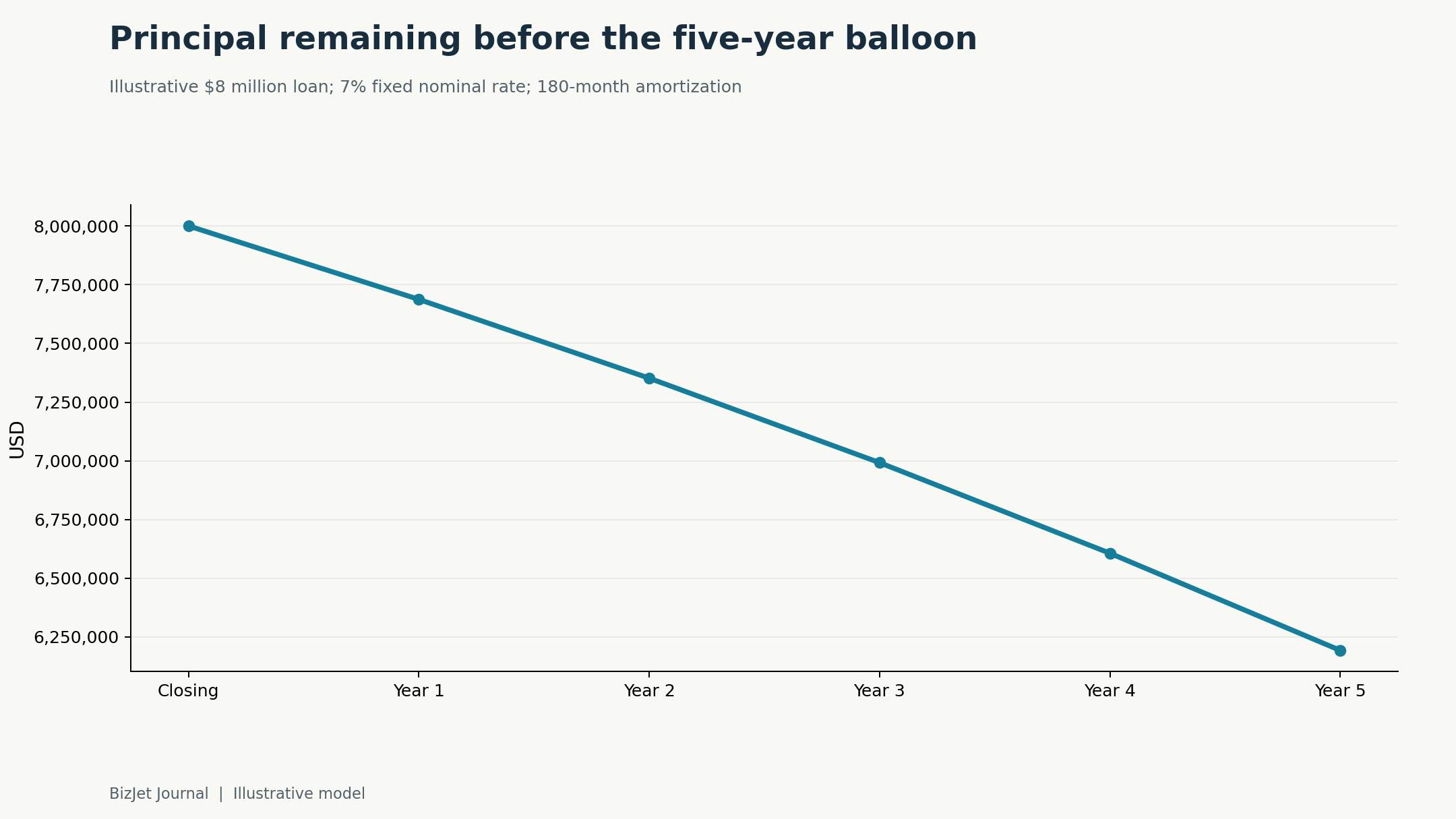
Work through the 15-year case. The illustrative assumptions are a $10 million purchase, $8 million borrowed, 7% fixed nominal annual interest, monthly compounding and payments in arrears. There are no fees, prepayments or rate changes. Maturity occurs immediately after payment 60, while the payment is calculated over 180 months.
The monthly rate is 0.07 ÷ 12. With principal P, monthly rate r and amortization period n, the payment is:
Payment = P × r ÷ [1 − (1 + r)^(−n)].
The resulting payment is $71,906.261668 before rounding. After k monthly payments, the balance is:
Balance = P × (1 + r)^k − payment × [(1 + r)^k − 1] ÷ r.
Applying k = 60 gives the following five-year cash and principal reconciliation:
| Item | Amount | What it represents |
|---|---|---|
| Initial purchase-price equity | $2,000,000.00 | Capital contributed at acquisition |
| Total of 60 scheduled payments | $4,314,375.70 | Principal plus interest paid during the term |
| Principal repaid in those payments | $1,806,975.84 | Reduction of debt |
| Interest included in those payments | $2,507,399.86 | Financing expense before any tax effects |
| Principal remaining at maturity | $6,193,024.16 | Balloon due after payment 60 |
| Total loan payments including balloon | $10,507,399.86 | Original $8 million principal plus interest |
The table uses unrounded calculations and rounds the results to cents; an actual payment schedule can differ slightly because of rounding conventions and day-count rules.
Only $1.807 million of the $4.314 million scheduled payments has reduced principal. Calling the entire payment an expense overstates financing cost, while treating it all as equity creation understates interest cost. Principal repayment increases your equity relative to an unchanged aircraft value; a falling market value can offset that improvement.
The balloon is remaining principal, not the sum of all the future payments on the original amortization schedule. Those hypothetical later payments would include interest that has not yet accrued.
Stress-test the balloon against aircraft value
Refinancing capacity depends on the aircraft's value and the advance rate a lender will accept at that future date. Neither is fixed by today's monthly payment.
Use the $6,193,024.16 balloon and three assumed maturity values. The table shows the additional cash needed if refinancing is approved for the stated percentage of each value. It excludes refinancing fees and any required maintenance spending.
| Assumed aircraft value at maturity | New loan at 80% LTV | Cash needed at 80% | New loan at 70% LTV | Cash needed at 70% |
|---|---|---|---|---|
| $8,000,000 | $6,400,000 | $0 | $5,600,000 | $593,024.16 |
| $7,000,000 | $5,600,000 | $593,024.16 | $4,900,000 | $1,293,024.16 |
| $6,000,000 | $4,800,000 | $1,393,024.16 | $4,200,000 | $1,993,024.16 |
The zero-cash cell means the hypothetical loan capacity exceeds the balloon; it does not mean the lender must advance the excess. At an assumed $7 million value, reducing the permitted LTV from 80% to 70% creates another $700,000 funding requirement without any further decline in the aircraft's value.
Selling the aircraft is a different exit. A $7 million sale would leave approximately $806,976 after repaying this balloon, before selling costs and taxes. A sale at $6 million would fall about $193,024 short of principal even before those costs. A valuation also does not establish when a buyer will close.
Use these scenarios to set a liquidity plan well before maturity. If your preferred answer is “refinance,” identify how much additional cash you could contribute if the new loan is smaller than expected. If your answer is “sell,” allow for inspection findings, transaction timing and a price that may differ from the appraisal.
Read the provisions beyond the headline rate
The payment calculation describes a particular fixed-rate loan. A floating-rate proposal needs a separate review of the index, margin, reset frequency, any floor or cap, and how payment changes are calculated. A five-year contractual term also does not necessarily mean five years of fixed pricing.
PNC Aviation Finance describes fixed, floating and hybrid structures and states that amortization depends on aircraft age, condition and usage. Those are examples from one lender, not universal eligibility rules. An aircraft that suits one financing program may require a different structure elsewhere.
Compare guarantees, reporting obligations, financial covenants, insurance requirements, permitted uses and restrictions on transfers or additional liens. Request a dollar estimate for paying off the loan early on several likely sale dates. A low rate can be less attractive if the exit provisions conflict with your expected ownership period.
Also identify costs outside the interest rate: origination, appraisal, documentation and closing charges, plus any required liquidity or maintenance commitments. A cash reserve that remains yours is restricted capital, not automatically an expense. It still reduces the funds available for other purposes.
Finally, match the financing to the asset you are actually acquiring. The contractual exit and collateral questions in financing a fractional jet share differ from owning an entire aircraft. Neither arrangement becomes affordable simply because its monthly payment fits the budget.
Frequently asked questions
Is the balloon the same as all remaining scheduled payments?
No. It is the unpaid principal due at maturity, with any other amounts required by the contract. The unused portion of a longer amortization schedule includes future interest, which should not be added to the principal balloon as if it were already owed.
Can a lower LTV produce different financing terms?
Yes, because it changes the lender's collateral exposure, but the result is lender-specific. Aircraft condition, borrower finances, loan size and proposed use also matter. Compare actual proposals rather than assuming a specific improvement in rate for each additional dollar down.
What happens if refinancing covers less than the balloon?
You must bridge the difference with other funds, obtain an agreed alternative from the lender, or pursue another repayment route such as a sale. Refinancing is a new credit decision, not an automatic extension of the original loan. Include fees and transaction timing when calculating the cash required.