

Flying Private · guide
Private Jet Sleeping Capacity: Why Eight Seats Do Not Mean Eight Beds
Count simultaneous sleeping places, individual surfaces and actual berth dimensions before booking. A jet’s seated capacity does not tell you how your group will sleep.

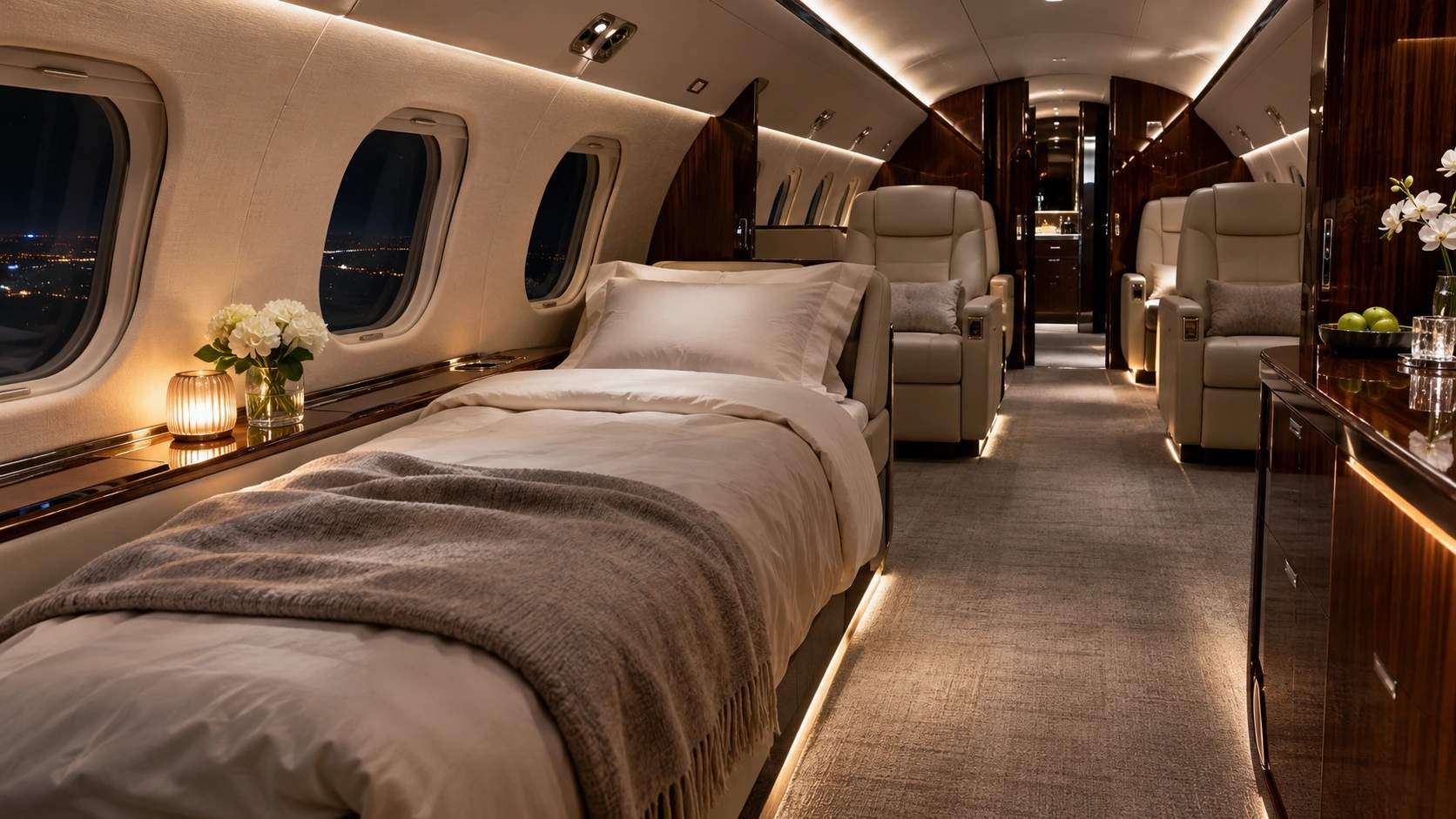
A jet can have room for everyone to sit and still leave someone without a suitable place to sleep. For an overnight flight, ask for the sleeping layout of the actual aircraft you would book, not just its passenger capacity.
Private jet sleeping capacity is a separate specification. It depends on the installed seats and divans, how they convert, the space available around them and whether travelers are willing to share a sleeping surface. “Sleeps six” can mean something different from six individual beds.
Start with the people and their requirements. Then check the configuration, dimensions and usable sleep window. Cabin photographs become helpful once you know which details you are trying to verify.
Count seats and sleeping positions separately
Separate upright passenger seating, reclining seats, converted berths and enclosed bedrooms. A reclining seat may be perfectly adequate for a short rest, but it should not be counted as a flat bed unless the actual arrangement supports that description.
Also distinguish people accommodated from individual sleeping surfaces. A double bed can count as two sleeping places while providing one shared surface. That may work well for two travelers who want to share and poorly for colleagues who each require their own space.
Use plain language in the request: “Six adults need to sleep simultaneously, each on an individual flat surface.” That is more precise than “a six-bed jet,” which leaves room for different interpretations. If two people are happy to share, say so. If reclining seats are acceptable for some passengers, identify how many.
Do not let the seating plan answer the sleep question indirectly. The number of seat belts, the number of dining places and the number of sleeping positions describe different uses of the same interior. The configuration has to meet your requirement in the mode you intend to use.
Read the configuration behind the headline
Manufacturer specifications often describe what a model can accommodate across available layouts. They are useful for identifying candidates, but they do not establish the interior installed on a particular aircraft.
Ask for the assigned aircraft's registration and a current floor plan showing the sleeping arrangement. If the provider cannot identify a particular aircraft yet, ask which sleeping requirement it is committing to preserve when the assignment is made.
Check that photographs match the offered aircraft and current interior. Images of the same model can show different furniture, cabin zones or bed arrangements. A rendering of an optional bedroom is not proof that the offered jet has one.
This is part of comparing business jets fairly: compare the configuration that can perform your mission, rather than assembling the most attractive specification from several different versions of a model.
Ask how the cabin converts
Find out which seats or divans form each sleeping surface, what additional cushions or mattresses are used and how the crew prepares them. The conversion plan should show where each traveler sleeps and which upright seats remain available afterward.
Ask whether everyone can be accommodated at the same time. A list describing several possible bed arrangements may include alternatives that use the same seats. You cannot add those alternatives together as though they coexist.
Consider a clearly hypothetical cabin with eight seated passenger positions. Its sleeping arrangement provides four single surfaces and one double surface. The arithmetic is:
| Sleeping arrangement | Separate surfaces | People accommodated if sharing is accepted |
|---|---|---|
| Four single berths | 4 | 4 |
| One double bed | 1 | 2 |
| Total | 5 | 6 |
Six travelers can fit if two share the double. If all six require individual surfaces, the same cabin falls one surface short. Eight seated passengers also exceed the six-person sleeping arrangement. This is an illustration of counting, not a claimed configuration for a named aircraft.
Confirm where bedding and personal items go when the cabin is converted. The sleeping plan should leave access routes usable and allow the crew to perform its duties. Ask how meals or work will be accommodated if some passengers want to remain awake.
Check whether each sleeping place works for you
Request usable length and width, not just the description “full-size bed” or “lie-flat seat.” Those labels do not tell you whether a particular traveler can rest comfortably. Where the surface narrows, ask for the narrowest useful dimension and a photograph with the bedding in place.
An enclosed bedroom, a curtained area and an open berth offer different privacy. Ask what separates each area and whether other passengers must pass through it to reach a lavatory or another cabin zone. A bedroom door does not answer every question about traffic through the space.
Think about individual needs without assuming they are identical. A tall traveler may prioritize length; another may need easier access to the aisle. Two travelers may prefer adjacent separate berths over a shared bed. Someone who expects to work during the flight may need an upright seat after the others settle down.
If sleep is central to the booking, request a demonstration or detailed video of the actual conversion when feasible. Seeing the prepared surface can resolve ambiguities that remain in a stylized floor plan. Ask the operator to confirm dimensions and usability rather than estimating them from a wide-angle photograph.
Estimate time actually available for sleep
A seven-hour flight is not automatically seven hours in bed. The time available depends on when the cabin can be converted, meal preferences, crew instructions and preparations for arrival. Aircraft comfort matters, but so does the schedule you ask the crew to support.
Take an example of a flight with an assumed 6.5 hours airborne. For a simple planning illustration, allow 45 minutes after departure before settling into the overnight routine, 30 minutes for a meal, 15 minutes for conversion and 45 minutes before landing for arrival preparation. Assuming those periods do not overlap, the remaining sleep window is 4.25 hours.
This is not an operational prediction. Discuss the real sequence with the provider. Choosing to eat before departure could preserve some cabin time, while a later meal or a need to change seating arrangements could reduce it. The point is to plan the whole overnight experience rather than count only the elapsed flight time.
For US Part 135 charter, 14 CFR 135.128 generally requires an approved seat or berth with a separate secured safety belt during surface movement, takeoff and landing, subject to stated exceptions. Ask the operator which positions are approved for each phase and follow crew instructions; a marketed bed is not automatically an approved position for every phase.
For a transatlantic itinerary, the timing issues sit alongside winds and airport choice. Our New York to London private jet guide considers those parts of the overnight journey.
Put the sleeping requirement in your request
Give the broker or operator a short written specification: passenger count, simultaneous sleeping places, sharing preferences, minimum useful dimensions, privacy needs and any requirement for upright seating during the sleep period.
Ask for a response against each item. “Sleeping configuration available” is less helpful than confirmation that the proposed layout meets the actual group requirement. Note whether conversion and bedding are included and whether any requested item needs to be arranged separately.
Make substitution part of that agreement. If the aircraft changes, require a fresh comparison of the sleeping layout and dimensions before accepting it as suitable. A replacement can have more seats or greater range while offering fewer individual sleeping surfaces.
Finally, communicate your preferred service sequence. If most passengers want to sleep soon after departure, tell the provider while the flight is being arranged. A suitable cabin and a suitable plan work together; neither should be left to inference from the words “overnight flight.”
Frequently asked questions
Does a reclining private jet seat count as a bed?
It may provide a useful resting position, but reclining alone does not establish a flat sleeping surface. Ask how far the seat reclines, whether another seat or cushion completes the berth and what the usable dimensions are. Describe your requirement rather than relying on the label.
Can two jets of the same model have different sleeping capacity?
Yes. Installed seating, divans, cabin zones and conversion options can differ. A model's maximum sleeping capacity is therefore not a promise about every example. Obtain the actual floor plan and sleeping arrangement for the aircraft being offered.
How do I confirm sleeping arrangements before chartering?
Request a current sleeping plan, usable dimensions, photographs of the converted cabin and confirmation of the number of people who can sleep simultaneously. State whether sharing is acceptable. Keep the requirement in the booking record and reassess it if the aircraft changes.
Is a jet described as sleeping six suitable for six colleagues?
Only if its arrangement meets their preferences. The stated count may include two people sharing a double bed. If everyone needs an individual surface, ask for six separate suitable positions rather than accepting a six-person capacity figure without the layout.