

The Americas and the Caribbean · guide
New York to London by Private Jet: Overnight Comfort, Winds and Arrival-Airport Choice
Plan a New York–London private jet flight with practical advice on sleeping layouts, winds, aircraft range, arrival airports and door-to-door timing.

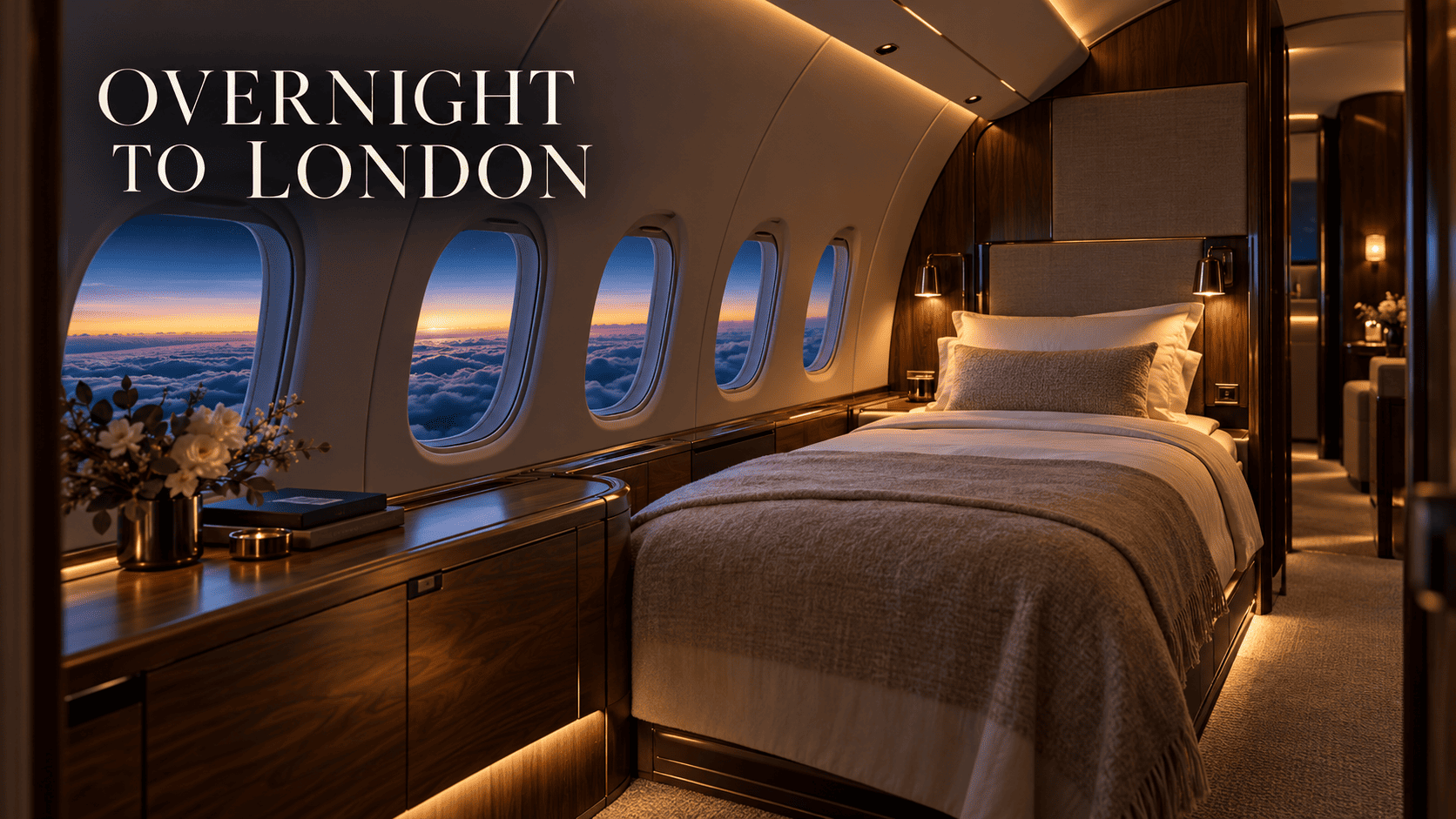
A New York to London private jet journey should be planned around the morning after the flight. Useful sleep, a workable arrival airport and a realistic ground transfer matter more than an attractive headline flight time. The aircraft needs to perform the actual mission, while the cabin needs to accommodate the people who expect to sleep in it.
These are separate checks. A jet can have sufficient range but too few suitable sleeping positions for the group. An early landing can look efficient until the chosen airport’s opening window or a long drive makes it inconvenient. The best itinerary brings the aircraft, cabin layout and arrival plan together.
Define what a successful overnight trip means
Start with the London destination, preferred arrival time and what happens next. Someone heading to a hotel for breakfast has different priorities from a team expected to present at a meeting soon after landing. A passenger who wants a full dinner and several hours of conversation is making a different use of the cabin from someone who wants the beds prepared immediately.
Tell the provider how many people genuinely need to lie down. Include baggage, privacy needs, meal preferences and whether anyone requires help boarding. Ask whether the proposed aircraft has a cabin attendant and what service arrangement is included. Do not assume every aircraft marketed for transatlantic travel offers the same staffing or cabin experience.
The return is part of the requirement too. A jet suitable for the eastbound flight may face a different fuel and payload calculation westbound. Discuss both directions before selecting an aircraft or accepting a broad claim that the route is “well within range”.
Choose the New York departure airport around the starting point
Teterboro, TEB/KTEB, can be a practical starting point for many Manhattan and New Jersey departures. Westchester County, HPN/KHPN, may fit passengers north of the city. Other airports can be useful for specific origins, aircraft or connections.
Aircraft access needs checking, particularly with larger long-range types. The Port Authority’s Teterboro aircraft-approval form sets out arrangements for aircraft capable of higher weights and the airport’s 100,000-pound limit. That makes aircraft model, actual operating weight and required approval relevant to the departure plan.
The provider should confirm a suitable airport and FBO for the actual aircraft rather than choosing the location solely from passenger preference. The flight brief should then give the exact facility address and reporting time. Private passengers do not simply arrive at an airport perimeter and expect the aircraft to be immediately accessible.
Which London airport fits your arrival?
There is no single London private-aviation airport that wins every comparison. Assess the final address, arrival window, aircraft, handling arrangements and road journey. An airport outside the city may provide an efficient passenger experience while still requiring a substantial drive to the destination.
| Airport | What makes it worth considering | Questions before choosing it |
|---|---|---|
| Farnborough, FAB/EGLF | Dedicated business-aviation environment southwest of London | Does the arrival fit the operating window and destination address? |
| London Biggin Hill, BQH/EGKB | Business-aviation access southeast of London | Are the aircraft, opening window and ground route suitable? |
| London Luton, LTN/EGGW | An option north of London with business-aviation services | What are the current movement, handling and noise arrangements? |
| London Stansted, STN/EGSS | A further option northeast of London for suitable itineraries | Does the transfer and confirmed operating plan fit the passenger schedule? |
Farnborough publishes its opening times as 07:00–22:00 Monday to Friday and 08:00–20:00 at weekends and bank holidays, with Christmas Day and Boxing Day closed. Those published times illustrate why an intended arrival before dawn cannot be assumed to work at every airport.
Biggin Hill publishes separate operational information. Its statement that runway slots are not required should not be expanded into a promise of unrestricted access at any time. The operator must still arrange the movement within the applicable conditions.
For Luton or Stansted, ask the provider to confirm the specific schedule and service arrangements rather than treating a general “24-hour airport” description as approval for the proposed flight. Airport opening, noise restrictions, parking, handling and border processing are related but distinct matters.
Range needs to be assessed with winds, load and reserves
Published range is a useful comparison, but it is calculated under stated assumptions. Passenger count, baggage, cruise profile, routing, wind, destination conditions, alternates and reserves all affect the mission. A marketing range circle does not include every real-world constraint.
For example, Gulfstream publishes the assumptions attached to its theoretical range figures, including specified passenger and crew loads and reserve conventions. That is the right way to read a specification: as a defined performance statement rather than an unconditional promise.
Super-midsize aircraft may enter the discussion for some transatlantic missions, while large-cabin and long-range jets provide other combinations of range margin, payload and cabin space. The provider should explain the proposed aircraft’s suitability for both directions and whether a fuel stop is a realistic possibility under some conditions.
If nonstop travel is a critical requirement, make that explicit and ask how the plan addresses an unfavorable westbound day. If a fuel stop is acceptable, understand how it would affect arrival time, formalities and price. Carrying less fuel to satisfy one limitation can change the wider itinerary; the operator needs to assess the complete result.
Seats and sleeping positions are different numbers
A charter listing’s passenger capacity describes seating, not necessarily comfortable overnight accommodation. Seats can face one another, divans may convert, tables may need to be removed or lowered, and some berths occupy space that has another use during the day.
Ask for the actual layout of the offered aircraft, with its sleeping arrangement clearly marked. Model-level figures are insufficient when your booking depends on how many people can rest. Gulfstream’s G500 page, for example, distinguishes maximum seating from sleeping capacity; the configuration of a particular aircraft still needs confirmation.
Useful questions are concrete. Which passengers share a converted area? Can someone reach the lavatory without disturbing a berth? Is a bed long enough for its intended occupant? Are bedding and mattress pads included? When can the cabin be converted, and does the planned service leave enough time to use it?
Also distinguish cruise comfort from the seating and restraint arrangements required during take-off, landing or other relevant phases. A sleeping layout is not permission to ignore crew instructions. Children and passengers with specific needs should have suitable arrangements agreed before the flight.
Understand the difference between flight time and sleep time
The full block time is not the period available for uninterrupted sleep. Taxiing, climb, meal service, cabin preparation and the approach take time. Even a comfortable aircraft cannot turn every minute between departure and arrival into rest.
A practical plan might involve eating before boarding, reducing service after take-off and having bedding ready early in cruise. Another group may prefer to enjoy the flight and accept less sleep. Neither approach should be imposed by a generic luxury-service script; tell the provider what the cabin needs to accomplish.
Check the onboard environment and connectivity if work remains part of the journey. Internet equipment and service plans differ even within one aircraft model. Our LEO, GEO and air-to-ground comparison explains why a Wi-Fi listing does not establish dependable video calls across the Atlantic. The cabin management systems guide covers the separate controls for lighting, entertainment and supported comfort functions.
Winds and clock changes alter the timetable
The upper-level winds frequently favour eastbound Atlantic travel more than westbound travel, but the strength and position of those winds vary. The actual route, speed profile and traffic arrangements also affect duration. Request a flight-specific estimate rather than assuming the return takes the same time as the outward leg.
Local clock arithmetic creates another source of confusion. London and New York do not change their clocks on the same dates. The UK government lists 25 October as the end of British Summer Time in 2026, while the US Naval Observatory’s 2026 daylight-saving calendar puts the US autumn change on 1 November.
Consider two flights using an assumed seven-hour elapsed journey. A departure at 20:00 in New York on 20 October 2026 would correspond to 08:00 in London the next day.
The same assumed elapsed journey after a 20:00 New York departure on 27 October would correspond to 07:00 London time the next day. The temporary four-hour clock difference changes the displayed arrival.
The final itinerary should state the date as well as the local time at each end. A midnight crossing, daylight-saving transition or rescheduled departure can otherwise create misunderstandings between the passenger, hotel, driver and meeting organizer.
Border requirements still apply
Private travel does not remove immigration requirements. Each passenger needs the documents and permissions applicable to their nationality and circumstances. The UK’s Home Office ETA guidance explains the authorization framework for relevant visitors; a private jet booking does not create an exemption.
On the US side, Customs and Border Protection’s general-aviation processing guidance addresses advance passenger and crew information. Operators handle the required transmissions, but passengers need to supply accurate details promptly. The return journey also requires the appropriate US entry permissions and an agreed airport processing arrangement.
Provide sensitive information through the provider’s appropriate process and advise it of changes. A passenger substitution late in the planning can affect more than a catering count. Border data, permissions and the aircraft’s load may all need updating.
Compare the complete transatlantic proposal
The quoted cost reflects aircraft deployment as well as the occupied journey. Where the aircraft starts, where it goes afterwards, the time between flights, crew arrangements and airport services all influence the commercial plan. A return several days later is not automatically priced like an aircraft waiting beside the terminal throughout the visit.
Compare the actual aircraft or substitution terms, sleeping layout, cabin service, connectivity, airports and recovery commitments alongside the total price. Clarify whether a potential fuel stop or airport change would create additional charges. Ask how the company communicates a technical problem shortly before departure and what replacement obligations the contract provides.
Before leaving, check both FBO addresses, local dates and times, operator details, reporting instructions, driver contacts and the arrival destination. Our charter booking guide covers the wider confirmation process.
Frequently asked questions
Is New York to London always nonstop?
No. Suitability depends on the actual aircraft, load, routing, winds and operating conditions. Confirm the plan in each direction, particularly if avoiding a fuel stop is essential.
Why does the return usually take longer?
Prevailing upper-level winds often make westbound travel less favorable than eastbound travel. The actual difference depends on the day’s winds, route and operating plan, so use the provider’s specific estimate.
Do eight seats mean eight beds?
No. Passenger seats and sleeping positions measure different things. Request the actual cabin layout and berth arrangement for the offered aircraft, rather than relying on its maximum seating figure.
Can I arrive at any London airport before dawn?
No. Operating windows and other access conditions vary. The operator must confirm a suitable airport and processing arrangement for the intended time; a general airport description does not establish unrestricted access.