Flying Private · guide
Private Jet Baggage Capacity: Why a Cubic-Foot Figure Can Mislead
A published baggage volume leaves out the door opening, the shape of the hold and the weight available for a particular flight. A six-passenger example shows how the limits interact.

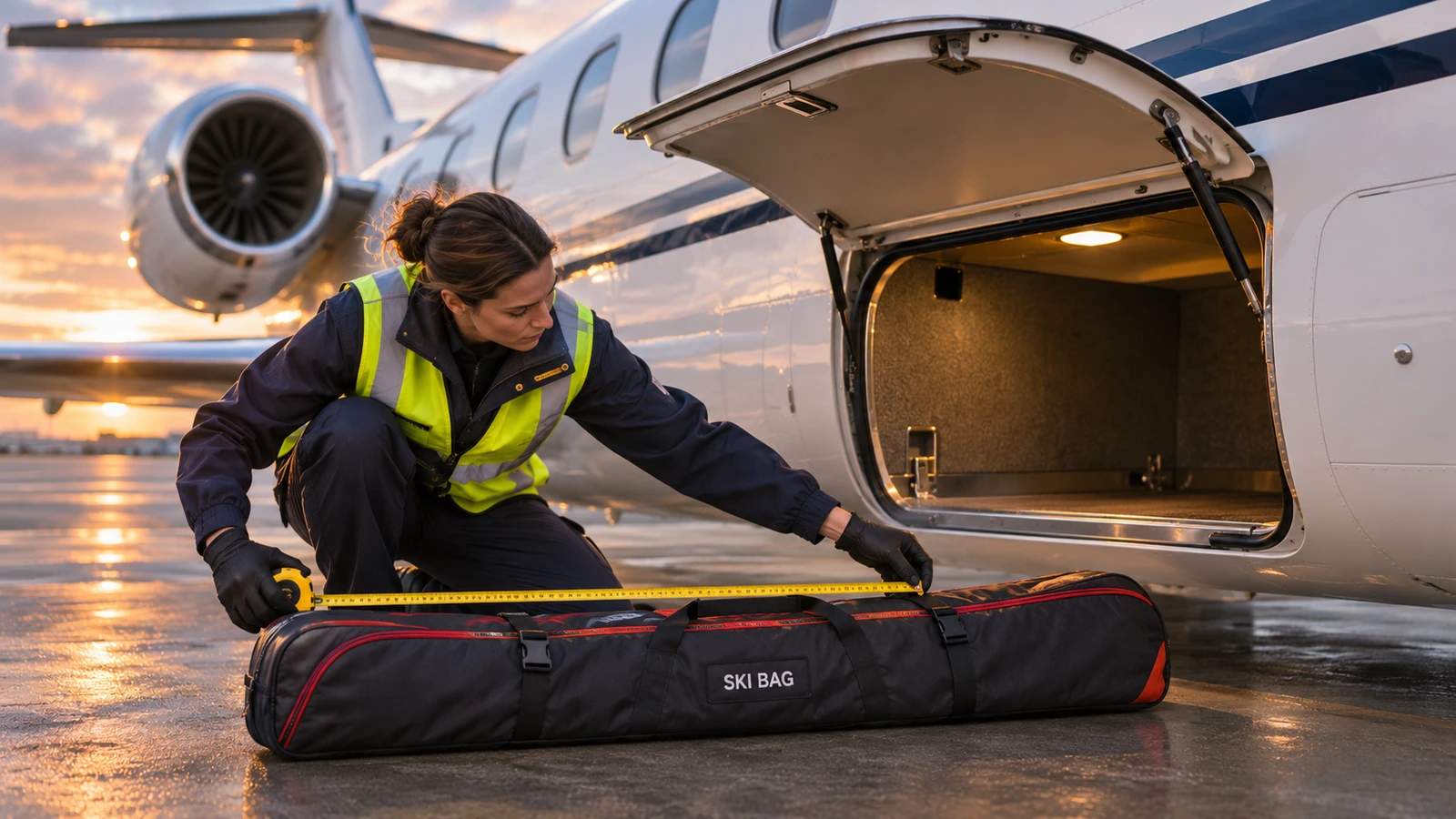
A 68-inch ski case takes up less than 6 cubic feet if it measures 14 inches wide and 10 inches deep. On paper, a jet with 55 cubic feet of baggage space should swallow it easily. At the airport, the case can stop halfway through the door. There might be plenty of room once it is inside and too little space to turn it past the frame.
Private jet baggage capacity involves three different questions. Can each item get into a suitable compartment? Can the aircraft carry the people and all their belongings over the planned route? Can the crew distribute and secure that load within the limits for the aircraft? A published volume answers only part of the first question.
What a private jet baggage capacity figure leaves out
A cubic foot measures volume in any shape. A 55-cubic-foot space that tapers near the end can accommodate several soft bags where a long rectangular case would need clear corners. The same published total could combine separate compartments. If the aircraft offers 40 cubic feet in one place and 15 somewhere else, a single item has to fit into one of those spaces. It cannot borrow the last few inches from the other one.
Even the comparison between the bag’s exterior and the compartment’s interior leaves out the loading path. Consider the ski case again. The operator needs its packed length, width and depth, including wheels, handles and corners. The crew then needs a clear opening and room to angle the case as it goes through. A photo of the packed case alongside its dimensions does more for that decision than a picture of the skis standing in a garage.
A soft bag has an advantage around curved walls if its contents can also give. A pair of boots or a helmet inside a soft duffel still creates a rigid section. A stroller may fold short enough to travel but remain too wide across its rear wheels. For a group flying with golf clubs, the dimensions of the travel covers matter more than the number of players. Six people who each bring clubs, a hard suitcase and a personal bag are proposing three different loads per person.
Six passengers and a 40-pound shortfall
Consider a hypothetical nonstop trip for six passengers. The operator’s preliminary plan leaves 1,250 pounds for those passengers and their possessions after accounting for the crew, the aircraft as equipped, planned fuel and other onboard items. That figure is an assumption for this particular flight. It is distinct from the maximum payload published for a model.
| What travels | Assumption | Combined weight |
|---|---|---|
| Six passengers | 170 pounds each | 1,020 pounds |
| Six packed suitcases | 35 pounds each | 210 pounds |
| Six personal bags | 10 pounds each | 60 pounds |
| Total proposed load | People and possessions | 1,290 pounds |
The plan is 40 pounds over before anyone adds golf clubs. Put the six personal bags in a cabin closet and the 40-pound shortfall stays exactly the same. Ship 45 pounds ahead and the proposed load falls to 1,245 pounds, leaving five pounds against this particular limit. The operator still needs to confirm the distribution and flight plan. An unnoticed seventh bag could consume the entire margin.
A separate problem can arise on a shorter flight where the aircraft has ample payload available. Imagine a single baggage compartment limited to 200 pounds. The six checked bags weigh 210 pounds. If the operator can place one 35-pound bag in another suitable location, the first compartment falls to 175 pounds. That move can solve the compartment problem. It would do nothing for the aircraft-wide shortfall on the longer flight.
These distinctions explain why the same people and bags can travel in one direction and prompt a discussion on the return. A different departure runway, weather or fuel requirement can change what the aircraft can carry. So can two extra passengers joining for the return. The FAA’s Weight and Balance Handbook explains why the distribution matters as well. Each item contributes weight at a particular distance from the aircraft’s reference point, and the resulting center of gravity must stay within the applicable range.
When a cabin seat or a fuel stop would help
Passengers sometimes offer to hold a small case or reserve the empty seat beside them. The operator has to establish where the object can travel during takeoff, landing and turbulence. For U.S. Part 135 charter, the rule for cargo and carry-on baggage allows approved stowage or securement and spells out conditions for other carriage arrangements, including restraint, structural limits and access to exits. A vacant seat on the layout establishes space for a passenger. The operator still needs a suitable arrangement for the particular case.
Choosing an aircraft with a different loading arrangement makes sense when the door or compartment geometry is the constraint. Buying more range cannot make a rigid case turn a corner. If the shortage is allowable weight on the original nonstop route, however, the crew may be able to plan shorter legs with less fuel at takeoff. A fuel stop costs time and may change the quote. It also leaves each individual compartment’s limits intact. A stop only helps when the revised flight plan resolves the constraint that actually prevented the trip.
One family might prefer to rent skis at the destination and carry its fitted boots. A production crew taking a custom camera rig to a morning shoot may have no equivalent rental and needs the rig on the same flight. In that case a more suitable baggage door or hold can be worth more than extra cabin seats. For equipment needed in transit, the location matters again. An externally loaded compartment may meet every size and weight requirement yet leave medication, paperwork or other essentials out of reach until landing.
What carries over when the aircraft changes?
A useful booking record ties the baggage agreement to identifiable pieces. “Six passengers with luggage” leaves the operator to infer a lot. “Six suitcases at 35 pounds each, six 10-pound personal bags and one rigid case measuring 68 by 14 by 10 inches at its widest points” gives it a load it can evaluate. The ski case in that description is an additional item. Its packed weight also belongs in the total.
If the aircraft changes, the operator can put that same description against the substitute’s door, compartments, securement arrangements and flight load. A replacement with the same number of seats can have quite different usable storage. Confirming that the necessary equipment travels on the substitute is often the most important part of accepting the change.
Frequently asked questions
How many suitcases fit on a private jet?
A count becomes meaningful when it describes a particular size and aircraft. Four 26-inch rigid cases can pack differently from four duffels with the same combined weight. A useful estimate starts with the outside dimensions and packed weights of the actual bags and identifies any long or unusually shaped item separately.
Can skis or golf clubs travel on a light jet?
They can on some aircraft and itineraries. A rigid ski case needs a workable loading path and enough usable length in one location. Golf groups also need room for the other luggage traveling with the clubs. The operator can assess the complete load against the assigned aircraft.
Can I reach my luggage during the flight?
That depends on the compartment, its access and the operator’s procedures. A compartment reached only through an exterior door is unavailable until the airplane is on the ground. Essentials needed en route belong in a bag the operator can stow appropriately in the cabin.
Does paying for a larger aircraft always solve a baggage problem?
A larger aircraft may increase usable space or payload, but the specific limiting measurement still matters. If a rigid case caused the problem, confirmation that it fits through the replacement’s opening and can be secured inside is more informative than a larger cubic-foot rating.