Flying Private · guide
Connecting a Private Jet With an Airline Flight: Where the Time Goes
A private jet can land on time and still deliver its passengers too late for an airline bag drop. A worked connection shows which deadline matters first.

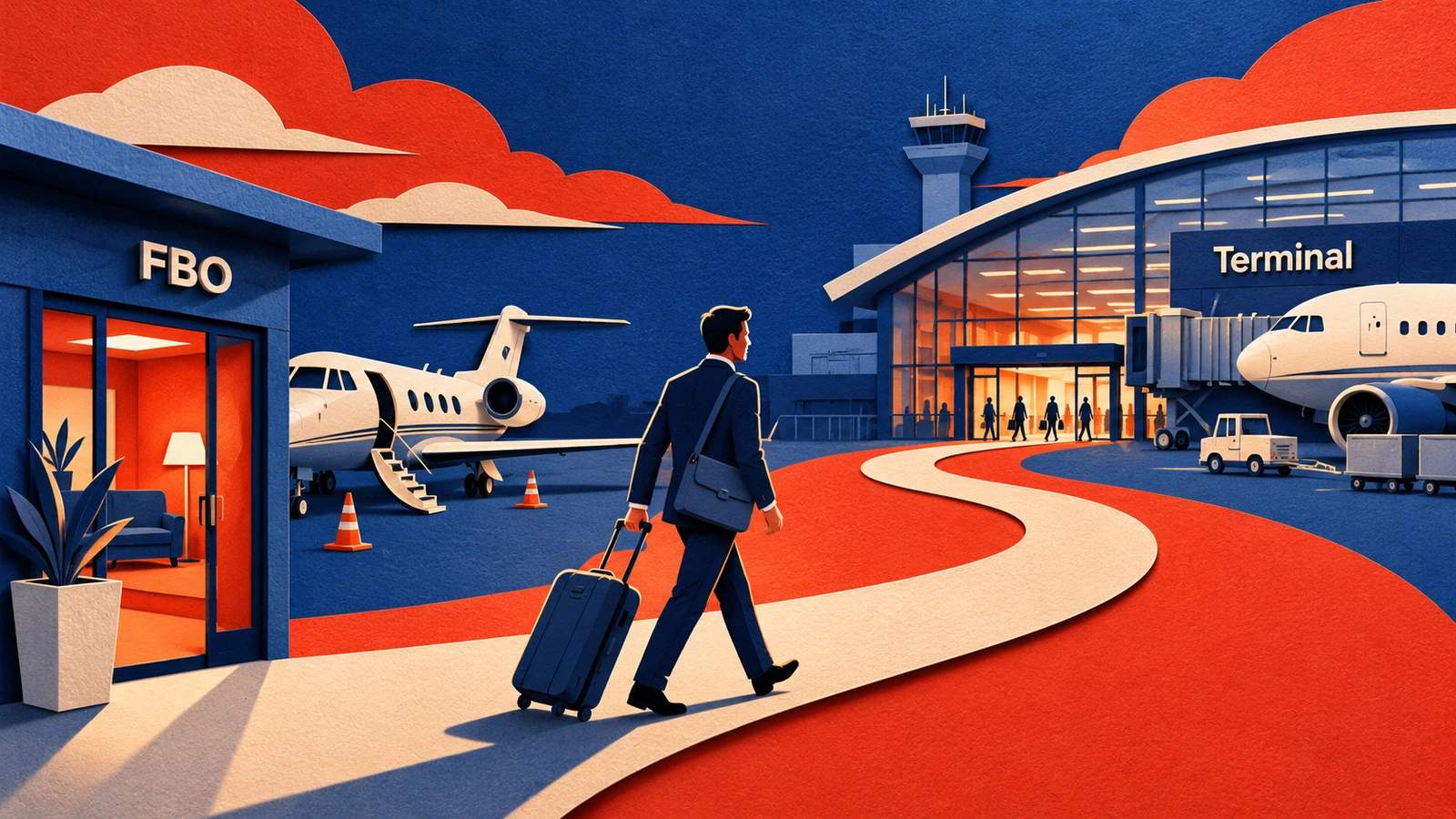
A private jet touches down at 3 p.m. The airline flight leaves at 5 p.m. That sounds like a two-hour connection until the bags have to reach an airline desk by 4 p.m. and the jet is still taxiing at 3:10. Half the apparent connection has already disappeared from the plan before anybody measures the drive between terminals.
The difficult part of connecting a private jet with an airline flight is deciding which clock to work backward from. A passenger with checked luggage has to satisfy two deadlines. A passenger traveling with a carry-on may have a different critical path. In either case, the airline runs on its own schedule.
Connecting a private jet with an airline flight starts at the bag desk
An estimated landing time marks the moment the wheels should touch down. An estimated arrival at the FBO may instead mean the time the aircraft reaches its parking stand. Before building a transfer around a quoted time, it is worth knowing which one the operator supplied. Adding taxi time twice makes a workable connection look tight. Omitting it has the opposite effect.
At the stand, the crew shuts down and the passengers and bags come off. A car at the FBO’s public entrance still needs its passengers to get out of the building. Airside pickup, where permitted and specifically arranged, can remove part of that walk. It does not turn the vehicle into an airline shuttle or put its occupants inside the airline’s secure departure area. For an ordinary landside transfer, allow for a drive to the correct public entrance, bag acceptance and passenger screening.
The airline’s deadlines belong in the schedule as separate entries. The U.S. Department of Transportation’s explanation of airline check-in deadlines distinguishes presenting yourself at a counter from reaching the boarding area. A boarding pass on your phone solves neither the bag-acceptance cutoff nor a long walk from security to a departing gate.
How much of a two-hour connection is actually available?
Take an example of a domestic private flight connecting to an airline at the same U.S. airport. All times are local. The airline is scheduled out at 5 p.m. Assume its checked-bag cutoff is 4 p.m. and the passenger must be at the gate by 4:40. Those are illustrative booking conditions. A particular airport, airline or destination can have different ones.
| Step | Working allowance | Expected time |
|---|---|---|
| Private jet touches down | Starting point | 3:00 p.m. |
| Taxi and park at FBO | 12 minutes | 3:12 p.m. |
| Unload and reach waiting car | 10 minutes | 3:22 p.m. |
| Drive to airline terminal | 18 minutes | 3:40 p.m. |
| Reach counter and complete bag acceptance | 10 minutes | 3:50 p.m. |
| Security and walk to gate | 30 minutes | 4:20 p.m. |
The plan puts the passenger at the gate 20 minutes before the required time. The bag has only 10 minutes of margin. Delay the private flight by 15 minutes throughout and the passenger projects to reach the gate at 4:35. The bag would reach acceptance at 4:05. The gate calculation still works, but the passenger cannot rely on taking the suitcase on that flight.
A traveler carrying only a permitted cabin bag can omit the checked-bag step if already checked in and cleared to go directly to screening. Someone who needs an in-person document check may still have to stop at the counter. For a group, the relevant case is often the traveler with a large case, a child or a mobility-assistance arrangement. Splitting the group can change the itinerary, but it ought to be an agreed choice.
The same airport can mean opposite sides of the field
An FBO address and an airline terminal address may share a three-letter airport code while sitting on different public roads. A runway crossing that looks trivial on a diagram might require a drive around the airport perimeter. A driver who is told only to meet “the private jet” can arrive at a different FBO altogether. An exact pickup address and the airline’s actual departure terminal give the transfer company a journey it can price and time.
A nearby business airport sometimes makes the private sector easier to operate. It also creates a road connection between two airports. Suppose the alternative saves 15 minutes of private flight and taxi time but changes the ground drive in the example from 18 to 55 minutes. The longer drive adds 37 minutes, and the earlier arrival recovers 15. The bag reaches the desk 22 minutes later, at 4:12. For that itinerary, the earlier landing is the later connection.
Traffic conditions can reverse a comparison on another day. The useful estimate is the transfer time for the planned weekday and hour, including the terminal curb and access to the desk. A passenger who must be on a once-daily onward flight may value an earlier private departure more highly than the ground-time saving available between airports.
An international arrival adds a handoff before the car
On an international arrival into the United States, the operator has to coordinate the appropriate customs arrangements for the private flight. The passenger’s bag and the waiting driver cannot set the pace of the inspection. For example, CBP’s Nashville general aviation airport instructions specify where and how the crew and passengers wait for processing. Other ports issue instructions for their own facilities.
That makes a domestic connection estimate a poor substitute for an international one. The operator can identify the accepted arrival location and arrangements. The passenger can establish who moves the luggage after clearance and whether the onward airline needs a counter visit. A group arriving with goods requiring extra processing has another reason to move the private flight earlier. An airline departure from the same airport does not itself establish a through-baggage arrangement.
What happens when the private flight runs late?
The charter contract provides the inbound flight. The passenger’s airline ticket governs the scheduled sector. Unless a specific agreement connects the bookings, the passenger has no basis to count on the airline holding the aircraft or the charter provider purchasing replacement tickets. The cost of a missed connection can include a fare change, loss of a specially priced seat and disruption to later sectors on the same airline reservation.
The earliest useful decision may come while the jet is still at its departure airport. If the predicted bag acceptance has already slipped past the cutoff, the traveler can investigate moving the airline booking while seats are available. If only one person has a bag to check, a second decision is whether the group will travel together. Knowing who can approve a new fare and who has the airline booking reference gives the coordinator a way to act on a delay.
For an important long-haul departure, moving the inbound jet an hour earlier buys that hour across both deadlines. Choosing an alternative terminal that saves ten minutes buys ten. An overnight stop changes the economics again: hotel rooms and a longer journey in exchange for less dependence on the inbound flight that day.
Frequently asked questions
Can the FBO transfer my bags directly to the airline?
That requires a specific arrangement accepted by the airport and airline. For a normal landside transfer, allow for collecting the bags at the FBO and presenting them at the airline’s baggage desk before its cutoff.
How much time should I allow after landing?
Start with the earlier applicable deadline and add realistic time for taxi, unloading, ground transfer, counter processing and any border inspection. Compare that result with the separate gate deadline and allow for disruption on the private flight.
Is an airline connection protected if the private jet arrives late?
Protection depends on what the parties agreed and on the airline ticket’s conditions. Independently booked sectors ordinarily leave the traveler to arrange the onward alternative. The ticket terms can also affect later flights if the passenger misses the first one.