Fractional Ownership · guide
Buying vs Leasing a Fractional Jet Share: Who Carries the Resale Risk?
Buying a fractional share puts money into an aircraft. Leasing spreads that commitment across the term. A five-year example shows how the resale price can change the cheaper choice.

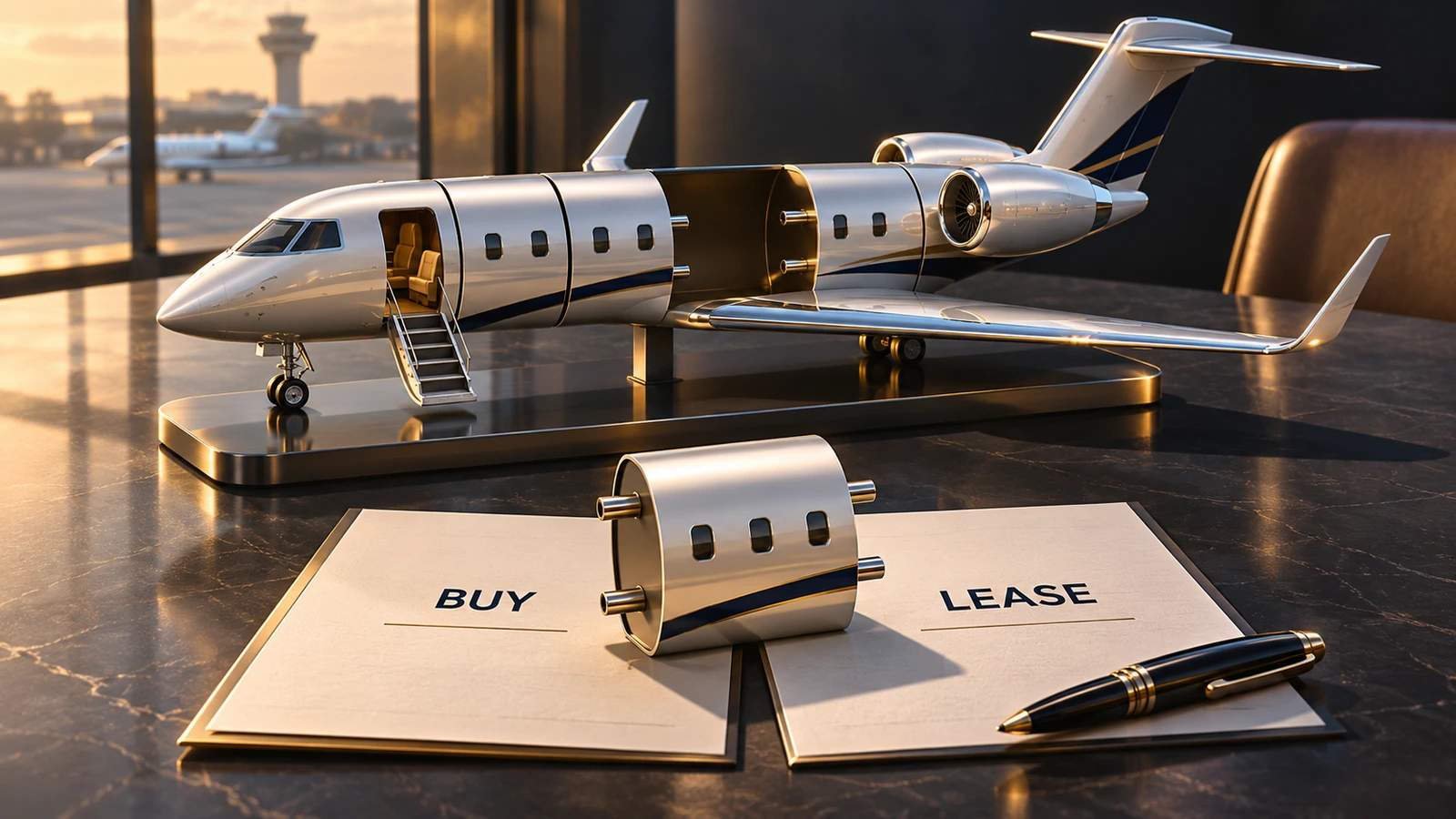
The board can put $900,000 into a fractional jet share today or pay $6,000 a month to lease a comparable interest. The purchase buys something the company can later sell. The lease preserves most of the cash at entry. Which offer costs less five years from now? In this illustrative case, the answer changes at a gross resale price of about $568,400.
That number is specific to the offers, but the question travels well. A buyer commits capital in exchange for an interest in an aircraft. A lessee pays for use of an interest over an agreed term. Both can receive similar access to the program’s fleet. The economic difference can sit almost entirely in who receives the exit proceeds, who covers a shortfall and when the money changes hands.
What a purchased or leased fractional jet share gives the traveler
Under the U.S. fractional program rules, a qualifying fractional interest can include an ownership interest, a multiyear leasehold or a multiyear leasehold that converts to ownership. A few months of charter reservations billed on a subscription would need its own analysis. The legal structure, exchange arrangements and program agreements are part of what makes the fractional product possible.
The aircraft attached to a buyer’s share and the aircraft that arrives for a trip can be different. The fractional program structure permits owners to use aircraft in the program through exchange arrangements. A passenger might find the cabin and booking experience on the purchase and lease offers indistinguishable. The finance department still needs to identify the asset underlying the share and the agreement that determines its exit value.
For a fair comparison, the offers should grant the same cabin access, annual hours, notice periods and rights during busy travel periods. A modest saving on a lease can disappear if the lease entitles the company to fewer of the trips it needs. Check the documents for each offer separately, especially where the purchase price or lease payment appears on one page and operating charges appear in another agreement.
Five years of lease payments against three resale prices
Assume each offer gives the company the same one-sixteenth interest size for travel purposes, with identical management and occupied-hour charges. The buyer pays $900,000 in cash and pays a remarketing fee of 5% of the gross resale price. The lessee pays $6,000 a month for 60 months plus a $30,000 security deposit returned in full at the end. The lease has no residual guarantee, end-of-term purchase obligation or additional return charge. These are hypothetical terms, with financing, taxes and the time value of money excluded.
| Five-year outcome | Gross sale price | Cash returned to buyer after fee | Buyer’s net capital cost | Lessee’s total rent |
|---|---|---|---|---|
| Weak resale | $450,000 | $427,500 | $472,500 | $360,000 |
| Middle resale | $600,000 | $570,000 | $330,000 | $360,000 |
| Strong resale | $750,000 | $712,500 | $187,500 | $360,000 |
At the middle resale price, the purchased share costs $30,000 less in nominal capital outlay over the term. At the weak price, the buyer spends $112,500 more. The lease’s $30,000 deposit leaves the treasury at entry and returns at exit, making it a cash requirement even though it contributes zero to net cost under the stated assumptions. The table covers the capital side of acquiring access. The company still owes the common management and flight charges on either offer.
Break-even comes when the buyer gets $540,000 back after fees. That figure is the $900,000 entry price less $360,000 in avoided rent. Dividing $540,000 by 0.95 gives a gross resale price of approximately $568,421. The calculation says nothing about how much the aircraft will actually be worth. It tells the board what its resale estimate must deliver for the purchase to match the rent.
Why the valuation language can outweigh the advertised buyback
A promise to repurchase at fair market value gives the buyer an exit mechanism. It can still leave the buyer exposed to a decline in the value of the aircraft. The critical terms identify the valuation date, who performs the valuation, the aircraft or pool being valued, the percentage applied to that value and the deductions made before payment. A guaranteed buyer and a guaranteed dollar amount are distinct promises.
A fee expressed as 5% of gross proceeds takes $30,000 from a $600,000 sale. Five percent of the original $900,000 purchase price would take $45,000. That wording alone would reduce net proceeds by another $15,000 in the middle case. If maintenance status, an outstanding balance or a contractual floor also enters the calculation, each adjustment needs its own place between the gross valuation and the money the owner receives.
On a lease, the corresponding page is the end-of-term settlement. An unconditional return at the agreed date leaves resale exposure with the party retaining the asset. A lease requiring the company to make up a shortfall against a stated residual value returns some of that risk to the lessee. A purchase option gives the lessee a choice whose value depends on the option price and the market. The title on the proposal settles none of these details.
The investment case changes when the company needs to leave early
The company may stop needing the same cabin after an acquisition, a change in headquarters or a reduction in travel. A five-year purchase comparison assumes it can wait for the modeled sale. A shareholder seeking an early exit may face a minimum holding period, accrued management fees until transfer or a different fee schedule. On the lease side, remaining rent, an agreed termination charge or an approved transfer can affect the exit bill. Model the date the company can stop paying alongside the date it stops flying.
Timing also matters in a full-term comparison. The buyer parts with $900,000 immediately and receives most of its recovery only at exit. The lessee keeps access to more cash while paying rent monthly. A company with a stated cost of capital can discount both sets of cash flows on the same basis. A financed share purchase adds interest and an outstanding loan payoff to the illustration. For the board in the middle case, the $30,000 nominal advantage is the amount available to absorb those differences before leasing becomes the cheaper choice.
Frequently asked questions
Does leasing a fractional jet share remove all resale risk?
A lease can leave the value of the aircraft entirely with the lessor when the interest is returned. Residual guarantees, mandatory purchase terms and settlement formulas can move some of that exposure back to the customer. The end-of-term payment clause identifies who writes the check if the aircraft is worth less than expected.
Will I fly on the aircraft in which I bought the share?
The agreement can provide access to other program aircraft through its exchange arrangement. A buyer can therefore travel in different aircraft while holding an interest tied to a particular asset. Which aircraft the program values at exit is a separate financial question.
Does a refundable lease deposit count toward the cost?
It belongs in the initial cash requirement and the dated cash-flow comparison. When it comes back in full, it contributes zero to nominal net expenditure over the complete term. Any amount the lessor can retain, and the opportunity cost of committing the cash, can change that outcome.