Paris fashion-week travel depends on individual house venues and invitations.. Anthony DELANOIX / Unsplash
Paris and Milan Fashion Week can turn a European trip into a dense sequence of runway shows, presentations, fittings, showroom visits and private dinners. A private jet can connect the cities around the guests’ actual invitations, with a cabin and baggage plan that supports the journey. The travel dates must follow the season’s real calendar, rather than the year printed on a collection.
A collection called Spring/Summer 2028 can be shown in 2027. Menswear, womenswear and couture also have different event windows. For a useful itinerary, begin with the official calendar and the individual house invitation, then connect the airports, hotels and city transfers around those confirmed appointments.
Couture has its own published calendar. For Milan, use the Camera Nazionale della Moda Italiana’s official information and the dated calendar for the intended menswear or womenswear edition. A general “fashion week” description is insufficient to determine the flight dates across both cities.
Individual houses control their show invitations and appointment times. The official event window identifies when the wider program takes place; it does not create admission to every runway. Record each invitation’s date, venue, guest name and arrival instructions before fixing a tight two-city flight.
Runway shows, presentations and showrooms are different visits
A runway invitation has a specific start and entry process. A presentation may allow a different visiting window. A showroom appointment can involve a longer working conversation, while a fitting or private dinner has its own purpose and guest list. Build those differences into the schedule rather than treating every event as an interchangeable hour.
For a buyer or industry professional, the most useful day may be organized around showroom meetings rather than the most publicized shows. Give each host the purpose of the visit and the time required. The aircraft and chauffeur should support the working agenda rather than a broad city-arrival target.
For a hosted leisure guest, be precise about the access being arranged. A hotel, concierge or flight package should identify the actual invitation or experience included. Keep shopping, exhibitions and private dinners on their own bookings where runway admission has not been confirmed.
The CNMI website states that Milan Fashion Week events are invitation-based and cautions visitors about third-party offers of tickets or related services. Review the organizer’s notice and confirm the invitation directly with the responsible host before building expensive fixed arrangements around it.
Airport comparison for Paris and Milan
Airport code
Directory runway context
City-planning role
LBG / LFPB
Longest reported paved runway: 3,000 m
Principal Paris business aviation gateway
LIN / LIML
Longest reported paved runway: 2,442 m
Convenient Milan city comparison
MXP / LIMC
Longest reported paved runway: 3,920 m
Larger international alternative with a longer city transfer
BGY / LIME
Longest reported paved runway: 2,874 m
Additional regional alternative where the complete plan fits
The figures provide airport-directory context. Declared distances, current restrictions, payload, conditions and accepted airport services govern the flight. Compare the actual aircraft and handling proposal rather than choosing an airport from runway length alone.
Paris–Le Bourget Airport
Paris–Le Bourget Airport is the main business aviation gateway to assess for a private Paris arrival. The Journal’s airport profile lists the wider airport and FBO context. Ask the provider to name the handling facility, accepted arrival and aircraft stay.
The chauffeur should receive the specific private-terminal location and the actual hotel entrance. A Paris fashion day can involve venues across several neighborhoods, so the airport is only the first part of the city itinerary. Give the driver a dated list of addresses rather than one general instruction to drive to Fashion Week.
For an evening departure to Milan, work backwards from the airport reporting requirement. Include the last appointment, city traffic, luggage collection and passenger formalities. A short scheduled flight can still require a substantial door-to-door block.
Milan Linate Airport
Milan Linate Airport is an important city-oriented comparison. Its location can support a short Milan visit when the aircraft, handling and accepted schedule fit. Ask about the actual business aviation facility and the parking arrangement for the intended stay.
The provider should show the return plan as clearly as the arrival. If the aircraft repositions or changes, identify its location and how the next leg is protected. The guest should understand whether the itinerary keeps one aircraft or uses separately sourced flights.
For a dense Milan day, assess the airport together with the hotel and show addresses. A convenient runway is useful when the city transfer, guest arrival and host’s timetable align. The exact venue can matter more than an airport-to-center estimate.
Milan Malpensa and Bergamo
Milan Malpensa Airport provides a larger international alternative. It can be relevant for the aircraft mission, parking or a wider travel plan, with a longer road connection to central Milan. Include that journey in the comparison rather than treating all Milan arrivals as equivalent.
Bergamo’s Il Caravaggio Airport is another option where the operating proposal and road journey support it. Ask why the provider proposes it: aircraft availability, airport acceptance, a regional appointment or a broader route may create a sound reason.
For either airport, confirm the accepted schedule, handling location, passenger formalities and aircraft stay. A lower initial flight figure can be offset by a longer ground journey or repositioning. The complete quoted itinerary is the useful unit of comparison.
Fashion-week transport follows individual venues and invitations, rather than one city-center address. · Illustration: BizJet Journal
Build the city transfer around the invitation list
For broad initial planning in ordinary traffic, consider 35–70 minutes from Le Bourget to a central Paris hotel, 20–40 minutes from Linate, 45–75 minutes from Malpensa, and 50–90 minutes from Bergamo to central Milan. These are editorial ranges; actual venue, traffic and entry arrangements can extend the journey.
Group appointments geographically where the hosts allow it. A fitting, showroom and dinner in different parts of a city can create more travel than the short flight between countries. Keep realistic gaps for road movement, security and finding the correct guest entrance.
For a house invitation, give the driver the precise address and the time the guest should report, not only the show’s scheduled start. Ask the host about an arrival window and whether a companion or assistant is included. Those details are particularly important when several travelers have different invitations.
A vehicle on standby can support a changing schedule, but its waiting and service terms should be agreed. Decide who updates the driver and whether a separate vehicle is needed for guests attending different functions. One car cannot simultaneously solve every individual agenda.
Paris and Milan hotels: choose a useful working base
Ritz Paris is one central property to compare for a Paris stay. Assess the room, meeting arrangements and the journey to the houses and venues on the guest’s list. A prestigious address can be valuable, but the daily routine should still guide the choice.
A Paris hotel near several repeated appointments can reduce city travel and create a practical place to change or regroup. For a leisure-led stay, the preferred dining and shopping area may matter more. Decide which pattern dominates the visit before paying for an unneeded location or room category.
Four Seasons Hotel Milano is one city-center Milan property to compare. Its setting is relevant to a central working or leisure stay, but the actual runway venues and showroom addresses remain the itinerary’s reference points. Ask for the hotel’s vehicle and baggage arrangements.
For both cities, request room type, nights, taxes, minimum stay, deposits and cancellation terms. Discuss wardrobe storage, pressing or other services important to the guest, and confirm the commercial terms of any meeting space. A fashion visit can place different practical demands on a room from an ordinary weekend holiday.
If continuing from Milan to Paris or the reverse, ensure the second hotel is prepared for the real arrival time. A final show, city transfer and airport process can shift the flight later than the guest first expects. A clearly communicated room and dinner plan helps absorb that change.
The Paris–Milan private jet leg
For a first planning block, a business-jet flight between the cities may be modeled at roughly 1.25–1.75 hours airborne, depending on airports, aircraft and routing. That is an editorial planning range, not a quoted block time. The operating provider must establish the actual flight and accepted airport schedule.
Add the roads at both ends, terminal formalities and luggage. A runway-to-runway journey that appears short can occupy several hours of the day. Avoid placing a Milan show shortly after the intended Paris departure without a complete transfer assessment.
Compare an aircraft staying with the guests against separately sourced legs. A continuous aircraft can simplify familiarity and baggage handling, while parking, crew accommodation and minimum utilization may affect its cost. Independent flights can produce a different positioning and availability structure.
For a longer European tour, put every leg in the quote. A Paris–Milan flight followed by another destination is a different mission from a two-city round trip. Keep the hotel, wardrobe and return baggage plan aligned across the full sequence.
Invitations and professional appointments
Maintain a guest schedule with the host, venue, date, reporting time and confirmation status. Label an invitation, accreditation request and tentative appointment differently so the traveler knows which commitments are firm. A professional title or a showroom meeting does not establish admission to another house’s runway.
For companion or assistant travel, confirm the access separately. The group may travel on the same jet but hold different permissions at the destination. That affects transport, hotel use and the place where guests can regroup between functions.
For buying or press work, prepare the purpose and the materials required at each appointment. A clear brief can make a short conversation useful and reduce the need for additional meetings. Keep confidential work appropriate to the setting and arrange a private discussion where necessary.
Garment bags, shopping and cabin use
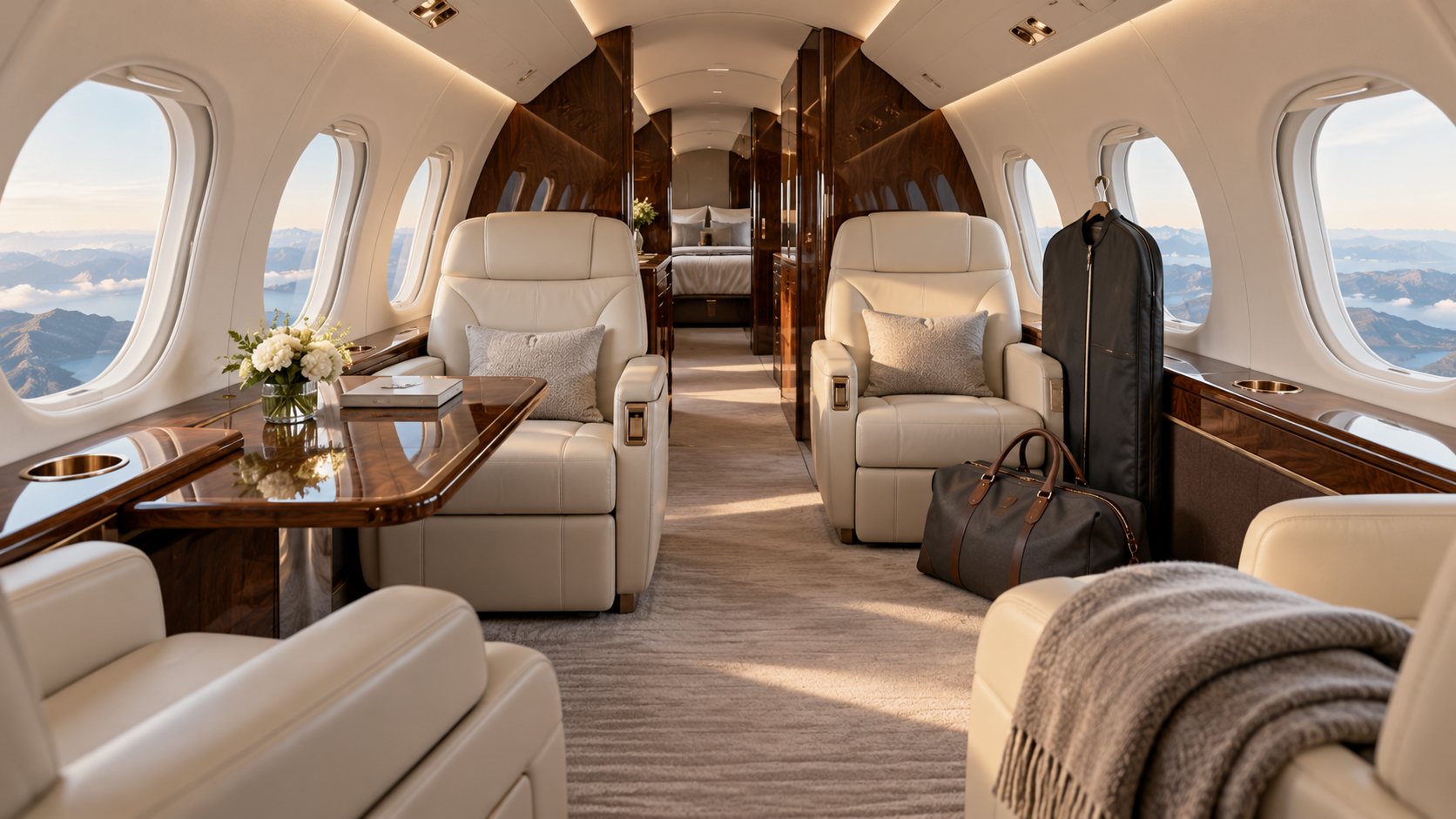
Send the provider the number, dimensions and weights of garment bags, suitcases and working equipment before choosing the aircraft. Long hanging garments or presentation cases can matter more than passenger count. Ask how they are handled in the actual quoted cabin and baggage arrangement.
If shopping or samples increase the return load, allow for that early. A return flight may have a different baggage requirement from arrival. The chauffeur vehicle needs the same inventory so the final airport transfer remains comfortable for the whole group.
For an overnight arrival, review sleeping positions, meal service and how the cabin is used by the guests. For a short city-to-city flight, practical boarding, luggage and schedule continuity may matter more than the largest cabin category. Choose according to the mission rather than the model name alone.
Garment bags and the expected return load belong in the aircraft brief. · Illustration: BizJet Journal
Sample six-night two-city itinerary
Stage
Suggested program
Main coordination point
First city, day 1
Arrive and settle into the hotel
Airport, baggage and wardrobe services
First city, days 2–3
Confirmed shows, showrooms and dinners
Individual invitations and road gaps
Transfer day
Final appointment, airport journey and private flight
Protect the complete door-to-door block
Second city, days 4–6
Confirmed program plus flexible city time
Keep the hotel and driver updated
Final morning
Checkout and departure
Return luggage and accepted airport schedule
Choose the order from the actual season’s calendars and invitations. The example is a travel structure, not a claim that every Paris and Milan program overlaps conveniently. If the desired shows are separated by several days, consider a longer stay or independent trips rather than compressing the schedule unrealistically.
Fashion-week costs: a transparent two-city example
This scenario covers four travelers, six nights in two rooms and three passenger flight legs modeled at five flying hours in total. It uses an assumed €7,000 hourly rate. Room, vehicle and hosting allowances are editorial budget inputs, rather than advertised fashion-week prices or purchased runway access.
Cost item
Scenario basis
€
Passenger flight component
5 total hours × 7,000
35,000
Hotel accommodation
2 rooms × 6 nights × 900
10,800
Chauffeurs in both cities
Assumed group allowance
3,000
Dining and hosting
Assumed group allowance
2,400
Working / concierge services
Assumed group allowance
1,200
Subtotal
Before aviation extras and taxes
52,400
Planning reserve
10%
5,240
Scenario total
Subtotal plus reserve
57,640
Runway invitations are not created by the concierge allowance. Confirm each house’s actual access separately. The aircraft offer must identify positioning, handling, parking, crew accommodation and taxes where they fall outside the passenger-flight component used here.
When comparing offers, hold the cities, nights, guests and confirmed appointments constant. Review whether one aircraft stays with the group and how the quote handles a delayed show or changed next leg. The Journal’s charter-cost section provides the wider pricing framework.
Booking timeline and final checks
Start with the correct menswear, womenswear or couture calendar. Build an initial hotel and aviation brief, then update it as invitations and appointments become confirmed. Keep a realistic transfer day between cities and the room arrangements at both ends clear.
Before travel, reconcile guest names, companions, wardrobes, vehicle capacity and entry instructions. Prepare the daily schedule in the local time used by the invitation. The driver, host and aviation team should receive the same changes rather than separate versions of the trip.
Keep a named decision maker available for schedule changes and a practical backup for the important contacts. A coordinated plan lets the traveler enjoy the program while the aircraft and ground services respond to the real agenda.
Frequently asked questions
Does a collection year identify the travel year?
The collection label and show year can differ. Use the organizer’s dated calendar and the house invitation to determine the actual trip dates.
Which airport should I use in Paris?
Paris–Le Bourget is the principal business aviation gateway to compare. Confirm the FBO, aircraft stay and city transfer with the provider.
Is Linate the best airport for Milan Fashion Week?
Linate is convenient for the city, while Malpensa and Bergamo can fit other aircraft or operating proposals. Compare the accepted flight and complete hotel and venue route.
Can I buy access to every show through a travel package?
The individual house controls its invitation. Check the organizer’s notice and the written access promised by the responsible host before relying on a package description.
Should the same jet stay with the group?
Compare continuity and baggage convenience with parking, crew, minimum utilization and positioning. The full multi-leg quote should make those assumptions visible.
How should I handle garment bags and shopping?
Send dimensions and weights before booking and allow for the return load. Check the aircraft and every ground vehicle against the complete inventory.