
Aircraft Ownership · guide
Business Jet Replacement: Should You Sell Your Current Jet First?
Selling first releases capital. Holding the current aircraft can save charter expense. A two-month, 40-hour example shows what a delay or bridge loan changes.


The buyer of your current jet is ready to close on Monday. The replacement is due next month, and a passenger trip already sits on the calendar. Holding the old aircraft could save a charter bill. It could also leave the company financing two jets while the crew is away training and the old one is in the buyer’s prebuy inspection.
The economics of a business jet replacement depend on three dates. One governs when sale proceeds become available. Another determines when the owner must pay for the incoming aircraft. The third is the first day the replacement can actually operate the passenger trip. Even if both sales close on schedule, those dates can be weeks apart.
What does a two-month business jet replacement cost?
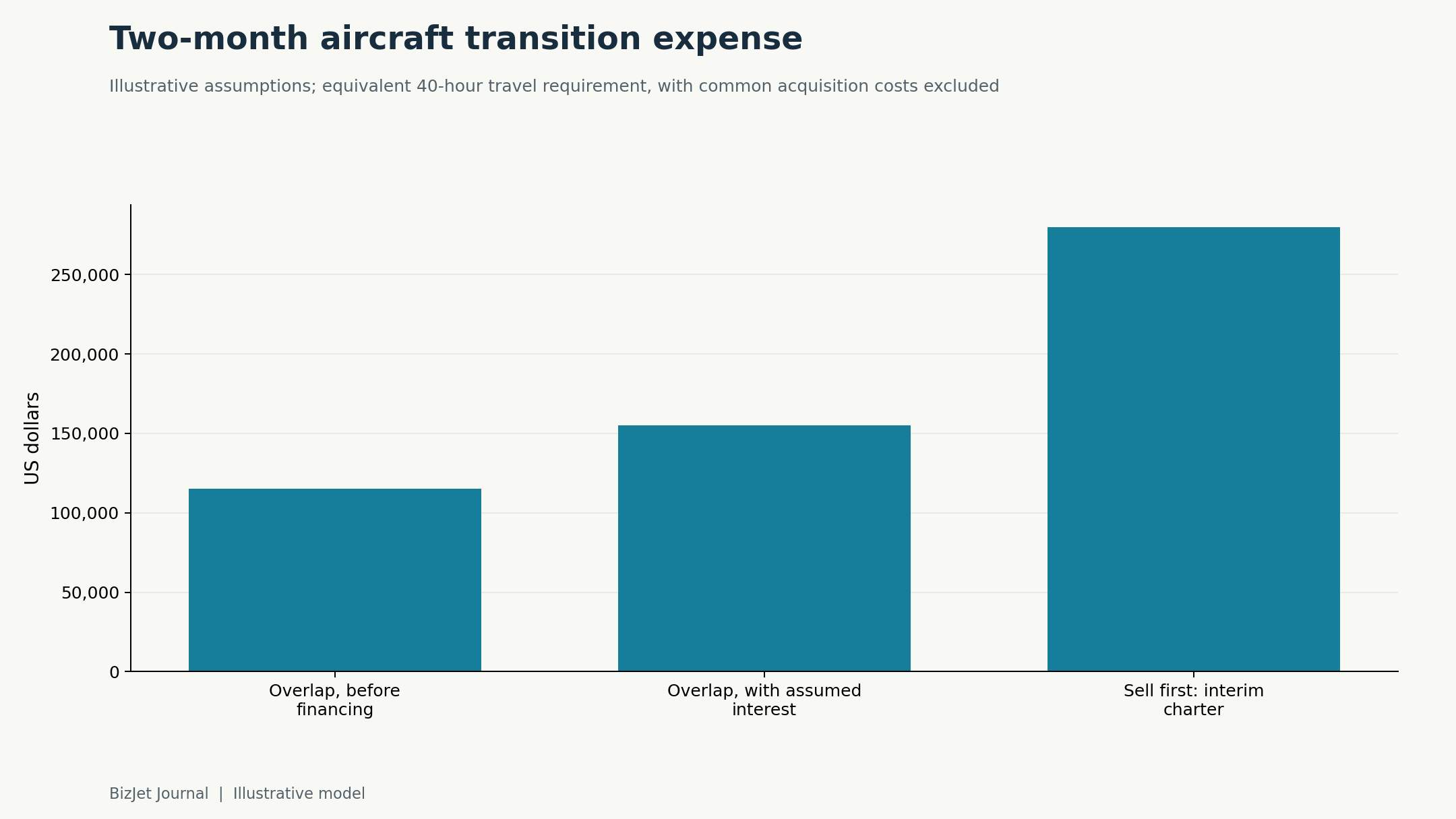
Assume an owner needs 40 hours of flying during a two-month transition. Buying first and retaining the current jet costs an estimated $45,000 per month in incremental carrying and flying costs, including the 40 hours of travel across the two months. Budget a further $25,000 for expenses specific to running the overlap. Assume that selling first removes those costs and that charter can cover the same trips at an illustrative all-in $7,000 an hour. Expenses common to both transactions are excluded.
| Two-month transition item | Buy first and retain current aircraft | Sell first and use interim charter |
|---|---|---|
| Retained-aircraft budget: 2 × $45,000 | $90,000 | $0 |
| Overlap-specific transition expense | $25,000 | $0 |
| Interim charter: 40 hours × assumed all-in $7,000 | $0 | $280,000 |
| Modeled incremental transition expense | $115,000 | $280,000 |
On those assumptions, the owner spends $115,000 to retain and operate the aircraft or $280,000 to charter. That $165,000 difference is meaningful only if the retained jet can fly the full schedule. A buyer’s inspection that removes the jet from service for two of the trips changes the calculation. The overlap case then needs the actual charter price for those trips, less any flying expenses the owner avoids.