
Aircraft Ownership · guide
Business Jet Engine Programs: What the Hourly Rate Covers
A $375 rate per engine-hour becomes $900 per aircraft hour in one twinjet example. Annual minimums, shop-visit coverage and transfer terms explain the difference.

At an illustrative $375 per engine-hour, a twinjet flying 250 hours a year generates $187,500 in annual payments. Give the same contract a minimum of 300 hours per engine and the bill rises to $225,000. The owner now pays $900 for each aircraft hour flown, before any work outside the agreement.
That calculation explains one difference between business jet engine programs. Another emerges when an engine goes to the shop. Two owners paying the same hourly rate can owe different amounts for the same qualifying repair because they enrolled at different points in the engine’s life or bought different coverage.
How business jet engine programs divide the shop bill
An engine program exchanges payments over time for a provider’s commitment to fund or arrange specified maintenance. The agreement attaches to particular engines and defines which events qualify. An aircraft sale listing that says “engines on program” leaves several material questions open, including whether both serial numbers have the same history and what the owner owes at the next scheduled visit.
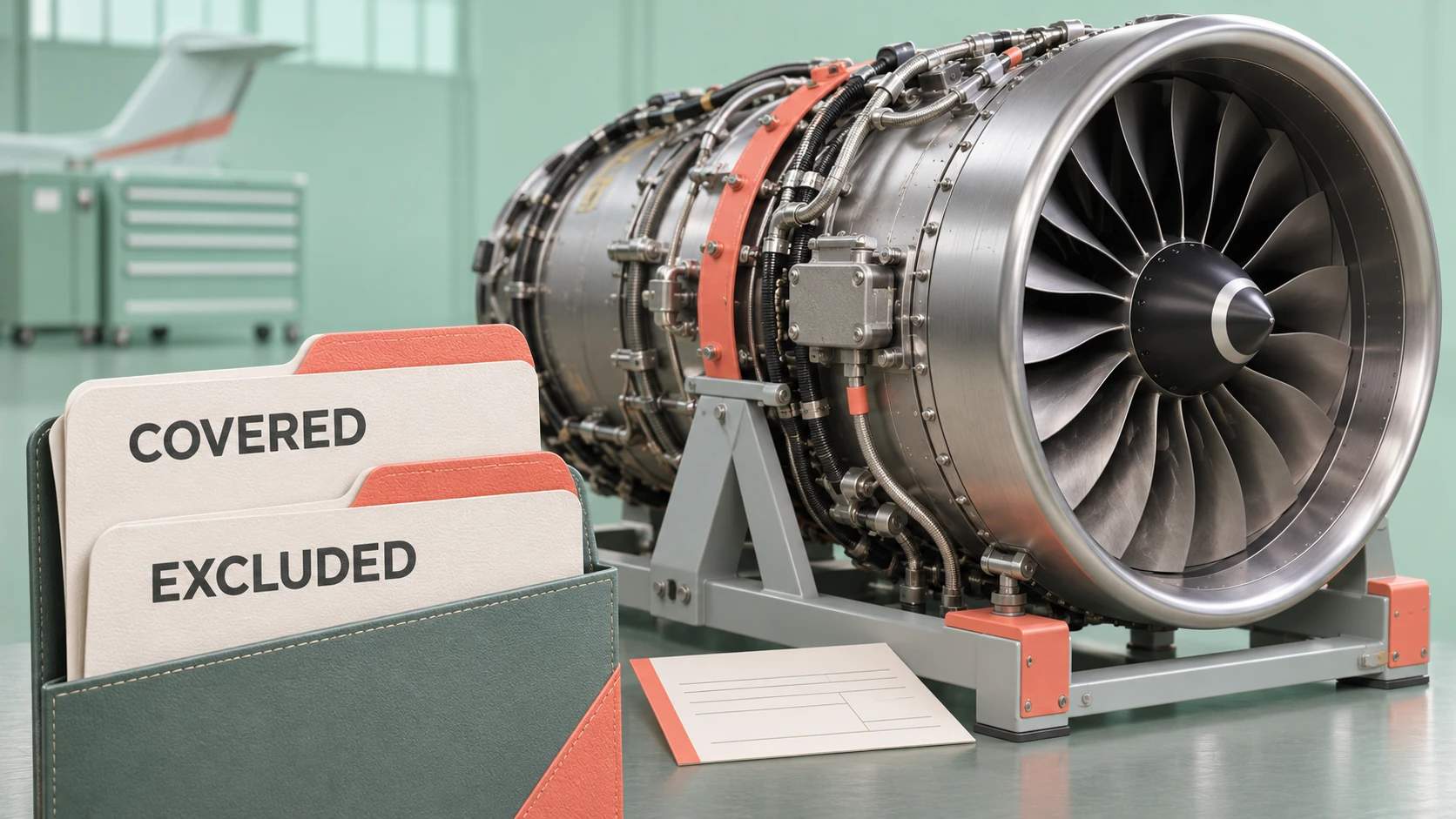
Suppose a buyer has two offers for an engine approaching a scheduled shop visit. The first requires a $150,000 payment at enrollment and covers the entire eligible bill for that visit. The second has no upfront payment but leaves the owner responsible for 25% of the eligible bill. Assume the hourly rates and all other coverage are identical.
At a $600,000 eligible shop bill, the buyer spends $150,000 either way, apart from the hourly payments. If the bill reaches $800,000, the second offer leaves the owner owing $200,000. If it comes in at $400,000, the owner owes $100,000. The break-even point turns on the eligible work. Repairs that both contracts exclude still need their own allowance.
What does the contract pay when an engine comes off the wing?
A shop visit generates more than one bill. The repair facility may quote the internal engine work, while the aircraft owner also needs troubleshooting, removal and reinstallation, shipping and possibly a rental engine. A program can pay for eligible shop work while leaving the owner with travel costs during the downtime. Even a rental benefit depends on the terms and availability of a compatible unit.
Consider an engine that ingests debris on the runway. The first invoice might be for an inspection to find damage. The next could be for a blade repair, or for removing the engine and sending it to a shop. If the agreement excludes foreign object damage, an inspection covered under another clause would still leave the repair bill to resolve. Whether insurance will pay any of it depends on the aircraft policy and its deductible.
The same question arises when a quote covers neighboring components. A shop might price work on the engine and its thrust reverser together. If the contract lists the engine work as eligible and excludes the reverser, the owner needs the shop to separate the two amounts. Where the agreement requires authorization before work begins, the approval also belongs in the job file.
How annual minimums change the cost per flight hour
In this worked example, both engines accrue one hour for each aircraft hour. The assumed price is $375 per engine-hour for both offers. One charges for actual hours. The second bills at least 300 hours per engine annually. No buy-in, tax, escalation or uncovered maintenance is included.
| Actual annual aircraft hours | Payments without a minimum | Payments with assumed 300-hour minimum per engine | Effective cost per actual aircraft hour with minimum |
|---|---|---|---|
| 200 | $150,000 | $225,000 | $1,125 |
| 250 | $187,500 | $225,000 | $900 |
| 300 | $225,000 | $225,000 | $750 |
| 400 | $300,000 | $300,000 | $750 |
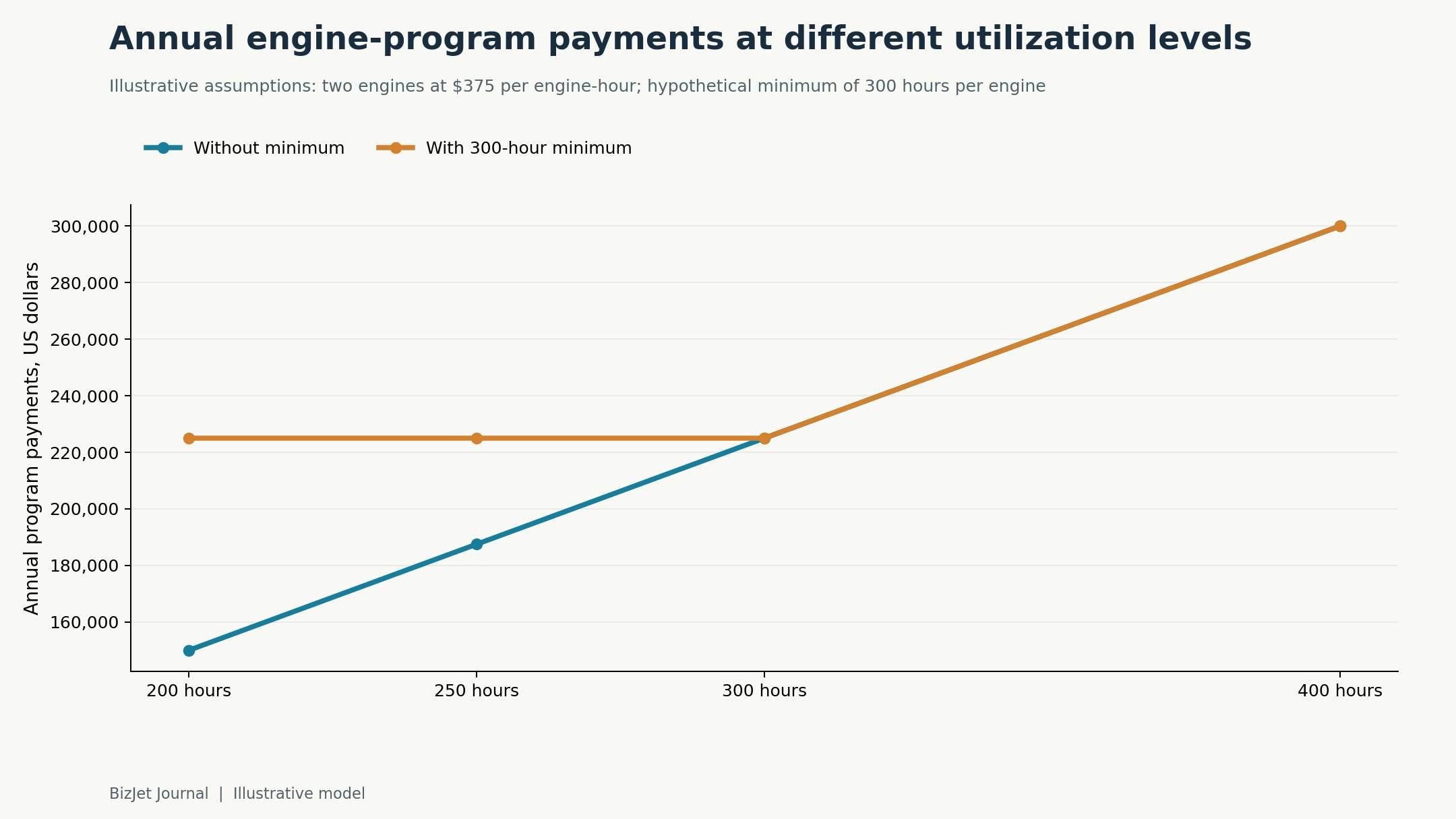
At 200 aircraft hours, the minimum adds $75,000 to the year’s payments. At 400 hours, both offers cost $300,000 because actual use exceeds the minimum. A separate 3% price escalation would lift the assumed rate to $386.25. At the 300-hour minimum for two engines, the annual bill would then be $231,750. These are illustrations of contract mechanics rather than provider prices.
A budget built from a quoted rate also needs the engine count and the definition of billable time. A price quoted per aircraft hour already covers the number of engines specified in the quote. Multiplying that price by two again would overstate the expense. The aircraft ownership budget still needs separate allowances for airframe maintenance and other uncovered items.
What transfers when a business jet is sold?
The seller’s last paid invoice establishes one payment. A provider’s statement of account can show overdue amounts, deferred hours and benefits attached to the account. Those details matter during a private jet acquisition because the buyer needs to know which liabilities the seller must settle and which coverage will be available under the buyer’s agreement.
The owner has a separate duty to deliver certain maintenance records. For aircraft subject to 14 CFR 91.417, records of each engine’s total time and the status of its life-limited parts transfer with the aircraft at sale. Those records establish the engine’s maintenance history. The buyer still needs written confirmation of when program coverage begins, the opening account balance and the rate payable after closing.
For a buyer comparing two otherwise similar jets, the decisive figures are the amount needed to put each account in good standing at closing and the owner’s share of the next major event. An attractive hourly rate has a measurable value once those two figures are known.
Frequently asked questions
Does an engine program cover foreign object damage?
It depends on the engine, tier and effective terms. Some coverage can distinguish minor repairable damage from events requiring removal. Ask the provider to assess specific scenarios under your contract, including approval requirements and interaction with insurance, instead of relying on a general statement that FOD is either always covered or always excluded.
Does coverage transfer automatically when a jet is sold?
Do not assume it does. Providers can require account clearance, forms, approval and a new agreement or rate. Confirm the process and any nontransferable obligations before closing. The seller's payment history is useful evidence, but direct confirmation of the buyer's coverage is the transaction milestone that matters.
Is a cheaper hourly rate necessarily a cheaper program?
No. Minimum payments, enrollment costs, escalation, pro-rata owner participation and uncovered events can outweigh a lower rate. Compare annual cash at realistic utilization and the owner's exposure in the same maintenance scenarios. Also assess the support and rental arrangements that determine how much disruption accompanies a covered event.