Aircraft Ownership · guide
Private Jet Cabin Refurbishment: What Drives Cost and Downtime?
New upholstery and a different seating layout can look equally dramatic at delivery. They have very different implications for engineering, shop time and cash.

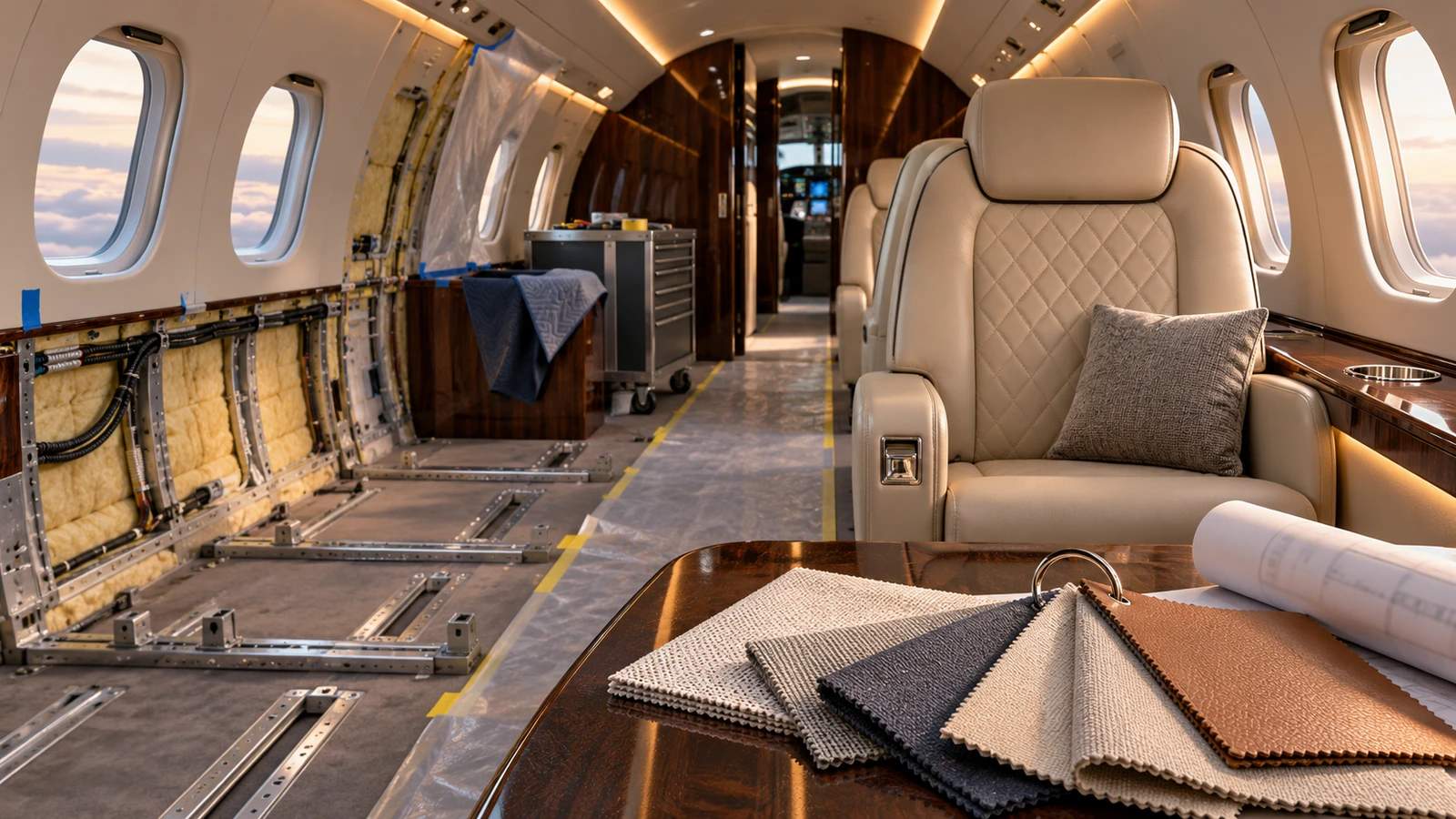
An owner brings two photographs to an interior shop. The first shows the aircraft's existing club seats in new leather. The second shows a divan where two club seats now sit. Either treatment could transform the view from the cabin door. Only one changes how passengers use that part of the airplane. The decision affects the price, the work that must be documented and how long the owner will need another way to fly.
A private jet cabin refurbishment begins with a deceptively simple question. What should passengers be able to do on the finished aircraft that they cannot do today? If the answer is sit on clean, comfortable seats, a materials refresh can be a well-defined project. If the answer is sleep two people on an overnight flight while someone else works, the floor plan, approved seat functions, lighting and access to the lavatory become part of the design.
What a private jet cabin refurbishment actually includes
The expression “new interior” can describe a wide range of work. One shop might recover seats using their existing frames and cushions, replace carpet and refinish visible panels. Another might replace seat foam, repair worn mechanisms, refinish the veneer under the windows and renew the flooring in the entry and galley. From a few rows away, the results may photograph much the same. An owner sitting for four hours in a seat with a tired mechanism will appreciate the difference.
Scope starts at the level of individual assemblies. On a carpet job, who removes and reinstalls the seats? Who pays to repair a damaged floor panel discovered under the old covering? If veneered cabinets are to be refinished, does the quote include the side facing the aisle, the enclosed surfaces, the hardware and the labor to remove the unit? Two proposals that both say “refinish cabinetry” can price different amounts of work.
A layout change introduces a separate set of questions. A longer divan may fit between two cabinets on a drawing and still interfere with a door, table or aisle when in use. A berth that works on the ground may have use restrictions in flight. The approved configuration defines which positions passengers may occupy for takeoff and landing. An owner buying an extra usable seat needs that particular capability documented in the proposal.
Where materials end and engineering begins
Finishes have to suit the aircraft as installed. The FAA's guidance on flammability testing after cabin-panel alterations addresses how applicants can show that certain panels continue to meet applicable self-extinguishing requirements after a finish is changed. Its scope is limited. It does not cover separate heat-release or smoke-emission requirements where those apply. A sample swatch or a reference to the original panel cannot by itself settle every question about the finished installation.
For an owner, the practical question is whether the quoted material, backing, finish and installation have a documented path to acceptance for this aircraft. A last-minute substitution can put the shop back into a design and documentation discussion just as it expected to start fitting the parts. An unusual color may be easy to obtain in a different material but expensive in schedule if it changes what has to be substantiated.
Moving a cabinet, installing a different seat or changing a powered cabin system can extend the engineering work. Existing approved data may cover the aircraft and the proposed arrangement. A change outside that coverage can need a different approval path. An FAA supplemental type certificate approves a modification to an existing type design and how that modification affects the original design. Whether a particular project needs one depends on the change and the data already available. A credible layout proposal identifies the applicable data and who owns the cost and schedule if the design changes.
The shop invoice and the replacement flights
Consider two invented proposals for the same cabin. The refresh keeps the seats and cabinets in place. The layout project installs a different seating arrangement and modifies cabinetry as well as refreshing the finishes. The owner has already identified the dates on which the aircraft would otherwise fly. Each substitute trip is estimated at $22,000 from a charter provider. Keeping the owned aircraft on the ground avoids $6,000 of variable expense on each of those trips. Salaries, insurance and hangar rent continue under either choice.
| Illustrative project cost | Materials refresh | Refresh and layout change |
|---|---|---|
| Shop proposal | $220,000 | $540,000 |
| Scheduled trips needing substitute lift | 3 | 7 |
| Charter cash paid | $66,000 | $154,000 |
| Owned-aircraft variable expense avoided | $18,000 | $42,000 |
| Incremental project and flying cost | $268,000 | $652,000 |
The larger project costs $320,000 more at the shop and $384,000 more once the additional replacement flying is included. For cash planning, the owner actually has to pay the shop and the charter invoices, $286,000 for one option and $694,000 for the other, before any change orders or taxes. The avoided flying expense explains why incremental economic cost is lower. It does not supply money for a shop deposit.
Whether the divan earns its place depends on the missions it changes. If the new arrangement lets the owner use the aircraft on trips that previously required a different cabin, those trips belong on the benefit side. A possible resale premium remains uncertain until a buyer values the alteration. An owner who prefers the appearance may still choose it, but that is a different reason to spend the money.
Which work actually holds up delivery?
A shop might start engineering and order long-lead materials while the airplane is still flying. That elapsed time and the period the aircraft occupies a shop bay belong on separate lines of the schedule. The owner cares most about unavailable flight days. The shop also needs decisions early enough to protect its installation slot. The two dates can be months apart on a complex project.
Combining refurbishment with a scheduled inspection can avoid opening the same area twice. Savings depend on the work sequence. A maintenance technician who needs access behind a cabinet may need to finish before the interior team can close that area. A replacement floor panel found to be necessary after carpet removal can delay an installation even when the new carpet arrived on time. A written change-order process gives the shop and owner a way to authorize the repair, adjust the cost and revise the return date while the work is accessible.
Acceptance is where the owner's original reason for the project comes back into view. With the completed cabin in its approved configuration, can someone reach the lavatory when the berth is in use? Does the table clear the armrest, do drawers latch and is the power outlet accessible with a laptop open? The delivery package should also reflect the installed configuration, the work performed and any applicable weight-and-balance or equipment-list changes. Those records give the next maintenance team, and eventually the next buyer, a clear description of what is aboard.
Frequently asked questions
Does replacing private jet seat leather require a completely new interior approval?
The work scope, aircraft and approved data determine the documentation. Recovering an existing seat to an established specification is a different assignment from replacing the seat, altering its structure or changing its approved occupancy. The proposal should identify the specification that applies to the finished assembly.
Can a cabin refurbishment happen during a scheduled inspection?
Yes, when the maintenance and interior shops can coordinate access, labor and parts. The owner gains the most when the work genuinely overlaps. If installation has to wait until a lengthy inspection or repair is finished, the combined ground period can still extend past the planned maintenance visit.
How can an owner estimate the cost of downtime?
Place the proposed shop dates against actual travel commitments. Price substitute transportation for trips that still need to operate, then subtract the variable cost the owned aircraft would have incurred. Keep charter cash, avoided operating expense and continuing fixed ownership costs separate so each appears once in the budget.