Aircraft Ownership · guide
Choosing a Home Base for a Private Jet: Hangar, Crew, and Positioning Costs
A cheaper hangar can cost more across a year of trips. Two airports show how empty flights, crew travel and ground services change the calculation.


A hangar across town costs $3,000 less a month. The owner usually flies from the more expensive airport, a 15-minute drive from the office. Should the flight department move the airplane and bring it back whenever the owner needs it? At an illustrative $2,400 per empty flight, the new base can absorb 15 extra legs a year before the rent savings disappear. Picking up and dropping off passengers on the same trip can use two of them.
That calculation is a starting point for choosing a home base for a private jet. The aircraft, its passengers and its crew may begin the day in three different places. Where each one ends the day matters just as much. A calendar showing who flew, where the airplane slept and where it went next tells an owner more than a comparison of advertised hangar rates.
Which trips would move with the airplane?
Start with the trips the owner actually took last year. For each departure from the current base, identify whether the passengers would drive to the alternative. Families leaving home on a Saturday may have a different answer from a team leaving headquarters after a meeting. Some trips already originate closer to the alternative. Their savings belong on the same sheet as the additional costs.
Then connect the trips in date order. If the aircraft returns with passengers on Monday evening and departs from the same airport Tuesday morning, there may be little reason to take it back to base overnight. There may, however, be a parking charge, a crew hotel bill or a morning departure restriction. A Friday arrival followed by five quiet days presents a different decision. Counting an empty round trip after every passenger trip can overstate the price of the move.
The airport where most passengers live may still be a poor fit for a specific airplane. The available hangar has to accommodate the wingspan, tail height and tow path through the door. A quoted space at the back of a shared hangar raises another question for a Monday departure. Who will move the aircraft parked in front, and when is that service available?
A home base for a private jet has two kinds of cost
Compare the costs the move changes. The following example uses invented quotes for two suitable airports and one aircraft. Both quotes include towing during staffed hours and the same basic services. The variable cost for each short empty leg is estimated at $2,400, including fuel and accrued engine and maintenance costs. The owner keeps the same salaried crew at either base. The occupied flights would cost the same.
| Annual cost in this example | Airport A, near the office | Airport B, farther away |
|---|---|---|
| Hangar rent | $120,000 | $84,000 |
| Additional empty legs for passenger pickups and returns | 0 | 18 |
| Cost of those legs | $0 | $43,200 |
| Total of the costs shown | $120,000 | $127,200 |
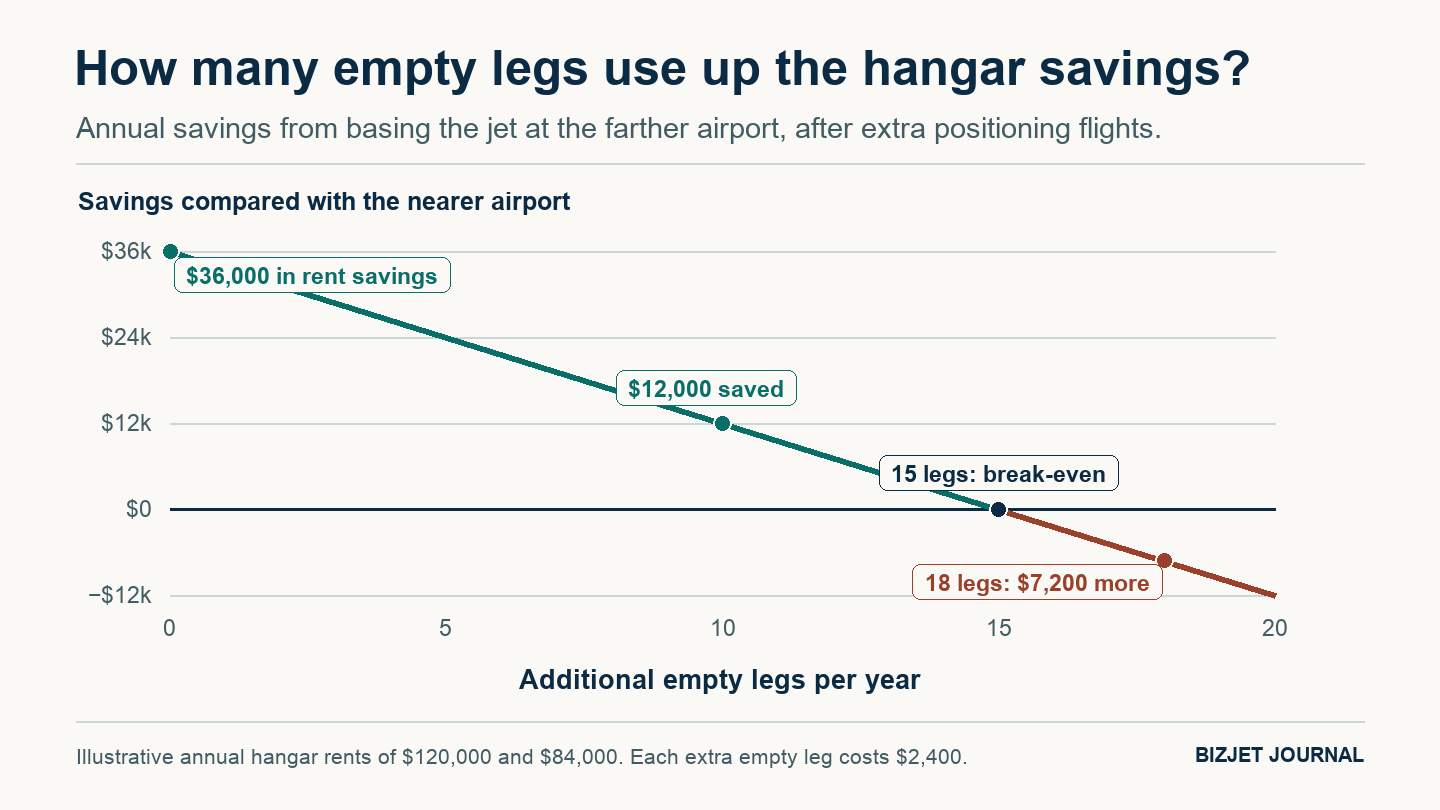
Airport B's landlord saves the owner $36,000. Operating the additional 18 legs uses $43,200, leaving B $7,200 more expensive on these assumptions. If more passengers agreed to drive to B and only ten empty legs remained, B would cost $108,000 and save $12,000. The calculation gives the owner a concrete decision about passenger pickup. It also gives the scheduler a reason to count complete movements. Each extra pickup and each separate empty return draws on the same $36,000.
An extra flight can also consume calendar time, landing cycles and crew availability. If the $2,400 assumption already includes a reserve for cycle-driven maintenance, adding that reserve again overstates the expense. If a particular airport charges for handling on each pickup, add that invoice where it occurs. A fuel discount belongs against gallons the aircraft could reasonably buy at that base, after any minimum purchase or handling charge. Applying the discount to every gallon burned throughout the network can produce savings the fuel supplier will never deliver.
Who can get the aircraft out on an early departure?
Two leases can describe 24-hour access and deliver different things. One gives the crew access to a hangar door at any hour. The other also includes a person qualified and available to tow the aircraft, arrange a fuel uplift and meet an early departure. The difference matters most when the change request arrives after the regular shift has gone home. An after-hours callout charge is a cost. An unavailable service changes the trip.
The FAA's Chart Supplement supplies published airport information and operating remarks for U.S. public-use airports. It is a useful first source for comparing facilities. A hangar tenant still needs the airport's current local arrangements and the service provider's written terms to establish what a particular lease buys. A nearby maintenance station may perform routine work during the week without offering troubleshooting on a Sunday evening. That difference can determine whether a small defect costs an afternoon or disrupts the following day's itinerary.
Crew arrangements deserve their own line. If the pilots already live near Airport B, the move may make the first departure easier even as it lengthens the passengers' drive. If the crew must report to B hours before a downtown pickup, the unpaid-looking movement on the passenger itinerary consumes real time for everyone operating the flight. Adding contract crew, hotels or ground transfers can change the economics even when salary stays fixed.
What happens when the usual plan breaks?
Run one difficult trip through each base. Consider a late return ahead of an early departure in winter. At Airport A the airplane can go straight into its heated space. At Airport B the aircraft arrives at A after B's normal towing hours. Leaving it at A may require transient parking, and the next morning may involve arranging deicing. Returning it to B may require a callout, a second movement and a different crew plan. Weather and availability decide which options are practical that day.
Now reverse the scenario. Airport B might have a maintenance provider on the field that can look at an aircraft on its first day home. If Airport A would require a separate ferry for the same work, that trip belongs on A's side of the comparison. A maintenance ferry is easy to miss in a passenger calendar because nobody booked a seat on it.
The lease is an obligation throughout quiet months, too. A seasonal owner may value flexibility to release the space. A flight department adding a larger aircraft may value a suitable door and expansion rights. Compare the actual term, annual increases, included services and exit provisions against the aircraft's expected time at that airport. The most defensible choice is the one the owner can trace back to a particular set of trips, passengers and services.
Frequently asked questions
Is the airport nearest the owner usually the best home base?
Proximity has the greatest value when most trips begin there and the airport can support the aircraft and crew at the required hours. A farther field can be less expensive if passengers will use it, it eliminates maintenance ferries or it offers a suitable hangar that the closer airport lacks.
How much can an owner save by moving to a cheaper hangar?
Subtract additional positioning, handling, crew and ground costs from the annual rent difference. In the example, saving $36,000 in rent leaves a $12,000 annual benefit with ten extra legs at $2,400 each. Eighteen legs turn that benefit into an additional $7,200 of expense.
Does a jet have to return to its home base after every trip?
The flight schedule, crew arrangements, parking availability and operating requirements determine where it stays. If two trips use the same departure airport on consecutive days, one night of transient parking may cost considerably less than sending the airplane home and bringing it back the next morning.