
Aircraft Ownership · guide
Aircraft Management Agreements: Fees, Markups and Reporting to Review
Trace management compensation, supplier charges and charter settlements to compare proposals accurately and retain clear reporting and control of owner funds.


A low monthly management fee can become an expensive arrangement once procurement charges, payroll administration, maintenance supervision and charter deductions reach your account. The useful comparison is the total cost of the services you need, with enough reporting to explain every material charge.
Before signing an aircraft management agreement, ask for a sample owner statement and trace several transactions from the original supplier invoice or charter receipt to the final amount charged or credited to you. If the proposal is difficult to reconcile in a quiet conference room, it is unlikely to become easier during a busy operating month.
Define the services and operating roles
Write down who handles staffing, scheduling, maintenance coordination, training, insurance administration and accounting. For each service, identify the provider, scope and escalation contact. “Full management” is a description, not a complete allocation of responsibilities.
Make staffing assumptions explicit. Are pilots your employees or the manager's? Who pays recruiting, benefits, recurrent training, travel and temporary coverage? Who approves replacement personnel? Our comparison of contract pilots and full-time flight crew explains why the staffing model changes the practical service requirement.
Separate those support services from operational control. The FAA's active Truth in Leasing advisory circular explains that operational control concerns authority over initiating, conducting and terminating a flight. The actual arrangement matters, not merely the agreement's label. A management relationship alone does not answer who operates each owner or charter flight.
Have the agreement describe the intended operating structure and align it with real practices. For US charter flights, the certificated operator's responsibilities need to be clear; owner flights may involve a different arrangement. The Part 91 versus Part 135 guide provides context for that distinction.
NBAA's aircraft operating and leasing guide provides a framework for aircraft support-services agreements. Use such a framework to identify issues for your transaction, while grounding the final responsibilities and compensation in the agreement you actually sign.
Build the complete fee schedule
Put every form of compensation in one schedule. Include recurring management fees, onboarding, payroll administration, maintenance supervision, procurement, charter administration and termination charges. Mark each service as included, separately charged or subject to further agreement. An omitted item is an unanswered question, not necessarily a free service.
Define percentage calculations precisely. If a maintenance supervision fee is based on “net cost,” establish whether that means supplier cost before discounts, after discounts, after credits, or including freight and taxes. Decide whether a markup applies to a supplier charge that already contains another management fee.
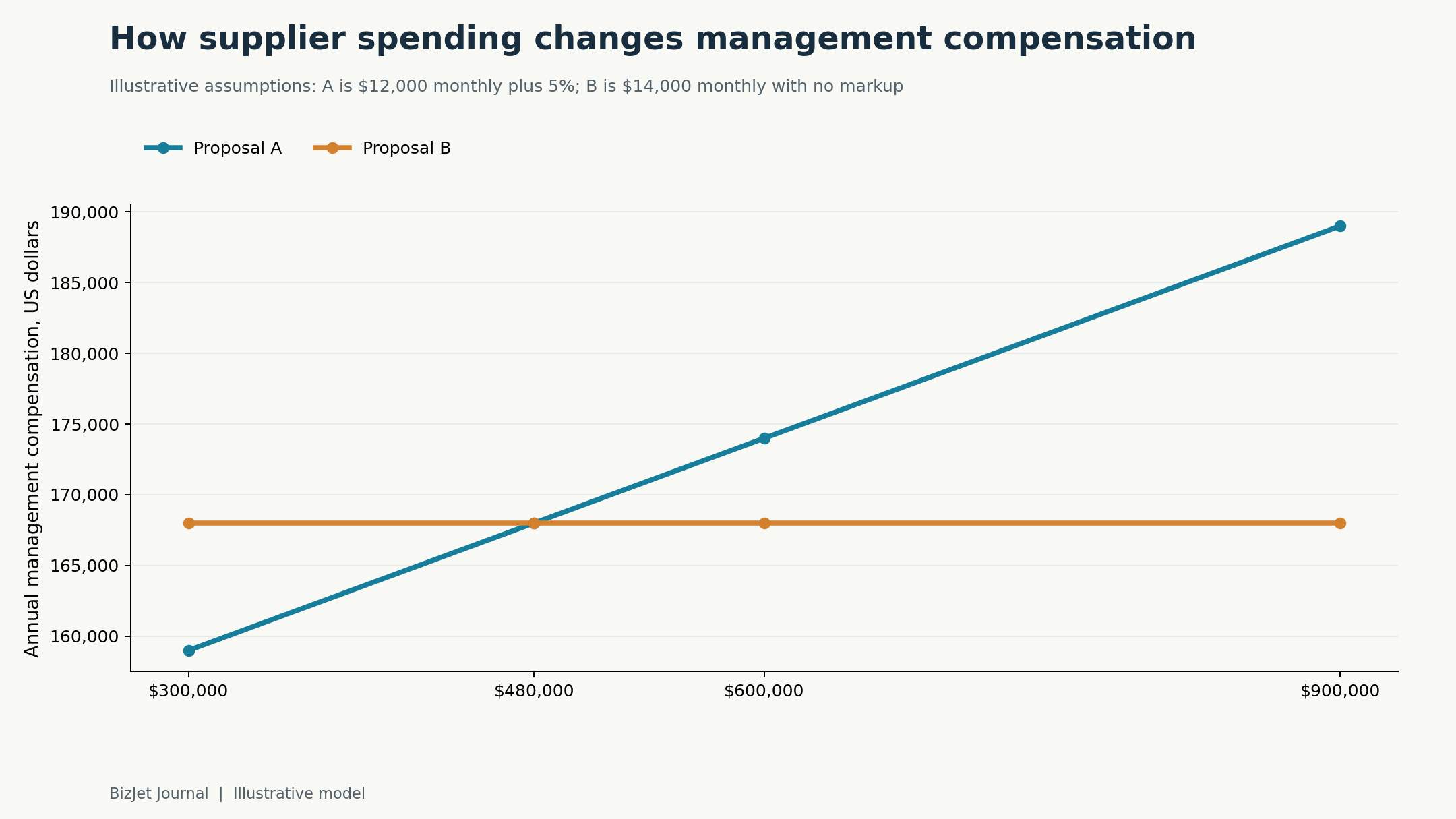
Use a common operating budget to compare proposals. The following figures are illustrative assumptions, with identical scope and an identical $600,000 annual basket of supplier invoices. They are not quotations from management providers.
| Annual item | Proposal A | Proposal B |
|---|---|---|
| Monthly management fee | $12,000 | $14,000 |
| Annual fixed management fees | $144,000 | $168,000 |
| Supplier basket before management markup | $600,000 | $600,000 |
| Markup on that defined basket | 5% | 0% |
| Annual markup | $30,000 | $0 |
| Management compensation in this comparison | $174,000 | $168,000 |
| Supplier basket plus management compensation | $774,000 | $768,000 |
Proposal B is $6,000 lower despite the higher monthly fee. The calculation does not include costs outside the assumed basket or compensation outside the two specified charges. If scope or negotiated supplier pricing differs, adjust those inputs before ranking the proposals.
The sensitivity is useful. Proposal A's fixed-fee advantage is $24,000 annually. At a 5% markup, that advantage disappears when the supplier basket reaches $480,000: $24,000 divided by 0.05. Below that level A is cheaper on these assumptions; above it B is cheaper.
| Annual supplier basket | A: fixed fee plus markup | B: fixed fee, no markup |
|---|---|---|
| $300,000 | $159,000 | $168,000 |
| $480,000 | $168,000 | $168,000 |
| $600,000 | $174,000 | $168,000 |
| $900,000 | $189,000 | $168,000 |
Also define fee escalation: timing, index or formula, caps if negotiated, and notice. A first-year comparison can be misleading if the fees change differently in subsequent years.
Trace discounts, rebates and related suppliers
A discount has value only relative to the price you would otherwise pay for the same service. Ask for a representative supplier basket covering fuel, training, insurance and maintenance. Compare the delivered cost after discounts, fees and credits, rather than a percentage off an undefined retail price.
Request written treatment of rebates, volume incentives, commissions and related-party transactions. If a supplier issues an annual credit after your invoices have been paid, who receives it and how is your share determined? If the manager uses an affiliated repair or charter business, what disclosure and approval process applies?
As a named provider example, Solairus says its management offering includes segregated owner accounts, detailed monthly financial reporting and full pass-through of negotiated discounts without markup or commission. Those are the provider's published descriptions, not rules that apply to every management company. Your agreement should state the treatment you are buying.
Test the process with a sample invoice. Start at the supplier's original amount, deduct the applicable discount or credit, identify any permitted management charge and reconcile the result to the owner statement. Ask to see how a later supplier correction flows back to your account. This simple exercise reveals whether the reporting supports the commercial promise.
Reconcile charter receipts and expenses
A headline revenue split does not tell you what reaches your account. Establish the denominator: gross customer charges, collected flight revenue, revenue after broker commissions or another expressly defined amount. Separate taxes collected for remittance from revenue available for distribution.
Then allocate the operating expenses that support charter activity. These can include positioning, fuel, crew travel, cleaning and program charges. Decide how cancellations, refunds, disputed payments and bad debts affect the owner. Clarify whether you receive credit when a trip is flown, invoiced or paid.
Consider an illustrative charter settlement. Eligible flight revenue collected is $100,000, excluding taxes. An agreed $10,000 broker commission comes off before an 85% owner share. The distributable amount is $90,000, and the owner's share is $76,500. If the owner then bears $35,000 in allocated trip expenses and program charges, the contribution is $41,500 before fixed ownership costs.
That $41,500 is neither gross charter revenue nor total aircraft profit. It is a contribution under the stated allocation. If a proposal changes where the commission enters the calculation, rerun the settlement rather than assuming the same “85%” produces the same result.
Also address owner priority, advance notice, maintenance scheduling and restrictions on charter use. More charter activity can increase receipts while reducing availability for your own missions. The agreement should make that tradeoff visible and define how scheduling conflicts are resolved.
Specify the reporting and exit you need
Request a monthly package that allows your finance team to reconcile cash, understand operating performance and anticipate upcoming expenses. Useful components include budget-versus-actual results, original invoices, trip-level expense allocation, charter settlements, bank reconciliation and a maintenance forecast. Ask for exportable underlying data as well as a presentation-ready summary.
Set spending authority by category and amount. Planned maintenance may require advance approval above a threshold, while an aircraft-away-from-base problem may need an emergency exception. Define the exception, notification deadline and documentation requirement. A workable process provides necessary authority without making the word “emergency” an unlimited purchasing instruction.
Clarify who owns and controls deposited funds. A working-capital balance is not automatically management compensation or an expense when deposited. It becomes expenditure as authorized bills are paid; any unused amount must be treated according to the agreement. Account segregation, withdrawal authority and final reconciliation should be described explicitly.
Plan the exit while relations are good. Specify notice periods, termination charges, outstanding supplier commitments, records delivery, data access and the handover timetable. Include how late invoices, rebates and charter receipts will be reconciled after termination. Retain access to information needed to review that final statement.
A useful agreement produces an intelligible owner account throughout its life. You should be able to identify what the manager earned, what suppliers received, what charter contributed and what funds remain yours without reconstructing the entire relationship each month.
Frequently asked questions
Are vendor discounts automatically passed to the owner?
No universal pass-through rule should be assumed. Providers describe different commercial models, and the signed terms determine the arrangement you have purchased. Ask about invoice discounts, later rebates, related-party margins and commissions, then verify their treatment in sample statements and the fee schedule.
What should a monthly aircraft management report contain?
It should let you reconcile the cash account and understand the aircraft's expenses and activity. Request budget variances, supporting invoices, trip costs, charter settlements, bank reconciliation and upcoming maintenance commitments. Exportable data is useful when your finance team needs to analyze spending across periods or challenge a particular allocation.
What happens to owner funds when the agreement ends?
The agreement should state how remaining funds, authorized unpaid bills and later receipts are reconciled, and when any balance is returned. Define account access and the final reporting timetable before signing. Do not treat an unused working-capital deposit as a fee merely because the manager holds or administers it.