Aircraft Ownership · guide
Was Smiling Thru the World’s First Private Aircraft? Inside Harry Ogg’s 1929 Flying Office
Harry Ogg’s 1929 Travel Air doubled as an office and washing-machine showroom. Archival records show what it achieved and which aircraft came first.
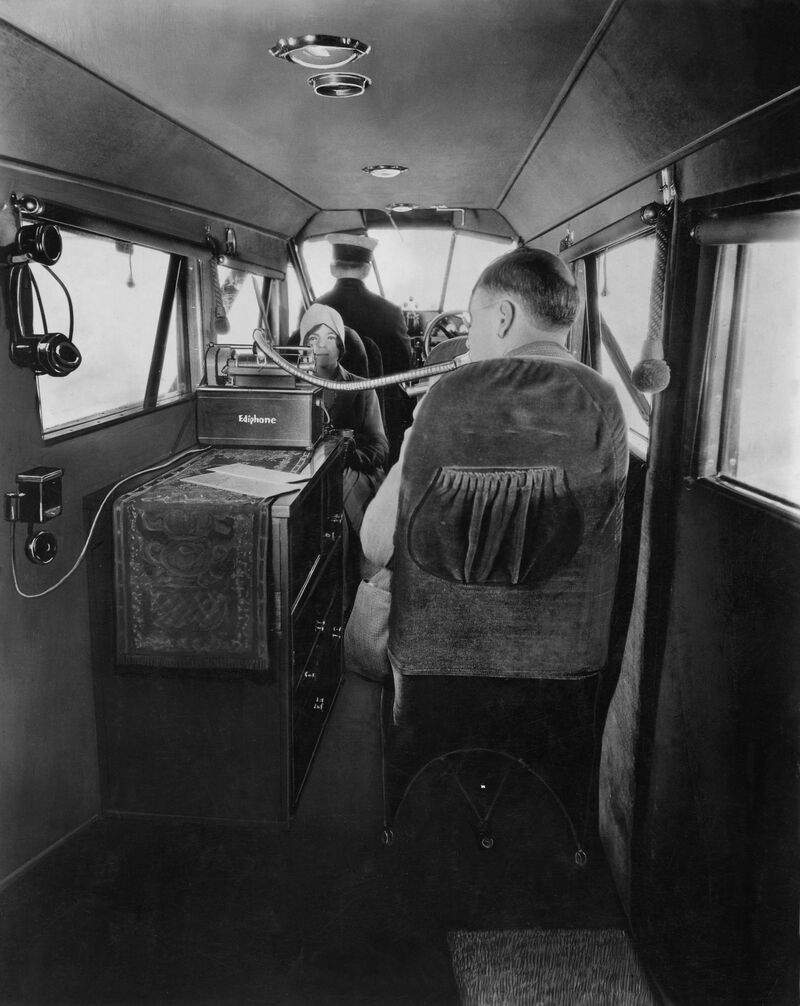
Harry Ogg’s airplane had room for a few washing machines. The 1931 Aircraft Year Book records Ogg’s account of one sales trip by air that brought in an order for 1,600. Ogg was president of the Automatic Washer Company in Newton, Iowa. He didn’t need an airplane big enough to fill that order. He needed one that could get him and a working machine in front of the buyer.
His airplane was a Travel Air 6000-B called Smiling Thru. It came to Newton in 1929 with a dictating machine, a place to type letters and an electrical outlet for product demonstrations. On one trip it could be an office; on the next, the seats could come out for deliveries.
Was it the world’s first private aircraft? No. Private owners had bought airplanes years earlier, and other businesses had already tried working in the air. What makes Smiling Thru worth remembering is how well we can reconstruct one company’s reasons for owning it. The office equipment survives in photographs, the crew can be identified by name, and the company even filmed the washers going aboard.
What came before Harry Ogg’s flying office?
“Private” describes who owns or uses an aircraft. A first civil sale, a company’s first airplane and the first time anyone worked in a cabin are three different milestones. In 1909, Glenn Curtiss delivered the Golden Flyer to the New York Aeronautical Society. The Smithsonian identifies it as the first sale of an airplane to a civil owner in the United States. That is a specific, documented first, and it predates Ogg’s Travel Air by 20 years.
Using an aircraft for company business was a separate milestone. Shell’s records show that it took delivery of a de Havilland Cirrus Moth called Arome in March 1927. Its open cockpit didn’t make much of an office, but it gave the fuel company a way to reach customers by air.
Even the flying desk had a predecessor. In September 1919, the Evening Herald of St. John’s, Newfoundland, carried an illustrated report on a flying office built by Britain’s Westland Aircraft Works. So what did Ogg bring to the idea ten years later? A product you could plug in and demonstrate at the other end.
Why a washing-machine manufacturer ordered a Travel Air
Newton was home to competing washing-machine manufacturers. A dealer might take an interest in a brochure, but a machine that could be seen running gave a salesperson something better to work with. Ogg wanted to take that demonstration beyond the factory without losing the time a sales trip normally took away from his desk.
In a history published by Midwest Flyer, Iowa aviator Jim Jones traced the purchase to a 1928 ride Ogg took in a Travel Air biplane with pilot Wilford Gerbracht. The following June, Ogg approached Walter Beech at Travel Air about a different sort of airplane: an enclosed, high-wing monoplane with enough room to work behind the pilot.
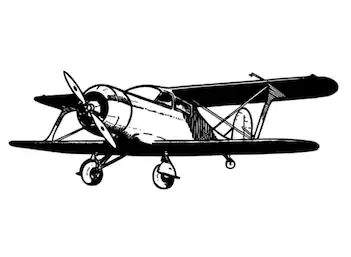
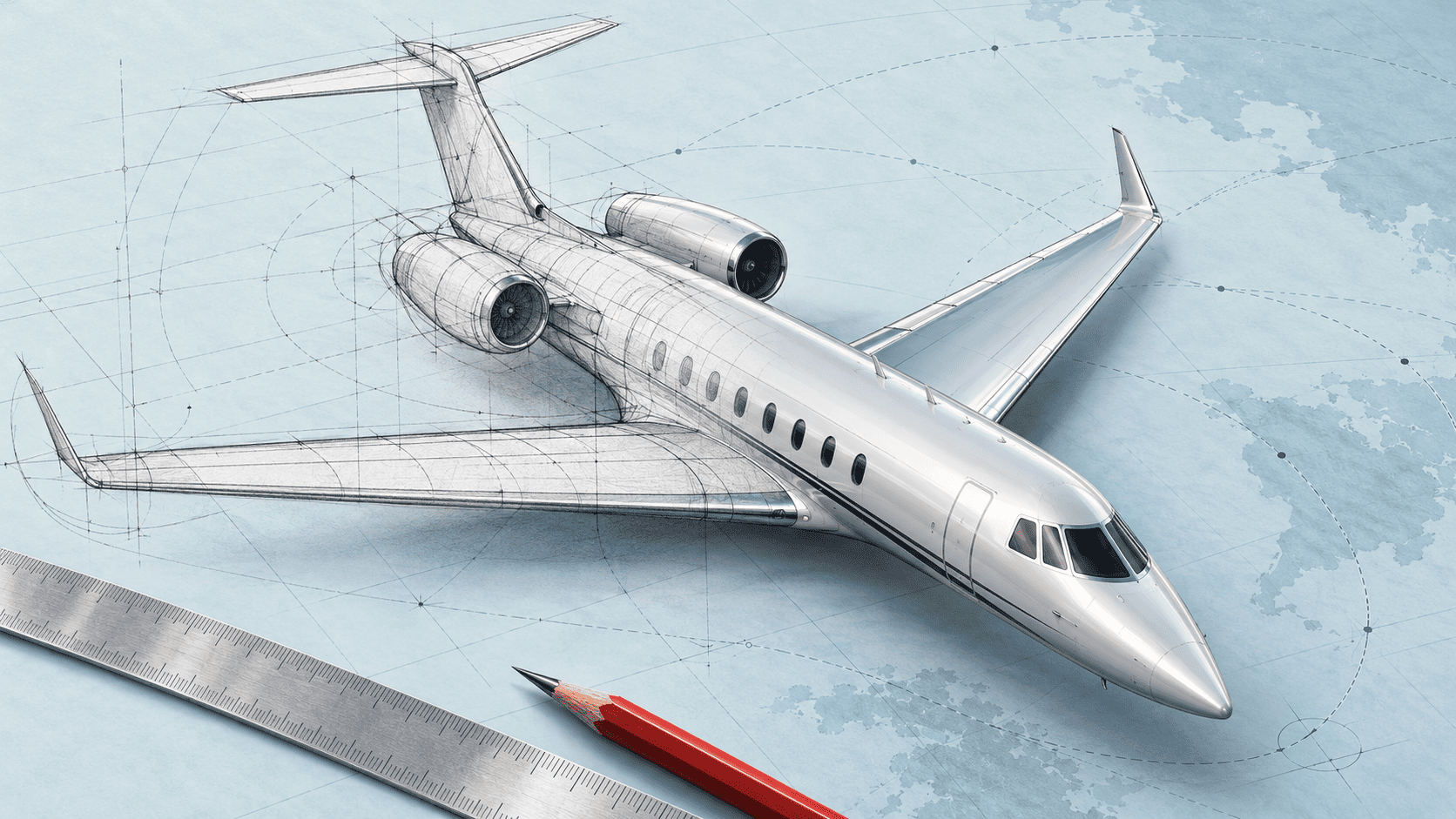
The wing arrangement is an easy detail to miss in pictures of early aviation. The aircraft Ogg ordered had one wing mounted above the cabin and a single radial engine in the nose. The biplane in the drawing has an upper and a lower wing. It illustrates the distinction; it isn’t a drawing of Smiling Thru.
Travel Air’s 6000 series was already suitable for carrying people. In June 1929, two months before Ogg’s aircraft appeared in Iowa, Delta began passenger service with a different airplane from the same family. The Delta Flight Museum describes how Delta could sell a fifth passenger seat by operating with one pilot. Ogg looked at that enclosed cabin and found another use for the space.
Inside Smiling Thru: an Ediphone, a typewriter and an interphone
Look closely at the cabin photograph. The name Ediphone is visible on the box beside the seated man. The flexible speaking tube belonged to the dictating machine, which recorded speech on a wax cylinder. The handset by the window did a different job: it let Ogg speak to Gerbracht at the controls. It wasn’t a telephone call back to the factory.
The equipment worked as a set. Ogg could dictate a letter, and his aerial secretary, Katharine McBride, could turn the recording into typed correspondence at a folding table. Noise mattered: Jones reported that the exhaust was modified and the fuselage insulated so that Ogg could make himself heard over the engine. A desk is easy enough to install. A desk at which someone can actually work is a different proposition.
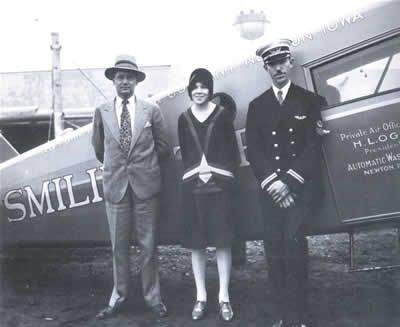
There’s a moving-picture record, too. A State Historical Society of Iowa collection entry describes ten minutes of silent, black-and-white company film from 1929. The footage includes the christening at Newton, McBride and Gerbracht, the office equipment and washing machines being loaded for express delivery. The catalog also identifies actor Gary Cooper, whom the airplane carried to a college reunion.
A contemporary newspaper puts the airplane to work outside its home town almost immediately. The Daily Iowan’s August 23, 1929 edition reported the new office-equipped Travel Air stopping in Iowa City. The inscription visible on the fuselage in the group photograph makes clear how Ogg wanted people on the ground to understand it: this was his private air office.
How the airplane helped sell washing machines
The detail that best explains Ogg’s purchase is the second electrical outlet. One connection served the dictating equipment. The other let the sales team run a washer at a stop. The company could show a prospective dealer how the product worked without asking the dealer to come to Newton.
The Iowa Department of Transportation’s aviation bulletin says that removing the seats allowed as many as four machines to be carried. There was no permanent showroom competing with a full row of passengers for space. The same floor served different purposes depending on what the company needed that day.
The name did some selling, too. Smiling Thru picked up the promise in Automatic Washer’s advertising: do the wash on Monday and spend the rest of the week smiling. The company put its name on the airplane and equipped it with a siren that could draw people out to the airfield ahead of a demonstration.
The sales figure Ogg reported puts those details in perspective. On page 213 of its 1931 edition, the Aeronautical Chamber of Commerce of America recorded his account of a single trip producing an order for 1,600 machines. That is a claim about an order, not the number of washers delivered by airplane. A few machines could travel as samples; the much larger sale was the reason to make the trip.
How far did Smiling Thru fly?
Jones’s reconstruction gives the scale of the operation: nearly 900 flying hours and visits to 43 of the 48 states of the time. He also reported that more than 9,000 people received rides in its first year. Those rides included people the company wanted to introduce to the airplane. They shouldn’t be counted as 9,000 customers or 9,000 long-distance business trips.
A ride was useful publicity even when a washer stayed at the factory. The accounts include employees, salespeople and local guests going aloft. Jones even recorded eight weddings aboard. The aircraft could earn a town’s attention on days when it wasn’t earning a sales order.
Was Automatic Washer part of Maytag?
Ogg ran the Automatic Washer Company, not the Maytag Company. The distinction matters because some retellings give Smiling Thru credit for building what became Maytag. Newton’s National Register historic-district documentation identifies the two as separate manufacturers, and the University of Iowa’s biography of F. L. Maytag places Maytag’s own move into washing machines in 1907—well before Ogg ordered his airplane.
The companies’ separate histories can also be traced forward. A 1964 federal court opinion identifies Automatic Washer Company as the former Newton manufacturer that entered reorganization proceedings in November 1956. Smiling Thru was an inventive way to sell Automatic’s products. It doesn’t supply an origin story for its better-known competitor.
What happened to the airplane?
After the airplane left Newton, its registration is easier to trace than its movements. Members of Newton’s Experimental Aircraft Association chapter identified its registration as NC677K. A historical compilation of U.S. civil registrations lists that number against Travel Air serial 6B-2012, associated with Minnesota owner C. W. Siehl and recorded as exported to Mexico on May 13, 1937. The entry doesn’t establish when Ogg sold it or what ultimately became of the airframe.
The hangar left a more tangible local record. Built for Smiling Thru at a grass strip north of Newton, the steel structure found another use after the airplane left. Decades later, local EAA volunteers took on the work of preserving it. Together with the film and photographs, it gives this particular company airplane a history you can follow beyond its sales pitch.
The distance to the Learjet 23 and the jet-age corporate cabin is easy to measure in years. The business logic is closer than it looks. In 1929, Ogg could take his secretary, pilot and product to the customer, and do the paperwork on the way. You don’t have to call his airplane the first to see why he wanted it.
Frequently asked questions
Who owned the Smiling Thru airplane?
It was the business aircraft of Harry L. Ogg, president of the Automatic Washer Company in Newton, Iowa. The company used it to visit dealers, demonstrate and deliver products, and promote the business.
What kind of aircraft was Smiling Thru?
It was a Travel Air Model 6000-B, a single-engine, high-wing monoplane with an enclosed cabin. It was a propeller airplane. Ogg’s modifications turned the cabin into a working office that could also carry washing machines.
Was Smiling Thru the first private jet?
No. It wasn’t a jet, and private aircraft ownership already existed. What distinguishes Smiling Thru is the record of how one manufacturer equipped and used a business airplane in 1929.
Could Harry Ogg make telephone calls from the airplane?
The documented handset was an interphone for talking to the pilot. The Ediphone was a different device: it recorded dictation for transcription. Neither piece of equipment was a telephone connection to a customer on the ground.