

Multi stop and specialist journeys · guide
Planning a Private Jet Mediterranean Tour: Combining Cities, Islands and Yacht Embarkation
Connect Nice, Olbia and Mykonos with a complete airport-to-yacht plan. A worked cost comparison shows how daily minimums can reverse the aircraft-retention decision.


A Mediterranean tour looks effortless as lines on a map. The practical work is connecting airport permissions, hotel nights and the moment your yacht can receive you. Plan those commitments together, then decide whether one aircraft should remain available or separate charters should connect the stops.
A Nice–Olbia–Mykonos itinerary is a useful example. It combines a city stay, an island arrival and a yacht handoff, with different airport arrangements at each point. The sequence can work in several forms, but none should be priced on passenger flying time alone.
Anchor the journey to fixed commitments
Start with the least movable event. For a yacht trip, that may be the confirmed embarkation port, date and receiving time. A yacht being “in Sardinia” or “near Mykonos” is not a transfer instruction. Ask for the named marina or agreed shore meeting point and the contact responsible for receiving the group.
Work backward to the island flight, then fit city nights around it. This makes it easier to avoid geographic backtracking and gives you a useful choice if a travel day changes: move a flexible hotel night while protecting embarkation.
An illustrative seven-day sequence could look like this:
| Day | Passenger plan | Aircraft decision |
|---|---|---|
| 1 | Arrive in Nice | Confirm whether the aircraft remains locally |
| 2 | Stay on the Riviera | Retention charges or a released aircraft |
| 3 | Fly Nice–Olbia | Accepted arrival and local parking or repositioning |
| 4 | Stay in Sardinia | Confirm next sector and baggage plan |
| 5 | Fly Olbia–Mykonos and embark | Coordinate airport-to-marina handoff |
| 6 | Yacht stay | Retained availability or no aircraft commitment |
| 7 | Tour arrangement ends | Define any onward flight separately |
Any international positioning or onward journey must be added explicitly. It also shows a useful question: if the final flight is on day five, why retain an aircraft through day seven? There may be a reason, but it should be deliberate.
Choose airports for the whole stop
Consider the airport, the stay and the following departure as one decision. The arrival closest to tonight's hotel may not support the aircraft parking or next movement you need. Similarly, using a different airport on departure can be practical if the road transfer and aircraft positioning are included.
On the Riviera, compare the actual hotel or marina location with the available airport options. Our guide to Cannes versus Nice for private jets provides the destination-specific framework. Do not transfer an aircraft acceptance at one airport to another without an operating assessment.
For every stop, supply the same passenger and baggage details. A change of aircraft midway through the tour can create a smaller baggage allowance even when every passenger still has a seat. Include large cases, sports equipment and anything intended for the yacht rather than the hotel.
Have the operator assess the full sequence before fixing one aircraft type. Airport suitability, conditions and required departure fuel can change from leg to leg. A coherent itinerary is more useful than selecting a preferred cabin first and discovering later that one stop requires a different plan.
Separate each airport's permission process
Different airports use different arrangements; “the handler is booked” does not mean every permission is complete.
At Nice, COHOR's coordination information states that general and business aviation slot requests go through handling agents. Its published W26 and S27 parameters require airport approval for turnarounds longer than four hours. A multi-night city stay therefore raises a parking question beyond obtaining movement slots.
At Olbia, Eccelsa Aviation's FBO information states that handling is mandatory and prior permission is required, with the PPR handled internally. Treat that as a process the handler must complete, not an invitation to arrive without acceptance.
For Mykonos, the airport's business aviation guidance requires a parking authorization number and says requests must pass through an appropriately licensed ground handling provider. Confirm what duration and movements the authorization covers.
Keep one status sheet showing each movement, aircraft, handling provider and parking duration. Mark requests and confirmations differently. If the itinerary changes, ask which approvals need revision before telling the hotel or yacht that the new time is firm. The same coordination questions appear in our Zurich to Nice planning guide.
Decide when the aircraft waits and when it leaves
Retaining an aircraft can simplify continuity, but the contract determines what that availability costs. Separate charters may reduce waiting charges while introducing positioning and possible aircraft changes. Compare both structures for identical passenger movements.
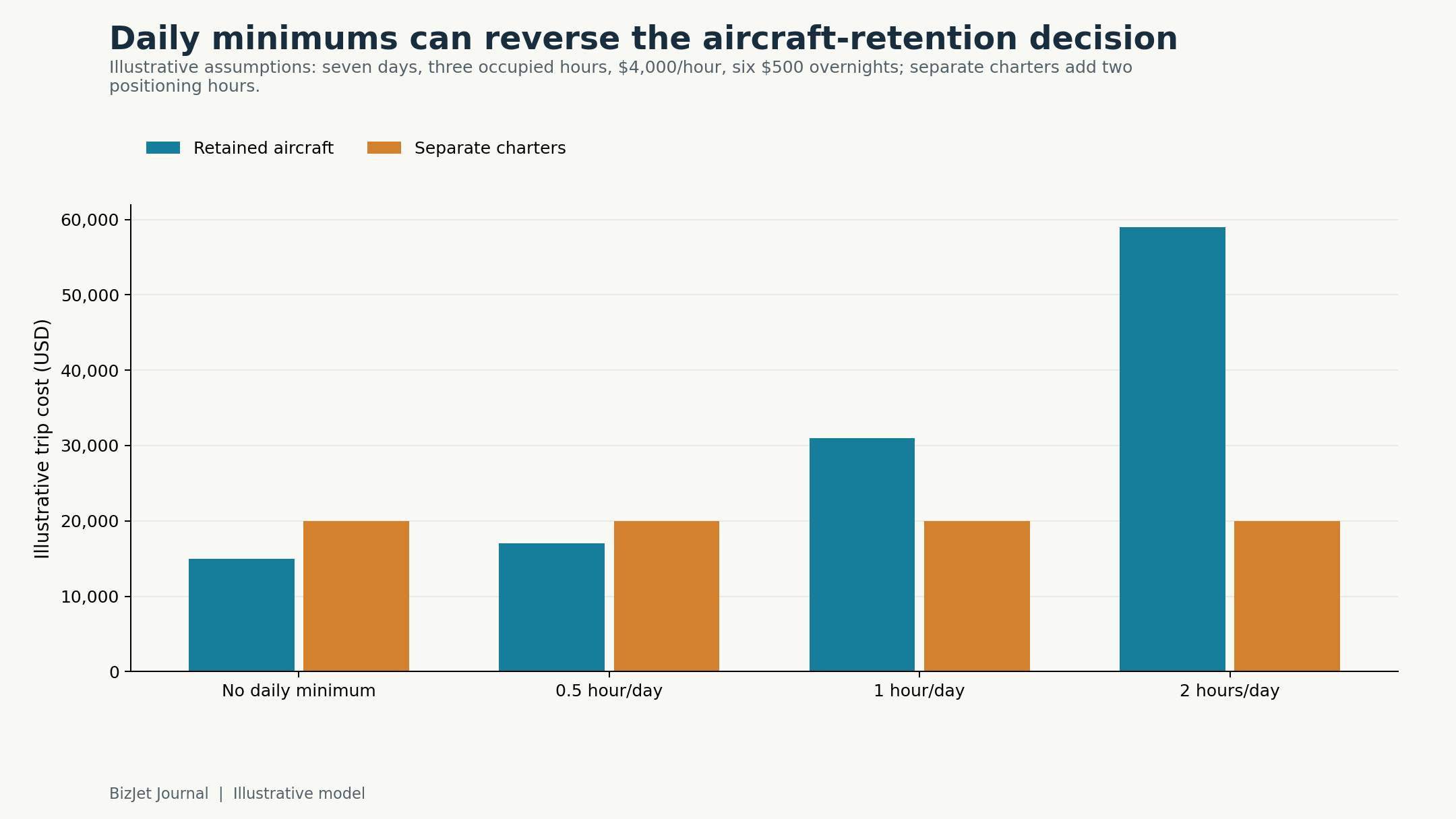
Use these illustrative assumptions for a seven-day comparison: three occupied flight hours, a $4,000 hourly charge, six retained overnights at $500 each and two additional positioning hours for separate charters. Assume the hourly charge is the same for occupied and positioning time. Exclude taxes, airport fees, handling, transfers and any other charges not represented by the assumed overnight allowance.
Without a daily minimum, retention costs 3 × $4,000 plus 6 × $500, or $15,000. Separate charters cost (3 + 2) × $4,000, or $20,000, with no overnight charge assumed in that scenario.
Now change only the retained-aircraft minimum. Assume the contract bills the greater of actual occupied time or the sum of a minimum for all seven retained days:
| Retained daily minimum | Retained billable hours | Retained flight charge | Six overnight charges | Retained total | Separate-charter total |
|---|---|---|---|---|---|
| None | 3.0 hours | $12,000 | $3,000 | $15,000 | $20,000 |
| 0.5 hour per day | 3.5 hours | $14,000 | $3,000 | $17,000 | $20,000 |
| 1 hour per day | 7.0 hours | $28,000 | $3,000 | $31,000 | $20,000 |
| 2 hours per day | 14.0 hours | $56,000 | $3,000 | $59,000 | $20,000 |
These are assumed commercial terms, not market prices or a claim that all operators use daily minimums. Actual contracts may calculate minimum use differently or incorporate positioning and overnights into a package.
The sensitivity is substantial: retention is $5,000 cheaper without a minimum, but $11,000 more expensive at a one-hour daily minimum. Under these assumptions, the retained total reaches $20,000 at 4.25 billable hours, because ($20,000 − $3,000) ÷ $4,000 = 4.25. That is the billable-time threshold to investigate, rather than arguing over the headline hourly rate.
Also define what retention buys. Does the aircraft remain exclusive to your party? Can the departure time change? What substitution terms apply? Parking the jet nearby and reserving it for immediate use are not necessarily the same contractual promise.
Make the yacht handoff a complete transfer plan
Name the meeting point, driver, vehicle, luggage capacity and receiving contact. If the yacht is at anchor, identify the tender arrangements and shore location. If it is alongside, confirm the marina access instructions. Neither should depend on the passenger finding a vaguely described representative after landing.
The luggage plan should cover every handoff. A vehicle that seats eight may not take eight travelers and their large cases. A tender may introduce another capacity or loading constraint. Send the same baggage description to the aircraft and yacht teams so that neither plans around a smaller load.
Build timing from touchdown through to boarding the yacht. For illustration, assume 30 minutes for airport processing, 45 minutes driving and 20 minutes to reach and board at the marina. That produces 95 minutes before any waiting or delay. If the yacht cannot receive guests until 16:00, a 14:00 landing under those assumptions reaches the handoff at 15:35 and needs a planned waiting arrangement.
These are assumptions, not transfer estimates for Nice, Olbia or Mykonos. Ask the local providers to replace them with trip-specific timings and an agreed margin. Do not assume a yacht has helicopter facilities or that a helicopter transfer is permitted simply because it would look convenient on the map.
Build a workable change order
Decide which element can move first if the itinerary changes. A flexible city night, an earlier island departure or a planned overnight near the embarkation point can be more useful than trying to keep every original booking untouched.
Identify who can accept a revised price and confirm a new flight. Changes may affect slots, parking, crew arrangements, hotel cancellations and marina transport at once. One organizer should collect those consequences and issue a single revised itinerary after the operating parties agree.
Check passenger entry requirements whenever the route changes jurisdiction, particularly if a later extension goes beyond the original Schengen itinerary. A convenient added stop may create different document and border-processing needs. Have the flight organizer review those before confirming the alteration.
Finally, preserve the distinction between the passenger's location and the aircraft's location. If the jet leaves Olbia while you remain in Sardinia, record where the next aircraft will come from and who monitors that sector. A backup plan becomes useful when it names the next decision, the responsible person and the practical alternative.
Frequently asked questions
Should I retain one aircraft for the tour?
Compare the full contract costs and the value of reserved availability. In the worked example, retention wins without a daily minimum but becomes more expensive with a one-hour daily minimum. Your actual answer depends on accepted parking, positioning and the operator's terms.
Does a slot include parking?
No. Movement coordination and the aircraft's approved ground stay answer different questions. Nice, Olbia and Mykonos use distinct procedures, so obtain confirmation of the planned duration at each stop rather than relying on a generic assurance.
How much margin does yacht embarkation need?
Build it from airport processing, the actual ground route, luggage handling and any tender transfer, then agree disruption allowance with the receiving team. The 95-minute illustration is not a destination-specific recommendation. The yacht's confirmed receiving time should anchor the calculation.