
Charter · guide
Why a One-Way Private Jet Flight Can Cost More Than Half a Round Trip
See how aircraft positioning, daily minimums and time away change the cost of one-way and round-trip private jet charters.

Suppose you have a private jet quote for a round trip, but decide you only need the outbound flight. You might expect the price to fall by half. After all, you have removed half your journey.
The aircraft's journey may barely change.
After you get off, the jet may still need to fly home. Those two hours you no longer need become two hours of empty flying, and the operator still has to pay for them. That is why a one-way private jet flight can cost much more than half a round trip.
Repositioning charges is the cost of moving an aircraft to or from a charter. Those hours are sometimes discounted, but are commonly priced at the aircraft's base hourly rate.
Once you follow the aircraft beyond your own flight, the quote starts to make more sense. The better comparison is the total cost of arranging your journey, including the flying you will never see.
Where the aircraft goes after you land
A locally based aircraft can be an attractive option for a short return trip. It starts near you, takes you to your destination, and brings you home.
Remove your return flight and the operator still has to decide where the aircraft goes next. Returning it to base can create an empty sector almost identical to the passenger sector you removed.
Those empty hours consume fuel, crew time and maintenance life. Positioning also brings airport charges and crew requirements into the calculation.
The aircraft might instead continue to another customer. That can improve the economics, especially when your destination is useful to the operator's next assignment. A one-way flight does not automatically require an empty return to its starting point.
There can also be positioning before your flight. An aircraft advertised as available in a region may still need to fly to your departure airport.
A $19,500 one-way flight and a $20,000 round trip
Take an example of a flight between two airports that requires two billable hours in each direction. The aircraft is based at your departure airport, and the operator prices occupied and empty flying at the same $4,500 hourly rate.
For this example, the rate includes fuel and the two hours include any billable taxi allowance. Assume $1,500 in airport, handling and other trip charges for the one-way itinerary, and $2,000 for the same-day round trip, including an additional $500 for return-passenger services.
These are example pricing assumptions; all totals below are before tax.
| Cost component | One-way passenger trip | Same-day round trip |
|---|---|---|
| Occupied flight time | 2 hours | 4 hours |
| Empty return to base | 2 hours | 0 hours |
| Total billable aircraft time | 4 hours | 4 hours |
| Flight charges at $4,500/hour | $18,000 | $18,000 |
| Trip charges | $1,500 | $2,000 |
| Total before tax | $19,500 | $20,000 |
Half the round-trip quote is $10,000. The one-way flight costs $9,500 more than that, a 95% premium over the half-price assumption.
Adding your return journey costs only $500 in this particular setup because the aircraft was already being priced to fly home.
That $500 is the marginal price of adding the return passenger sector to this assignment. It is not a standalone return-flight fare available to anyone who calls the operator.
In the one-way booking, you receive two occupied hours for $19,500, an effective $9,750 per occupied hour. With the return, you receive four occupied hours for $20,000, or $5,000 per occupied hour.
You are getting much more use from the same four hours of aircraft flying. That is where the apparent round-trip bargain comes from.
Of course, a cheap return sector has no value if you do not need to travel back. The calculation explains the small price difference; it does not give you a reason to buy a journey you will not use.
A higher hourly rate can produce a lower quote
Now suppose another suitable aircraft can serve the same passenger flight with only half an hour of positioning allocated to your booking. Its next assignment makes returning to your departure airport unnecessary.
Assume this second aircraft costs $6,000 per billable hour and has the same $1,500 trip-charge allowance.
| Cost component | Aircraft A: return to base | Aircraft B: better positioned |
|---|---|---|
| Hourly rate | $4,500 | $6,000 |
| Occupied hours | 2 | 2 |
| Positioning hours charged | 2 | 0.5 |
| Flight charges | $18,000 | $15,000 |
| Trip charges | $1,500 | $1,500 |
| Total before tax | $19,500 | $16,500 |
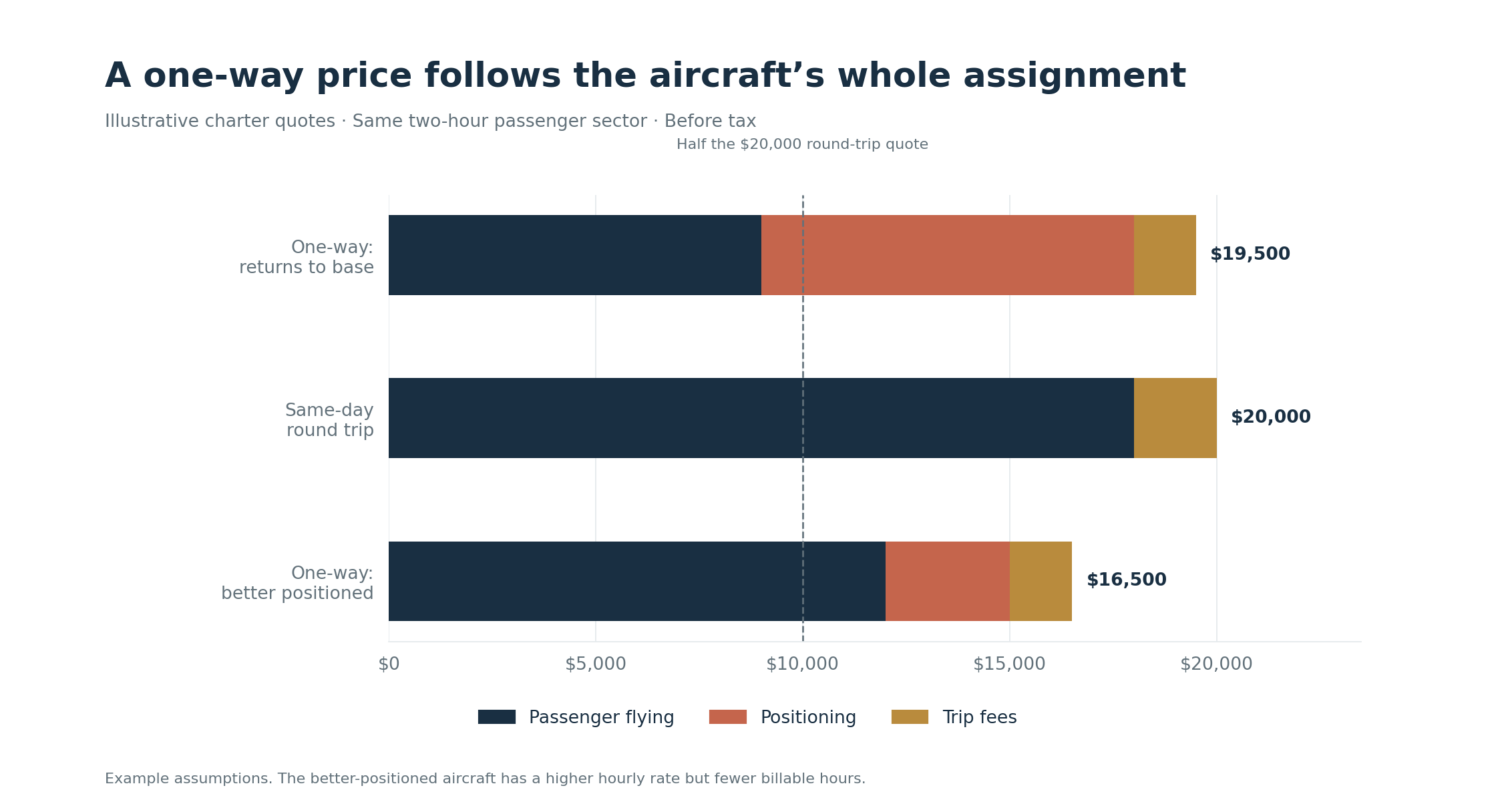
Aircraft B's hourly rate is one-third higher. Its complete quote is $3,000 lower, a saving of 15.4%.
It is easy to favor the $4,500 rate when you first compare the proposals. But you buy the complete trip, so the extra positioning can outweigh the saving on every hour.
It also explains why another departure airport can change the quote. If it reduces the aircraft movement required, it may be worth comparing the saving with your additional ground-transfer time and cost.
What floating fleets change
A floating fleet moves aircraft between assignments rather than requiring every jet to return to one permanent home base after each trip. This helps avoid an unnecessary empty return.
Membership programs can also allocate positioning expense across a wider network. VistaJet says Program and Corporate members do not pay positioning fees when flying within its global service area.
For your comparison, distinguish between a quote that bills specific positioning hours and a point-to-point price that already reflects the provider's broader operating economics. Adding a second estimated repositioning charge to an inclusive quote would count it twice.
When waiting makes a round trip more expensive
The short-return advantage can fade when you stay for several days. Keeping the aircraft and crew available has a cost even while the jet is parked.
Some charter companies describe daily minimum charges for round trips, including two-hour minimums on many smaller aircraft.
Extend the same example. Assume the operator charges the greater of actual billable flying or two hours per calendar day while the aircraft remains assigned to your trip. Add $900 per night for the combined crew and parking budget, and retain the $2,000 round-trip charges.
A one-night stay spans two calendar days. Four actual flight hours meet the four-hour minimum, so the additional cost is the $900 overnight budget.
A three-night stay spans four calendar days. The minimum becomes eight hours even though the aircraft still flies only four.
| Trip arrangement | Billable hours | Overnight budget | Trip charges | Total before tax |
|---|---|---|---|---|
| Same-day return | 4 | $0 | $2,000 | $20,000 |
| One night, aircraft waits | 4 | $900 | $2,000 | $20,900 |
| Two nights, aircraft waits | 6 | $1,800 | $2,000 | $30,800 |
| Three nights, aircraft waits | 8 | $2,700 | $2,000 | $40,700 |
| Two separate one-way bookings | 8 total | $0 | $3,000 total | $39,000 |
The two separate bookings assume the same $19,500 price in each direction, each including two occupied and two positioning hours, with no aircraft held between your travel dates.
At two nights, keeping the aircraft costs $8,200 less. At three nights, the separate bookings cost $1,700 less.
The crossover comes from this example's daily minimum and overnight budget. Change those terms, the aircraft's other commitments or the separate one-way quotes, and the result changes with them.
A round-trip booking can also involve an aircraft leaving during your stay and another returning to collect you. The label describes your itinerary; the proposal establishes whether the same aircraft and crew remain available throughout it.
The full quote matters more than the flight-time calculation
Flight charges are only part of the comparison. Landing and handling charges, crew accommodation, catering and additional services among the items that can sit within a charter price.
Airport charges can apply to empty movements as well as passenger flights. Passenger services may differ between the one-way and return itineraries, as the extra $500 in the first example shows.
For both proposals, establish whether fuel is included, how taxi time is counted, which minimums apply and whether the quoted amount includes applicable taxes. The broader private jet charter cost guide explains how those components build into the final total.
Keep your passenger count, baggage requirements, airports and dates the same when you compare the proposals. Otherwise, you can spend time negotiating what looks like a better price only to discover that it buys a different trip.
Why an empty leg is a different purchase
An empty leg exists because an aircraft already needs to move for another assignment. Buying that movement can produce a substantially lower price than commissioning a new flight around your own schedule.
That makes an empty-leg listing a useful alternative when its route and timing fit. It is not the standard price against which every fully arranged one-way charter should be measured.
Compare the aircraft assignment
For a short return, request a single round-trip price alongside the one-way price. For a longer stay, compare an aircraft that waits with separately arranged flights in each direction.
The useful explanation from the provider is specific: where the aircraft starts, how many hours are charged, whether it stays, and what happens after your last passenger sector.
In the first example, removing your return flight saves $500 because the aircraft still flies home. In the second, changing the aircraft's position saves $3,000 despite a higher hourly rate. Those are the mechanics that determine whether a one-way quote represents good value.
Frequently asked questions
Why can a one-way private jet flight cost almost as much as a round trip?
The aircraft may still have to fly back after you get off. In the example above, it flies four hours whether you book one way or return the same day. The one-way quote is $19,500 before tax, while adding the passenger return brings the total to $20,000.
Do you always pay repositioning charges on a private jet charter?
The quote can charge positioning separately or include it in the overall trip price. What matters is the final amount for your itinerary. If positioning is already included, adding another estimated ferry charge would count it twice. An aircraft that is already nearby may also need less positioning.
Can a jet with a higher hourly rate be cheaper to charter?
Yes, if it needs fewer billable hours to deliver your trip. In the example above, an aircraft charging $6,000 an hour produces a $16,500 quote, compared with $19,500 for one charging $4,500. The higher-rate aircraft needs only half an hour of positioning instead of two hours.
Is it cheaper to keep the aircraft waiting or book two one-way flights?
Compare both arrangements for your actual dates. Daily minimums, crew accommodation and parking can make waiting expensive. In the example above, keeping the aircraft for two nights costs $30,800 before tax versus $39,000 for separate one-way bookings. At three nights, waiting rises to $40,700 and becomes the more expensive option.
Is a one-way charter the same as an empty leg?
No. With a conventional one-way charter, you request the journey and the provider arranges an aircraft around it. An empty leg offers a movement the aircraft already needs to make for another assignment. Its price can be attractive, but you have to fit the available route and timing.