Regulation · guide
UK General Aviation Reports: Filing Deadlines and Passenger Changes
A late passenger, a missing passenger and an overnight delay have different consequences for a UK-bound private flight. The clock runs from departure.

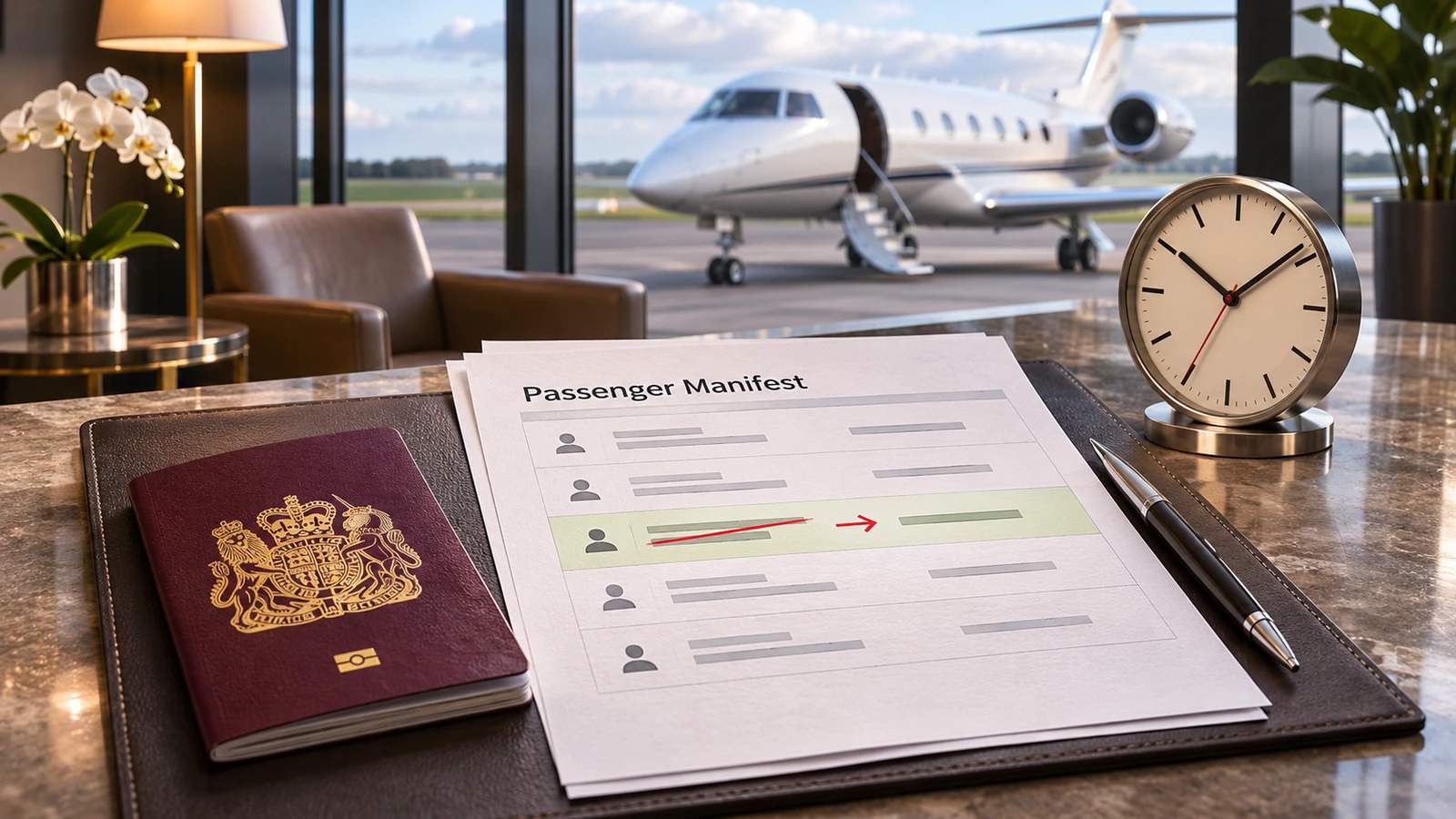
At 2:10 p.m., a colleague asks to join a private flight leaving France for the UK at 3. There is an empty seat. The aircraft, crew and arrival airport are all ready. But if the colleague was absent from the UK General Aviation Report, the flight cannot take the extra passenger at 3 under the ordinary reporting rules. File the revised information at 2:10 and the earliest departure with that person is 4:10.
Reverse the situation and the answer changes. If a passenger already listed decides to stay in France, the remaining party can keep the 3 p.m. departure, assuming everything else is in order. Border reporting treats an additional person differently from an empty seat. For a traveling party making decisions over lunch, that distinction is worth more than the number of seats on the airplane.
When the UK General Aviation Report filing window opens
The UK requires advance electronic reporting for international general aviation flights arriving in or departing from the UK, including flights involving the Common Travel Area. The ordinary window opens 48 hours before the expected departure and closes two hours before it. The reference time is when the flight is expected to leave its departure aerodrome. The length of the crossing and the time the aircraft is due at the UK terminal do not enter the calculation. The Home Office sets out the routes, approved submission methods and information required in its general aviation guidance.
Take a Friday departure scheduled for 15:00 UTC. The window runs from 15:00 UTC on Wednesday through 13:00 UTC on Friday. Filing at noon on Wednesday would be too early. Filing at 13:15 on Friday would put the planned departure inside the two-hour minimum. Using the same time basis for both endpoints also avoids an easy mistake when the departure airport and the British destination show different times on their wall clocks.
The report identifies the aircraft, journey, crew and passengers. The responsible person can use the free UK submission service or another approved electronic system. Sending the handler an email can supply information for the booking, but that email itself does not accomplish the statutory filing. A handler can do the work as agent. On a managed aircraft, it matters whether the handler or the management company actually submitted the accepted version, especially when a second person subsequently changes the manifest.
Which changes require a new report?
Two itineraries that look identical to the traveler can have different reporting consequences. The Home Office distinguishes a delayed departure from a change in who is actually traveling. The online service also explains how to deal with amendments and people who drop out.
| Change to an ordinary, previously reported flight | Effect on the report |
|---|---|
| One listed passenger stays behind | No amendment is needed solely for that person's absence. |
| A colleague takes the place of a listed passenger | The colleague is an addition. Submit the new information at least two hours before departure. |
| The aircraft leaves later on the same calendar day | A delay alone does not require another submission. |
| Departure slips to the following calendar day | Submit a new report for the new day and allow the reporting time. |
| The destination airport changes before departure | Submit the revised arrival aerodrome. |
A name swap deserves particular attention on a company trip. The cabin may still hold six people, and the invoice may be exactly the same, but the seventh name the operator has received over the course of the day belongs to somebody the authorities have yet to assess. A note saying “one guest replaced” does not identify that traveler. The same timing principle matters when correcting an error in a traveler’s details. A birth date noticed to be wrong at the boarding desk is a reason to contact the person handling the filing immediately.
A late mechanical issue receives narrower treatment. If the aircraft has a technical problem within two hours of expected departure and must be replaced, the operator should send the revised aircraft information. Under the Home Office’s stated exception, the two-hour wait does not apply if every person on the amended report was included on a previously submitted report. Combine that aircraft substitution with an entirely new passenger and the exception no longer describes the flight.
What a Friday meeting can do to the return leg
Consider an outbound flight from the UK on Thursday with a return from the continent on Friday. These are separate international movements. Preparing the Thursday paperwork does not cover Friday’s return. The outbound passenger list can be a starting point for the return filing, but the return has its own departure time, aircraft details and travelers.
Suppose the Friday meeting runs on and the original party moves its 15:00 departure to 17:00. For an otherwise unchanged flight later that day, the GAR already filed can stand. Meanwhile, another attendee has asked to join. If the agent files the additional passenger at 14:40, the ordinary reporting window allows departure with the new passenger from 16:40. The meeting delay has, in effect, provided enough time for both changes. If the original group decides at 15:30 to leave after all, the decision turns on whether the additional person travels.
A postponed meeting can have a larger effect than a long taxi delay. Change Friday’s departure to Saturday morning and the new calendar day requires a fresh filing. The travelers might use the same cars, hotel and aircraft, yet the border report now describes another day’s movement. A weekend departure can also affect the hours during which the chosen airport accepts the flight.
What submitting the report settles
A submitted GAR gives the authorities advance information about the journey. Immigration eligibility, the airport’s authority to receive that category of flight and any separate police notification remain relevant. An air traffic flight plan serves another purpose. A clearance to fly the route does not resolve a mistake in a traveler’s identity information. Likewise, an airport accepting a parking reservation tells the operator where the aircraft can stand, without establishing whether everyone on board has permission to travel.
The Common Travel Area is particularly easy to oversimplify. The UK guidance treats routes, aerodrome designations and journeys for reward differently in setting out police notification requirements. An itinerary involving Ireland or the Crown Dependencies deserves a route-specific reading even on a short sector. A party that moves its departure to meet the ordinary two-hour window can still have another constraint at the chosen field.
Frequently asked questions
Can a UK General Aviation Report be filed a week before the flight?
The ordinary submission window opens 48 hours before expected departure. The operator can collect and verify travel documents earlier, then submit once the window opens. An early aircraft reservation or completed passenger spreadsheet does not start the statutory clock.
Does the two-hour deadline run from arrival in Britain?
It runs from expected departure, including when the departure airport is outside the UK. A long flight therefore does not give the operator more time to supply passenger information after takeoff.
Does a crew replacement count as a change if the passengers stay the same?
Yes. Crew are people on board and their information forms part of the report. An additional crew member who was absent from the previous filing must be reported with the required notice. A listed crew member who simply drops out is treated under the removal guidance, subject of course to the flight still having the required crew.
Can a passenger who misses the flight use the same filing tomorrow?
The original party can leave without that passenger. The following day’s flight is a different movement and needs its own report, covering the traveler and the actual aircraft, route, crew and departure time.