
News · news
Nine Killed in Learjet 60 N722BD Crash Near West Palm Beach
All nine aboard the Austin-to-Bahamas Learjet 60 died, Sean Duffy said. Flight tracking indicates the steep descent began around 35,000 feet.


All nine people aboard a Learjet 60 business jet, registered N722BD, were killed when it crashed near West Palm Beach, Florida, on Sunday, November 1, during a flight from Austin, Texas, to the Bahamas, U.S. Transportation Secretary Sean Duffy said.
In its published accident statement, the FAA said the aircraft came down in a residential area near Cresthaven, in Palm Beach County, at about 12:50 p.m. local time. Flightradar24’s flight record lists an actual departure from Austin (AUS) at 15:37 UTC, with North Eleuthera (ELH) as the destination.
The identities of those aboard and any casualties on the ground had not been independently verified by BizJet Journal at this update.
The crash occurred in the Greenacres area, southwest of West Palm Beach. The FAA and National Transportation Safety Board will investigate, with the NTSB leading the inquiry.
Rapid descent from around 35,000 feet
Videos circulated on social media and carried in news reports show the jet descending at a steep angle before impact and a large fire. Images from the scene show a crater, scattered debris and flames beside a roadway.
Flightradar24’s barometric-altitude graph shows N722BD cruising at approximately 41,000 feet earlier in the flight. It then descended to 35,000-foot and briefly leveled before the much steeper final descent.
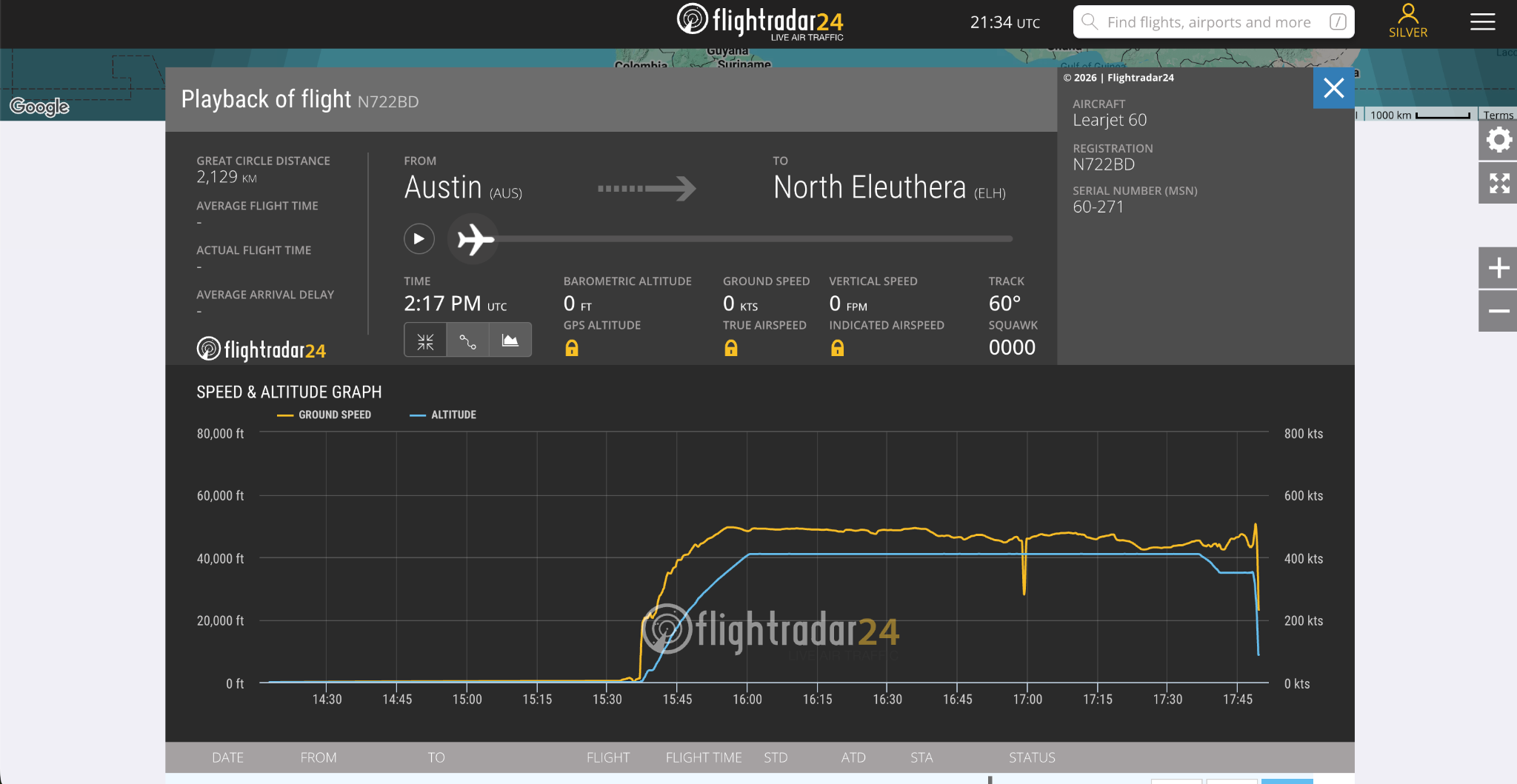
Related tracking view: ADS-B Exchange replay for A9AB17 on November 1.
ATC communications: icing, turbulence and an overspeed report
🔴 ⚠️ WARNING — GRAPHIC AUDIO This recording contains graphic and distressing emergency communications from a fatal aircraft accident. Listener discretion is strongly advised.
Listen to the ATC audio shared by AirNav Radar on X.
The recordings of radio calls captured by LiveATC.net show the pilot reporting ice accumulation, an outside air temperature of −47°C and moderate turbulence causing altitude fluctuations of up to about 700 feet. The pilot described the light, clear ice as manageable while communicating with Miami Air Route Traffic Control Center.
The crew subsequently reported precipitation and requested a climb. The situation then developed into an emergency: the pilot made Mayday calls and reported a descent reaching 10,000 feet per minute, followed by 20,000 feet per minute and an overspeed condition, according to the published account.
“We are in an overspeed condition descending 20,000 feet per minute,” the pilot said.
These were reports transmitted by the crew over the radio, separate from the GPS-derived estimates in the timeline below. The account establishes what was reported during the exchange; it does not determine the cause of the accident.
What the ADS-B analysis reports: a timestamped sequence
A preliminary analysis by BizJet Journal, described as based on a KML export from ADS-B Exchange’s November 1 replay for N722BD, sets out a more detailed sequence. BizJet Journal has not independently reprocessed the underlying KML. The times and calculated figures below are attributed to that analysis and remain provisional.
All times are Eastern Standard Time (EST, UTC−5) on November 1. In the supplied analysis, vertical rates were calculated from changes in GPS altitude over windows of approximately four seconds.
Such short-window estimates can fluctuate; the speed and angle figures are also estimates rather than verified flight-recorder measurements.
Around 10:36 a.m. — Departure and climb
The analysis places departure from the Austin area at approximately 10:36 a.m., followed by a climb to FL410, or 41,000 feet pressure altitude. Flightradar24’s separate flight record lists the actual departure at 15:37 UTC, equivalent to 10:37 a.m. EST. The one-minute difference between the two summaries has not been reconciled.
12:37–12:41 p.m. — Descent to FL350 and level-off
The timeline describes a step-down from FL410 to FL350, approximately 35,000 feet pressure altitude, at around 1,500 feet per minute. It reports a level-off at FL350 before the later rapid descent.
Around 12:47 p.m. — Right turn near Palm Beach
The track direction reportedly changed from approximately 051° to 100° during a right turn near the Palm Beach airport area. The analysis places groundspeed at approximately 460 knots. These direction values describe the track over the ground.
12:48:06–12:48:16 p.m. — Brief altitude excursion
A brief climb reaching approximately 450 feet above FL350 before the aircraft began descending. A climb rate near 1,000 feet per minute.
12:48:16–12:48:32 p.m. — Rapid descent develops
The analysis places the transition into the rapid descent at approximately 12:48:16 p.m. The descent rate increased to about 20,000 feet per minute within the following 16 seconds, after the aircraft had been near FL350.
12:48:32–12:48:48 p.m. — Descent near 20,000 feet per minute
For this interval, the descent rate holding around 20,000 feet per minute and an estimated downward trajectory angle of approximately 22°. It estimates speed at approximately 540 knots, describing that figure as true airspeed and roughly Mach 0.9. Those airspeed and Mach estimates have not been independently verified.
For comparison, a EUROCONTROL performance table lists the Learjet 60’s maximum operating Mach number, or Mmo, as 0.81.
12:48:48–12:49:33 p.m. — Descent steepens
The reconstruction describes a progressively steeper path through this interval. Its estimated downward trajectory angle passes approximately 50° as altitude falls through about 18,000 feet, reaching roughly 65°–70° late in the recorded descent. It places estimated speed in the range of 575–600 knots, again labeling this as true airspeed.
The analysis also reports an encoded vertical-rate value of −32,640 feet per minute, which it describes as the limit of that encoded field.
The final turn and estimated 77-second sequence
Across the final descent, the analysis describes a continuing right turn, with track changing from about 100° to 292°—approximately 190° in around 75 seconds. It characterizes the resulting path as a tightening right-hand spiral and estimates approximately 77 seconds from near FL350 to the reconstructed impact time.
The analysis describes no apparent recovery in the trajectory. The track summary does not establish what recovery actions the crew attempted, and its estimated impact time has not been independently confirmed.
Disclaimer: The angle estimates above describe the reconstructed trajectory, not a directly measured nose or pitch attitude. Groundspeed, true airspeed and Mach are separate quantities. The summary does not establish whether its airspeed estimates came from recorded air-data fields or from calculations using position and altitude. GPS-derived motion alone is insufficient to verify those true-airspeed and Mach estimates.
This preliminary chronology describes a reported flight path. It does not establish why the aircraft entered the descent or determine the accident’s cause.
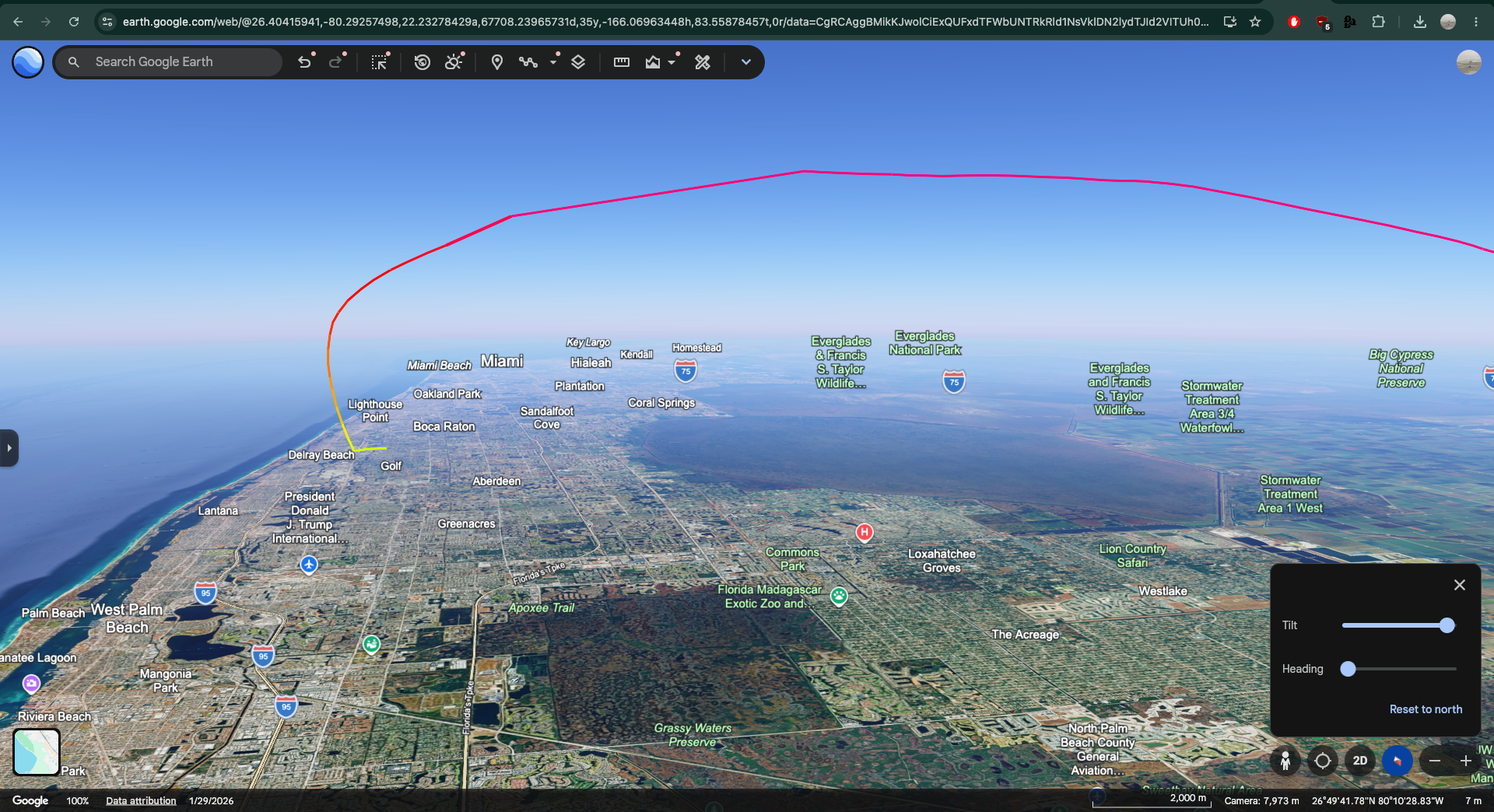
View the depiction in Google Earth.
The Palm Beach County Sheriff’s Office placed the response along Military Trail between Cresthaven Boulevard and 10th Avenue North. Authorities closed the road in both directions and asked motorists to avoid the area while emergency crews worked.

N722BD: age, ownership and operator
The FAA aircraft registry identifies N722BD as a Learjet Inc. Model 60, serial number 271, registered to LR60271 LLC of Wilmington, Delaware.
An archived Aircraft.com sales listing identifies N722BD, serial number 271, as a 2004 Learjet 60, making it approximately 22 years old.
The FAA record shows a registration certificate issued in January 2023, but leaves the manufacturing-year field blank. The certificate date is not the aircraft’s build date.
LR60271 LLC is the registered owner. BizJet Journal had not independently confirmed the company operating Sunday’s flight or whether it was conducted as a charter or a private flight.
The Learjet 60’s place in business aviation
The Learjet 60 is a midsize business jet developed from the earlier Learjet 55 family. It entered service in 1993, following Bombardier’s acquisition of Learjet in 1990. The European Union Aviation Safety Agency’s type certificate data sheet records FAA certification of the Model 60 on January 15, 1993.
The aircraft has a swept wing with winglets, a T-tail and two rear-mounted Pratt & Whitney Canada PW305A turbofan engines, each rated at 4,600 pounds of takeoff thrust. It requires two pilots.
Bombardier later introduced the Learjet 60XR. The updated version brought a redesigned cabin and Rockwell Collins Pro Line 21 avionics, replacing the original model’s Pro Line 4 flight deck.
A Transport Canada operational evaluation describes the XR as an upgrade of the existing Model 60 rather than an entirely new aircraft. It identifies serial number 319 as the start of the new production configuration. The XR entered service in 2007, succeeding the original Learjet 60.
Investigation to establish what happened
No cause had been established at publication. The available videos and flight-tracking information describe part of the aircraft’s final descent; they do not explain why it occurred.
The NTSB will lead the federal investigation, supported by the FAA. Further official updates are needed to establish the sequence of events and confirm the flight’s occupants, operator and any impact on people on the ground.
This is a developing story. Please check back for updates. BizJet Journal will update this article as official information is verified.