
A step-by-step look at how the new platform takes a customer-confirmed trip through fleet matching, a sealed operator bid, an aircraft hold and a signed contract.
Amalfi Technologies has launched LastLook, a platform that gives Part 135 operators a final opportunity to compete for charter trips a broker has already confirmed with a customer. The product brings together a disclosed benchmark price, one confidential operator offer and a sequence of award and contract actions.
Amalfi Jets founder and CEO Kolin Jones announced the launch in a LinkedIn post. He described LastLook as the first software product from Amalfi Technologies and said operators would be offered a last look at trips booked by Amalfi Jets. Access for other brokers is planned at NBAA-BACE 2026.
The company’s product tour explains more than the launch announcement: the bid becomes a commitment, the aircraft must be held, the broker chooses an offer, and the operator then sends a contract for signature. The walkthrough below follows that process, using screenshots from the tour. Routes, dates, registrations, prices and metrics in these illustrations are demo content, rather than independently verified transactions.
The key to understanding LastLook is that customer confirmation, operator selection and a signed operator contract are different stages. A broker can have a booked customer trip while still sourcing the aircraft that will perform it. LastLook is intended to bring operators into that sourcing stage with a defined opportunity and a number to beat.
| Participant | Role in the demonstrated workflow |
|---|---|
| Customer | Has confirmed a trip with the broker before it reaches LastLook. The tour later refers to the client re-signing during the aircraft hold. |
| Charter broker | Provides the opportunity, receives confidential bids, selects an operator and signs the operator contract in the demonstration. |
| Aircraft operator | Evaluates the trip, nominates an aircraft, submits a NET price, holds availability and sends the operating contract if awarded. |
| LastLook | Presents opportunities, records the bid and tracks the award and contract stages. The awarded Part 135 certificate holder operates the flight. |
1. Start with a customer-confirmed trip
The starting point is a trip the broker has already booked with its customer. LastLook’s explanation says that the broker opens this opportunity to the market for a final sourcing look.
The example is KVNY–KDAL, from Van Nuys to Dallas, with six passengers and a requirement for a Citation X or larger aircraft. These details define the demand the operator is considering: a particular journey, passenger load and aircraft requirement.
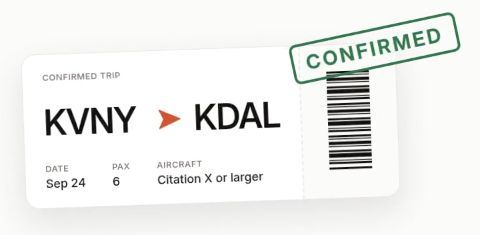
The proposed benefit is a more qualified starting point for operators that spend time answering enquiries which may never become bookings. Customer confirmation does not, by itself, establish that a particular operator has won the trip, received payment or completed the flight.
2. Receive a matching opportunity and inspect the trip
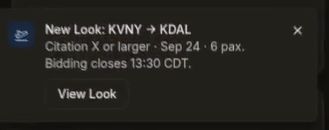
LastLook says qualified operators with matching or larger aircraft receive the opportunity. In the tour, an in-app notification identifies a new “Look,” gives the route, aircraft requirement and passenger count, and shows when bidding closes. A View Look action opens the opportunity.
The trip list then presents a countdown, route and itinerary details, aircraft information, the benchmark and a Bid action. The KVNY–KDAL row shows one hour and 55 minutes remaining and a $29,000 benchmark.

For an operator, this is the first feasibility check. An aircraft-category match still needs to be assessed against the actual aircraft’s position, availability, passenger requirements, crew availability and the cost of performing the itinerary. Those operating considerations determine whether the opportunity makes commercial sense before a firm offer is submitted.
The tour includes one-way, round-trip and multi-leg opportunities. Its list also uses aircraft-category filters, so the workflow is broader than selling a single empty repositioning sector.
3. Read the benchmark, deadline and disclosure rules
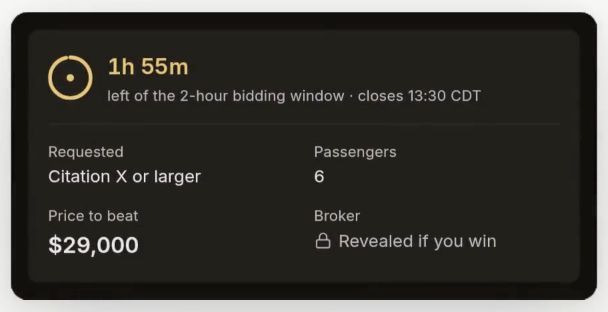
Opening the example reveals a compact decision panel. It confirms six passengers, the Citation X-or-larger requirement and the $29,000 price to beat. It also shows one hour and 55 minutes left in an example two-hour bidding window.
This changes the pricing task. Instead of preparing an offer without a stated target, the operator can compare the published benchmark with its own economics and decide whether to compete. The tour does not explain how the broker calculates the benchmark or identify it as the customer’s final retail fare.
The panel also says the broker will be revealed if the operator wins. At this point, the operator is evaluating the itinerary and benchmark without the broker name being displayed in this view.
The two-hour bidding window belongs to this example. Other opportunities in the tour display different remaining times, so the demonstration does not establish a universal deadline for every trip.
4. Choose an aircraft and build the NET offer
The bid form asks the operator to select an aircraft. In the example, the selected entry is a Citation X, N405ER, based at KVNY. The form therefore ties the offer to a nominated aircraft, rather than leaving it as an unallocated aircraft-category quote. The registration is illustrative tour content.

The next field is the operator’s NET price. Its help text says the figure includes fuel, crew, repositioning, catering, handling and event fees. It describes the amount as what the broker wires to the operator and the amount of the operator’s invoice, before federal excise tax (FET).
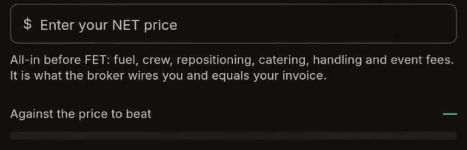
The distinction matters: an offer based only on airborne flying costs could leave out repositioning or other expenses the interface expects to be covered. This is the point at which the operator has to build a price that works for the complete operation being offered.
The tour uses a final bid of $25,500 against the $29,000 benchmark. The $3,500 gap is approximately 12%, which the interface displays as the amount below the benchmark. That percentage measures distance from the published target; it does not tell the operator where its bid ranks against competitors.
Nor does that gap establish the operator’s profit, the broker’s commission or the passenger’s saving. Jones says savings will be passed to customers, but the tour does not show the customer’s final invoice or verify realised savings.
5. Review the commitment and submit one sealed bid
Before the offer is sent, the tour displays a binding-bid warning. It requires the aircraft to be held for three hours after the bidding window closes while the client re-signs.
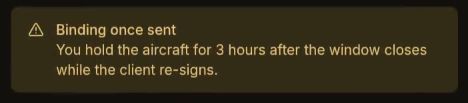
This is a substantive part of the model. The operator is offering a price and committing aircraft availability for a period, which affects how it can respond to other work. A hold is also different from winning: it supports the decision and contracting process while the award remains unresolved.
The platform’s stated rule is one sealed bid per opportunity. Operators cannot see another operator’s price, the number of competing bids or their ranking. The tour also says a submitted bid cannot be edited or withdrawn. The review action therefore matters because the displayed workflow does not provide a later repricing round.
The resulting receipt records the route, six passengers, nominated aircraft, $25,500 NET offer, $29,000 benchmark and three-hour post-close hold.
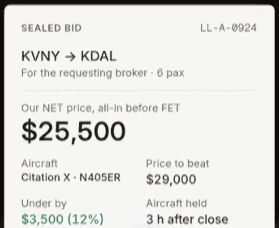
These restrictions make the process a single confidential sourcing offer, with the broker able to compare submissions while each operator prices independently.
6. Wait for the window to close and the broker to decide
When the bidding period ends, the opportunity changes to Closed. The row retains the itinerary, nominated aircraft, bid and benchmark, and adds a Broker deciding status.

An offer below the benchmark has not yet won at this stage. The tour shows a broker decision, rather than establishing an automatic rule that the lowest price receives the award. It does not disclose the broker’s full selection criteria.
For the operator, the practical distinction is between a submitted offer awaiting a decision and an awarded trip requiring action. The aircraft hold introduced during review is relevant to that waiting period.
7. Receive the award and identify the broker
The winning notification says Amalfi Jets selected the operator’s offer. It confirms the itinerary, passengers, nominated aircraft and $25,500 NET amount. The broker identity is now visible, consistent with the earlier disclosure rule.
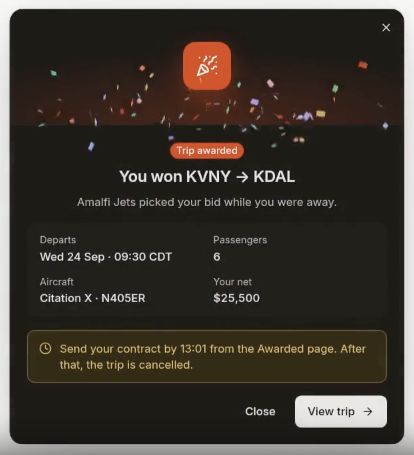
The notification also directs the operator to send its contract through the Awarded page by the displayed deadline. It warns that the trip is cancelled if the document is not sent in time. The View trip action leads into that next stage.
The award is therefore a selection milestone with an outstanding documentation task. The demonstration continues through that task and the broker’s signature.
8. Send the operator contract and track signature
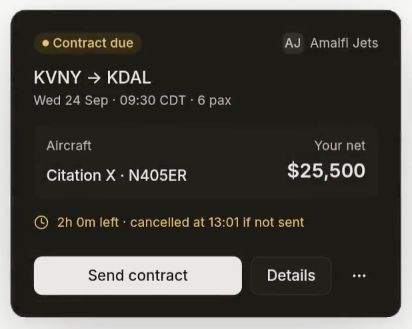
On the Awarded side of the app, the example card is marked Contract due. It shows the broker, route, aircraft and NET amount, alongside a countdown and a Send contract action.
After the contract is sent, the card changes to Awaiting signature. It records that the document has been sent, gives the broker a signing deadline and presents a Send reminder action.
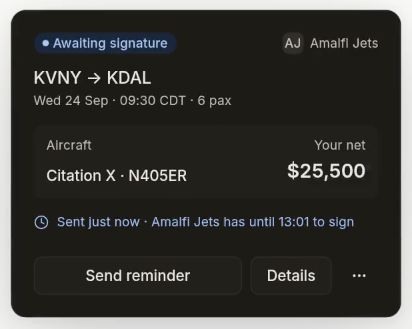
This is a clear handover in responsibility. The operator can distinguish an unsent document from one that has reached the broker but is still awaiting signature. Sending the document does not immediately produce the final signed state.
9. Confirm signature and access the signed contract
The final card becomes Contract signed. It identifies Amalfi Jets as the signing broker, records a signing time and makes a Download contract action available. The tour describes this as the trip-confirmed stage.
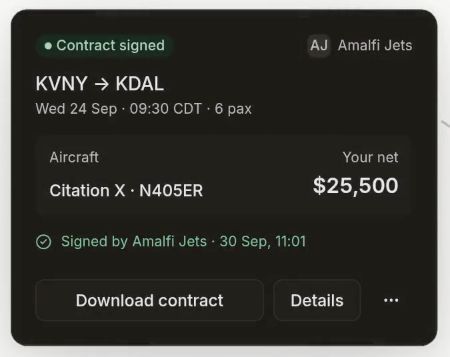
The full sequence is therefore customer-confirmed demand, operator bid, broker selection, operator contract submission and broker signature. The initial customer confirmation and this later operator-contract confirmation serve different purposes.
The demonstration covers sourcing through contract signature. It does not walk through payment settlement or the subsequent flight operation, so the signed card should not be read as evidence of payment received or a flight completed.
The timing cues also belong to different obligations:
| Timing cue | What it governs | What the tour illustrates |
|---|---|---|
| Bidding window | How long operators have to submit their offers. | A two-hour window for the highlighted opportunity. |
| Aircraft hold | Availability committed while the decision and re-signing process proceeds. | Three hours after the bidding window closes. |
| Contract and signature deadline | Sending the operator document and obtaining the broker’s signature. | A countdown on the Contract due card and a signing cutoff on the Awaiting signature card. |
The displayed dates and clock values are illustrative. The tour does not establish these durations as default terms for every opportunity.
The dashboard’s supporting controls
The operator workspace separates open opportunities, submitted bids, lost opportunities and awarded trips. Aircraft filters include light, midsize, super-midsize and heavy categories. Countdown-led rows and a closing-next panel help users identify which opportunities need attention.
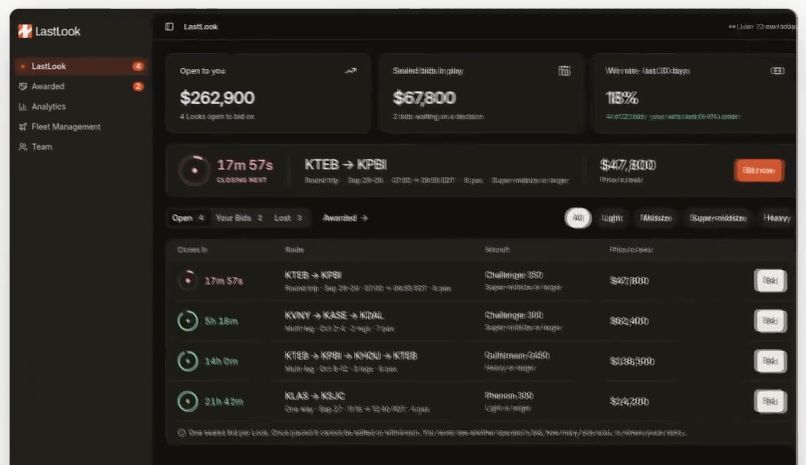
Its summary cards distinguish open opportunity value from sealed bids still in play. The Analytics view adds earned NET value on signed trips, bid rate and win rate, with a selected reporting period. The tour labels win rate in terms of decided bids won, making its denominator different from the total number of opportunities presented.
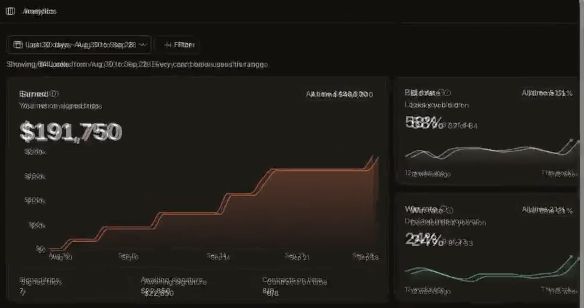
These measures should be read according to their stage. An open-opportunity total is potential work, and an in-play bid is still unresolved. A signed-trip value is a different measure again; the tour does not demonstrate cash collection or operator profit reporting.
Navigation also includes Fleet Management and Team. Those entries are visible, but the supplied tour does not explain aircraft onboarding, team permissions or dispatch-system integrations.
How LastLook differs from established charter apps
LastLook’s proposed distinction is the combination of customer-confirmed demand, a disclosed benchmark, one sealed bid and a time-bound availability and contracting sequence. Digital aircraft sourcing, alerts and booking workflows already exist across the charter market.
The links below open the relevant profiles in BizJet Journal’s Intelligence directory.
Avinode · CharterPad · Returnjet
| Platform | Published workflow | How LastLook positions its approach |
|---|---|---|
| Avinode | Aircraft search using live availability and estimated pricing, with requests and broader quote, contract and payment workflows. | Starts the operator offer around a customer-confirmed itinerary and an upfront benchmark, with one sealed submission. |
| CharterPad | Trip Board, aircraft and operator searches, enquiries, quotes and criteria-based alerts. | Applies a timed, confidential bidding process to trips the broker says are already confirmed with the customer. |
| Returnjet | Fleet marketing, broker–operator messaging, scheduling and quoting integrations, and empty-leg listings. | Presents a final sourcing opportunity for a confirmed customer trip, followed by award and contract-status tracking. |
Established marketplaces can also support booked trips. The comparison is about LastLook’s stated entry point and demonstrated workflow, rather than evidence that confirmed demand is exclusive to the platform. Free operator participation is also an existing model: LastLook advertises no operator fees, and Returnjet already promotes free operator fleet marketing without subscriptions or fees.
LastLook could give operators a more defined offer to evaluate, with less uncertainty about whether the customer intends to travel. It also asks them to make an independent price decision and commit availability before the final contract stage. Its practical value depends on the suitability of the opportunities and the operator’s ability to deliver them at the submitted NET price.
The rollout remains staged. At the time of review, LastLook’s public terms described invitation access and were marked as a template awaiting legal review. They place the carriage contract between the broker or customer and the awarded operator, and do not guarantee that a trip will be awarded, flown or paid for. Final commercial terms matter alongside the product demonstration.
Jones’s plan to offer Amalfi Jets’ booked trips provides an initial source of demand. Opening LastLook to other brokers would extend the pool beyond Amalfi’s own bookings. Whether the platform improves operator utilisation and customer pricing will become clearer through completed-trip results and the broader broker rollout.
Sources reviewed 1 October 2026. Images: LastLook product tour; tightly cropped screen captures. Figures, registrations and timings are illustrative demo content.