

Technology Tools · guide
Private Jet Wi-Fi Systems Compared: What You Can Install and Where Amazon Leo Fits
Compare private jet Wi-Fi systems by aircraft, route, installation and monthly cost, including Starlink, Gogo, Viasat and Amazon Leo’s rollout.


Take an example of a flight from New York to London. Halfway across the Atlantic, you need to send a revised presentation while your colleague is on a video call. The aircraft’s equipment list says “Wi-Fi equipped.” What matters now is whether the service covers the crossing and how much upload capacity the two of you share.
If most of your flying is between Dallas and Chicago and you mainly answer email, an air-to-ground system may do the job. The same equipment won’t keep you connected over the Atlantic.
To choose a private jet Wi-Fi system, start with the trips you make and the work you do onboard. Then compare what fits your aircraft and what you’ll pay to install and use it.
Which private jet Wi-Fi systems can you actually buy?
Your phone talks to a Wi-Fi access point inside the cabin. The aircraft needs a second connection to carry that traffic to the internet. That second link might use towers on the ground or an antenna pointed at satellites. A cabin can even have perfectly good Wi-Fi for watching movies stored onboard and no internet connection at all.
| System or service | How it connects | Where it fits |
|---|---|---|
| Gogo AVANCE L3, L5 and 5G LX5; Apcela ONE and DUAL | Air-to-ground (ATG) | Domestic and regional trips inside the provider’s tower coverage. |
| Starlink Aviation; Gogo Galileo | Low Earth orbit (LEO) broadband | Business aircraft with a compatible installation. Ocean crossings also require a plan that covers the route. |
| Viasat JetXP / Jet ConneX; Gogo Plane Simple Ku / SES FlexExec; Collins LuxStream | Geostationary (GEO) broadband | Long-range aircraft, including jets that already have a compatible satellite terminal. |
| Viasat SwiftBroadband; Iridium Certus; Airtext | Lower-bandwidth satellite data, voice or messaging | Smaller cabins, a second connection, or owners who principally need to keep in touch. |
| Starlink General Aviation Local and Global | LEO, with separate aircraft speed limits | Eligible general aviation aircraft. The lower subscription price comes with operating restrictions. |
| Airline and VIP airliner platforms | Satellite, multi-orbit or hybrid satellite and ATG | Airliner-specific equipment and fleet contracts. Selected systems also have documented VIP installations. |
| Amazon Leo, formerly Project Kuiper | Announced LEO aviation broadband | Airline deployments are planned. No publicly confirmed private-jet retrofit identified for this guide. |
One distinction makes the names easier to follow: a service, a satellite network and a piece of hardware can all appear on the same quote. Taking Galileo as an example, you buy the service from Gogo, the satellites belong to Eutelsat OneWeb, and Hughes makes the antenna. Those are three parts of one installation.
Where Amazon Leo fits
Amazon Leo is Amazon’s satellite internet network, previously called Project Kuiper. In April 2026, Amazon unveiled its commercial aviation antenna, a flat panel with no moving parts. Amazon specifies simultaneous speeds of up to 1 gigabit per second down and 400 megabits per second up. That capacity is for the aircraft. It isn’t a gigabit connection for everyone sitting in it.
Amazon identifies business jets alongside airline and cargo aircraft as intended customers. The firm dates are on the airline side: JetBlue plans to start introducing the service on part of its fleet in 2027, and Delta plans to begin installations on an initial 500 aircraft in 2028. Even Amazon’s October 29 earnings release described its initial network service as still to come later in 2026.
So can you order Amazon Wi-Fi for your Citation or Gulfstream? Amazon’s announcements identify airline programs. They don’t identify an approved Citation or Gulfstream retrofit, a dealer price or a date on which an owner can activate one. If a seller describes an aircraft as ready for Amazon, ask what has actually been installed and who has approved the modification. A provision for a future antenna is worth pricing differently from a working system.
Air-to-ground: Gogo AVANCE and Apcela
Take an example of a flight from Dallas to Chicago. If most of your trips look like that, a tower network may cover the flying you do, without the cost of buying oceanic satellite service. Fly the same jet from New York to London and the calculation changes. A better antenna on the belly doesn’t put ground towers in the middle of the Atlantic.
With Gogo, start by identifying the box. AVANCE L3 and L5 are established ATG platforms. The 5G AVANCE LX5 uses an onboard unit and two belly-mounted antennas; Gogo lists a peak of 80 Mbps over its 5G network in the contiguous U.S. and parts of Canada.
An aircraft advertised as L5-equipped doesn’t automatically have active 5G. Textron’s U.S. retrofit announcement gives Citation buyers a useful starting point for checking eligible models.
There’s also a less expensive question: can you keep what you have? Gogo now describes a late-2026 LTE transition and lists its C1 replacement for selected ATG 1000, 2000, 4000 and 5000 systems at $35,000 before installation. C1 aims to preserve roughly the existing service level. It’s a different purchase from upgrading to LX5. Have the shop check your unit against Gogo’s migration guidance.
Gogo isn’t the only U.S. ATG choice. Apcela acquired and upgraded the former SmartSky network. Its ONE and DUAL systems use one and two antennas respectively.
Apcela lists radio throughput of 5 Mbps average and 20 Mbps peak for ONE, versus 8 Mbps average and 30 Mbps peak for DUAL. Notice the distinction between average and peak before comparing either number with another supplier’s fastest advertised result.
Starlink and Gogo Galileo: two different LEO purchases
Starlink sells aviation service on its own constellation. Its business aviation range includes regional and global subscriptions. The highest advertised Global Unlimited performance, up to 1 Gbps down and 100 Mbps up, requires the Aviation Performance antenna. A listing that says only “Starlink installed” doesn’t tell you which antenna is on the roof or what service the operator has activated.
Gogo Galileo uses Hughes terminals on Eutelsat OneWeb. Its compact HDX and larger FDX come with different capabilities. Gogo’s October 2026 figures put HDX at up to 60 Mbps down and 10 Mbps up, and FDX at up to 195 down and 32 up. If two passengers regularly join separate video calls, the difference in upload capacity deserves as much attention as the larger download number.
There are concrete installations to look at. In February 2026, Lufthansa Technik delivered a privately configured Airbus ACJ319neo with Galileo as part of its cabin completion.
At the smaller end, PlaneSense announced Galileo for its PC-12 and PC-24 fleet. A delivered VIP aircraft and a fleet installation plan are different evidence; for your own airplane, the useful piece of paper is still the approval for that model and configuration.
GEO broadband: Viasat JetXP, FlexExec and LuxStream
If the airplane already has a tail-mounted satellite antenna, find out what it supports before paying to remove it. Viasat JetXP brings the former Inmarsat Jet ConneX and Viasat Ka-band business aviation services under one offering. Honeywell JetWave and JetWave X, Gogo Plane Simple Ka and Viasat’s own terminals are hardware choices. The terminal on your aircraft helps determine which plan you can use.
The words after “Plane Simple” matter. Gogo’s Ka-band terminal connects to Viasat; its Ku-band terminal uses SES FlexExec. Collins Aerospace LuxStream is another business aviation Ku-band service using SES capacity. Ku and Ka are radio-frequency bands. Seeing the same network owner on two proposals doesn’t make the antennas, subscriptions or coverage interchangeable.
This is worth checking on a preowned aircraft. Viasat scheduled the sunset of its legacy business aviation Ku service for September 2026. That announcement concerned Viasat’s older service, not every Ku-band system. A broker’s listing that still says “Viasat Ku” deserves a different follow-up from one listing an active FlexExec subscription.
A GEO satellite sits much farther from the aircraft than a LEO satellite. You’ll notice the longer signal journey more readily when talking over someone on a call than when a buffered movie is playing.
If a GEO-equipped jet already meets your needs on a long-haul route, compare the cost of changing its plan with the cost and downtime of replacing the system. Our guide to LEO, GEO and air-to-ground internet explains the network differences in more detail.
Smaller aircraft: when messaging is enough
An owner who wants to text a pickup time has a different job for the system than an executive who wants to host a video meeting. Airtext offers installed and portable Iridium-based products for messaging; selected versions add email or calling. A passenger can connect a phone to the onboard equipment without getting an unrestricted web connection.
Iridium Certus 700 reaches up to 704 kilobits per second down and 352 kbps up with suitable equipment, such as a SKYTRAC SDL-350 with a high-gain antenna. Viasat SwiftBroadband offers standard IP data at up to 432 kbps per channel on L-band. These services can suit voice, light data or a backup link. Iridium is itself a LEO network: the orbit alone tells you very little about whether a passenger can stream video.
You may also see the terminal manufacturer’s name in the equipment list. Honeywell’s Aspire 350 Hybrid uses Iridium Certus for cabin voice and data as well as supporting flight-deck communications. Flightcell DZMx brings cellular and Iridium communications and aircraft tracking to smaller fixed-wing aircraft and helicopters. In either case, ask which passenger functions the operator has enabled.
SwiftBroadband-Safety is a flight-deck service, distinct from a passenger’s internet plan. And SwiftJet, the faster L-band development announced for Honeywell equipment, shouldn’t be assumed to be active on a jet simply because it has SwiftBroadband. Look for the activated service on the invoice.
Starlink also has two general aviation plans. Both include 50 GB: Local starts at $200 per month with a maximum in-motion speed of 300 mph, while Global starts at $1,000 with a 450 mph limit. Those figures are aircraft speeds, not internet speeds. Starlink’s terms for the Mini specify carry-on use and prohibit mounting it on the airframe. That $200 offer won’t turn a fast business jet into the equivalent of a certified Starlink Aviation installation.
What’s different on an airliner or a VIP aircraft?
On a Boeing Business Jet or Airbus Corporate Jet, a completions center may be comparing airline-class systems as well as dedicated business aviation products. Starlink, for instance, places BBJ and ACJ airframes in its separately quoted Commercial Unlimited offering. The ACJ319neo delivered with Galileo shows why aircraft category alone won’t tell you what the owner chose.
The airline market also shows which combinations are already flying. SES offers Ku-band and multi-orbit equipment, including its 2Ku and electronically steered antenna families. On October 29, 2026, Air Astana’s first A321LR with SES multi-orbit Wi-Fi entered commercial service. SES also offers Open Orbits, a Ka-band approach drawing on geostationary and medium Earth orbit capacity. These are different architectures within the same provider’s portfolio.
Panasonic Avionics offers LEO and dual-orbit hardware. Airbus HBCplus is an integration platform through which airlines select a managed service provider; Delta selected it with Hughes connectivity for 20 A350-1000s on order. Anuvu supplies airlines with satellite connectivity, including contracted Eutelsat Ku-band capacity. Thales FlytLIVE is another documented airline implementation, using the SES-17 satellite. The logo you see on the cabin login page needn’t be the company operating the satellites.
There are regional and lighter alternatives, too. The European Aviation Network combines satellite service with Deutsche Telekom ground towers for European airline routes. SkyFive also supplies air-to-ground technology, including equipment intended for business aircraft.
Regional service depends on a deployed ground network as well as a compatible radio. AirFi LEO uses Iridium and a cabin Wi-Fi network for jobs such as passenger messaging and payment authorization. A flight can therefore advertise inflight connectivity without offering the open browsing or streaming you might expect on a different airline.
What does private jet Wi-Fi cost?
Separate the installed price from the monthly bill. Starlink lists an equipment MSRP of $200,000 for most business jets. That figure isn’t a fly-away quote for your aircraft; the installer will price the work required for your particular configuration. The $35,000 Gogo C1 cited earlier is also an equipment price, but for a far narrower job: replacing eligible legacy hardware.
Service pricing can change the decision even if the hardware stays the same. Starlink’s July 2026 business aviation plans put Regional 25 GB at $4,000 per month, with extra data at $250 per GB. Regional Unlimited is $12,500. Both cover a single region; Global Unlimited is $20,000 and has a different coverage footprint. Prices here are in U.S. dollars before taxes.
| Monthly data use | Regional 25 GB | Regional Unlimited |
|---|---|---|
| 25 GB | $4,000 | $12,500 |
| 40 GB | $7,750 | $12,500 |
| 50 GB | $10,250 | $12,500 |
| 59 GB | $12,500 | $12,500 |
| 65 GB | $14,000 | $12,500 |
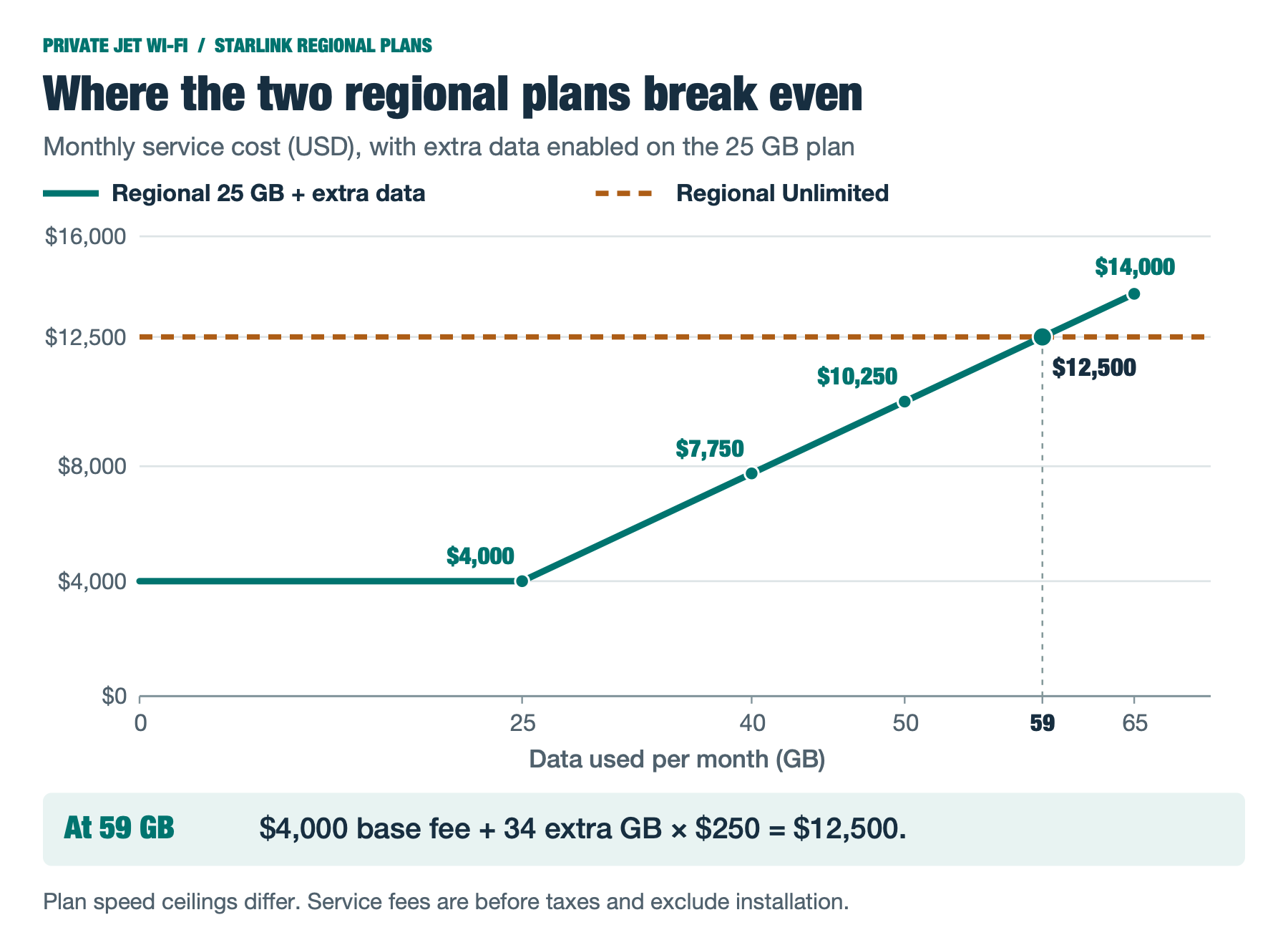
At 59 GB, you’ve bought 34 extra gigabytes. At $250 each, that adds $8,500 to the $4,000 base charge. That’s the cash break-even. The plans still have different download ceilings, and paying for regional unlimited data doesn’t extend the region.
Other networks price usage differently. Gogo’s published 5G launch rate is $2,595 for 30 GB plus $140 per additional GB: 45 GB would cost $4,695. Viasat has also announced new JetXP pricing for January 1, 2027, including a one-year 40 GB plan at a monthly MSRP of $4,400 for JetWave X and Plane Simple Ka terminals. That’s a future rate for specific equipment. The quotes also buy different routes and capabilities. Put three months of your own usage next to each quote; a single high-use month can tell a different story from your annual average.
How to choose an installation for your aircraft
Start with the trips where losing the connection would matter most. For a domestic day trip, ask the operator or installer where the ATG network picks up and drops out on that route. For Teterboro to London, ask which oceanic portion the subscription covers. For a charter passenger, ask about the specific aircraft and what happens to the Wi-Fi if the operator substitutes another jet.
Then describe what everyone will do at the same time. Sending a 30 MB presentation means uploading roughly 240 megabits. At a steady 2 Mbps up, the transfer alone takes about two minutes; at 10 Mbps, about 24 seconds, before overhead. That’s why a large download number won’t answer a simple question like “Can I send this deck before the call?”
Finally, give the installer the exact aircraft model, serial number and modification history. An FAA supplemental type certificate approves a design change and its effect on the original design. A shop still has to determine that the approval and the proposed installation apply to your airplane.
On one Gulfstream G550 retrofit at West Star Aviation, a cabin entertainment unit was already sitting where the new Starlink power supply was meant to go. The team had to engineer a solution. Clay Lacy reported that its first five Starlink installations averaged three weeks and coincided with other scheduled work. Neither detail appears on a monthly pricing page.
Ask for a fly-away quote that separates equipment, installation and certification work from recurring airtime. Then ask the shop to demonstrate the jobs you actually care about: the video call, the VPN login, or the text from the cabin over your regular route. You’ll know what you’re buying in a way that a Wi-Fi logo on a specification sheet can’t tell you.
Frequently asked questions
Can I get Amazon Leo Wi-Fi on my private jet now?
Amazon names business aviation as a target market. As of November 3, 2026, the announced airline timetables start in 2027 and 2028, and the announcements don’t identify an approved retrofit and service plan you can order for a particular private jet. Ask anyone quoting a system to identify the approval, installer and activation date.
Will the Wi-Fi work when my private jet crosses an ocean?
ATG needs ground towers and won’t cover an ocean crossing. With satellite internet, check both the network coverage and the geographic rights in your subscription. A regional plan can include some offshore flying without covering the full flight to another continent.
Is the speed on the brochure available to each passenger?
The published terminal speed generally describes the aircraft’s link. Passengers, background updates and crew traffic can all draw on it. For video calls, ask for typical upload speed and delay with several people online, preferably from flights similar to yours.
Should I upgrade the Wi-Fi before I buy a used jet?
First get the equipment list, installation records and recent service bills. If an approved terminal is already installed, changing the plan might solve your problem. If the hardware needs changing, a written retrofit quote gives you a concrete number to use in the purchase negotiation.
Can I use the cabin Wi-Fi just to send messages?
Yes, if the aircraft has an active service that supports your messaging app. An Iridium-based messaging product can meet that need at a much lower data rate than a broadband terminal. A cabin network offering only stored films or a moving map won’t send a message off the aircraft.