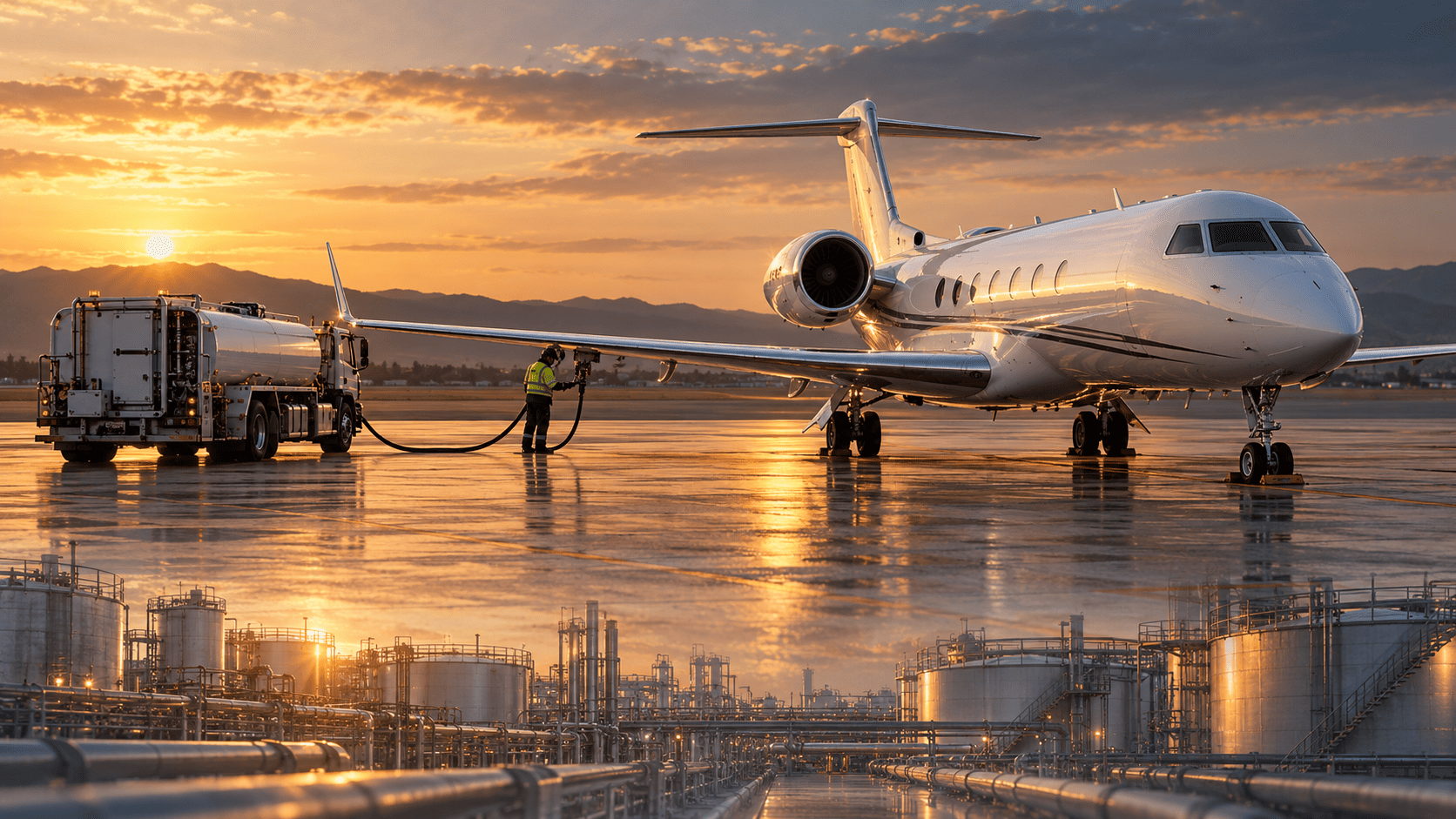
An illustrative fuel supply chain links production infrastructure with private jet refuelling; SAF still produces emissions in flight.. BizJet Journal Illustration
Sustainable aviation fuel can reduce the lifecycle greenhouse gas emissions associated with a private jet’s fuel. It does not eliminate the aircraft’s fuel burn or make exhaust emissions disappear. The result depends on how the fuel is produced, the evidence supporting its lifecycle calculation and how much qualifying SAF is included in the supplied fuel.
That distinction is essential when evaluating a charter proposal, a flight department’s fuel purchase or a claim about “sustainable flying”. SAF is a practical way to address part of aviation’s impact, but its name is not a substitute for a calculation. The useful questions are what was supplied, which environmental benefit is supported and what remains outside that benefit.
What is sustainable aviation fuel?
SAF describes aviation fuel produced through qualifying alternative pathways and meeting relevant technical and sustainability requirements. Possible inputs include certain wastes and residues, other eligible biomass and synthetic processes using hydrogen and captured carbon. Different production routes have different requirements, resource needs and environmental outcomes.
It helps to separate three questions. Is the fuel suitable for use in the aircraft? Does its production meet the sustainability criteria of the relevant scheme? And how is any environmental benefit allocated to the buyer? A positive answer to one does not automatically answer the other two.
The US Department of Energy’s Alternative Fuels Data Center explains that approved production pathways have pathway-dependent blending limits. The term “SAF” therefore should not be interpreted as permission to put any alternative liquid into a jet’s tanks.
The numbers behind SAF for private jets: 2026 supply, fuel prices, lifecycle emissions and a worked example showing how blend share changes cost and benefit.
For approved drop-in fuel, the objective is to fit existing aircraft and fuel infrastructure through the required qualification and quality-control process. “Drop-in” is a technical compatibility description. It does not mean the fuel can bypass normal specification, handling or documentation requirements.
ASTM D7566 addresses aviation turbine fuel containing synthesised hydrocarbons and the requirements applying when approved components are blended. EASA’s fuel explanation describes how compliant fuel is subsequently treated as conventional-specification Jet A or Jet A-1. Operators still need to follow applicable aircraft and fuel requirements.
Passengers should not expect a different cabin experience simply because the fuel purchase includes SAF. Nor be presented as a promise of longer range or lower trip cost.
What changes most directly is the fuel’s supply-chain profile and the associated accounting. That change matters, but it needs to be described at the correct boundary.
Lifecycle emissions are different from exhaust emissions
Follow the fuel before it reaches the aircraft
A lifecycle assessment considers emissions associated with producing and supplying the fuel as well as its use. The calculation can include feedstock sourcing, processing energy and transport, with methodology-specific treatment of other effects.
ICAO’s CORSIA lifecycle framework provides default and actual-value approaches for eligible fuels. Its existence is a reminder that the reduction is calculated from a defined method and baseline. It is not established by the colour of a fuel truck or a generic percentage in a brochure.
A producer using a waste-derived input and lower-carbon process energy may achieve a different result from another producer using a different feedstock, conversion process or electricity supply. Buyers should ask for the documented intensity of the actual qualifying product rather than applying the best result achieved anywhere in the industry.
The engine still burns hydrocarbon fuel
The aircraft’s engine continues to release CO2 when it burns SAF-containing jet fuel. The lifecycle benefit comes from how the fuel’s carbon and production chain are accounted for compared with the specified fossil-fuel baseline. It is inaccurate to translate a lifecycle reduction directly into the same percentage reduction in visible exhaust or fuel consumed.
EASA’s sustainability assessment also discusses non-CO2 effects and feedstock integrity. These issues are a further reason to avoid describing a single fuel purchase as eliminating the complete climate impact of a journey.
Why the blend percentage matters
Two percentages are frequently confused: the share of SAF in a fuel supply and the lifecycle reduction associated with that SAF component. They answer different questions.
Consider a simplified example measured on an energy basis. Assume conventional fuel has a lifecycle intensity represented by 100 units. Assume the qualifying SAF component has an intensity of 30 units, which is 70% lower. If SAF supplies 30% of the fuel energy and conventional fuel supplies 70%, the weighted intensity is:
(0.30 × 30) + (0.70 × 100) = 79 units.
Under those assumptions, the blend has a 21% lower lifecycle intensity than the all-conventional comparison. It does not have a 70% reduction, because 70% described only the SAF component. It does not have a 30% reduction merely because the SAF share was 30%.
Example input
Assumed value
SAF share of fuel energy
30%
SAF component’s lifecycle reduction
70%
Calculated blend-level reduction
21%
What SAF does not solve
SAF does not remove the need to plan efficient missions. The operator still chooses an appropriate aircraft, manages payload and fuel, works within airspace constraints and deals with positioning. Buying qualifying fuel does not make an unnecessary repositioning flight consume no energy.
It also does not address every part of an organisation’s footprint. Fuel-related lifecycle accounting is different from aircraft manufacture, airport buildings, passenger road transfers or other activities. Whether those are included in a particular report depends on the boundary selected.
Some SAF properties can offer benefits for certain non-CO2 effects, but that should not be stretched into a blanket claim that contrails, nitrogen oxides or other climate effects have disappeared. The calculation supporting a CO2-equivalent fuel claim and the evidence supporting a non-CO2 claim need to be identified separately.
The practical response is to use precise wording. “This purchase supports a documented lifecycle fuel benefit of X under Y method” is more informative than “this is a green flight”.
Why availability and price remain constraints
Producing more SAF requires more than demand from passengers. Projects need suitable inputs, equipment, finance, process energy and routes into the fuel system. Synthetic pathways can also depend on substantial supplies of appropriately sourced electricity and hydrogen.
Feedstocks are not unlimited. A material suitable for one pathway may have competing uses, and a supply chain labelled as waste-derived still needs credible traceability. Scaling a production route should therefore be assessed alongside the quality of its inputs, not just the nameplate capacity of a proposed plant.
In its June 2026 production update, IATA estimated that global SAF output would reach about 2.4 million tonnes in 2026, or around 0.8% of aviation fuel use. That was a forecast, not proof of the final year’s production, and it covered the wider aviation market rather than private aviation alone.
For a buyer, the relevant availability question is local: can qualifying fuel be supplied where and when the aircraft needs it, with the required documentation? A global production announcement does not establish stock at a particular FBO. Likewise, an industry price estimate is not a quotation for a specific uplift.
Physical fuel and book-and-claim are different purchases
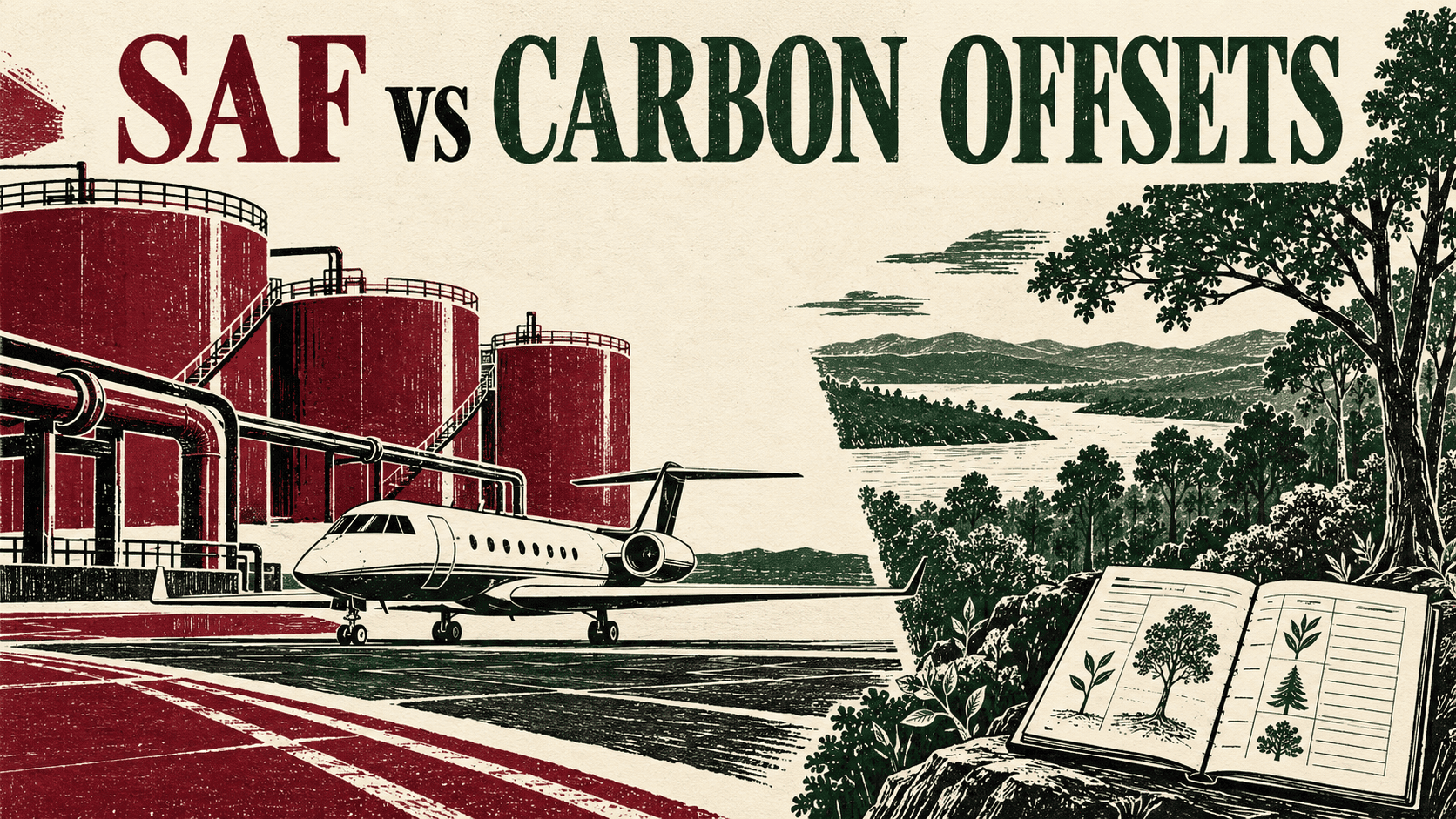
A physical SAF arrangement concerns qualifying fuel entering the supply chain and being delivered under a documented chain of custody. Once fuel is mixed in shared infrastructure, claims must follow the relevant allocation rules rather than assumptions about individual molecules.
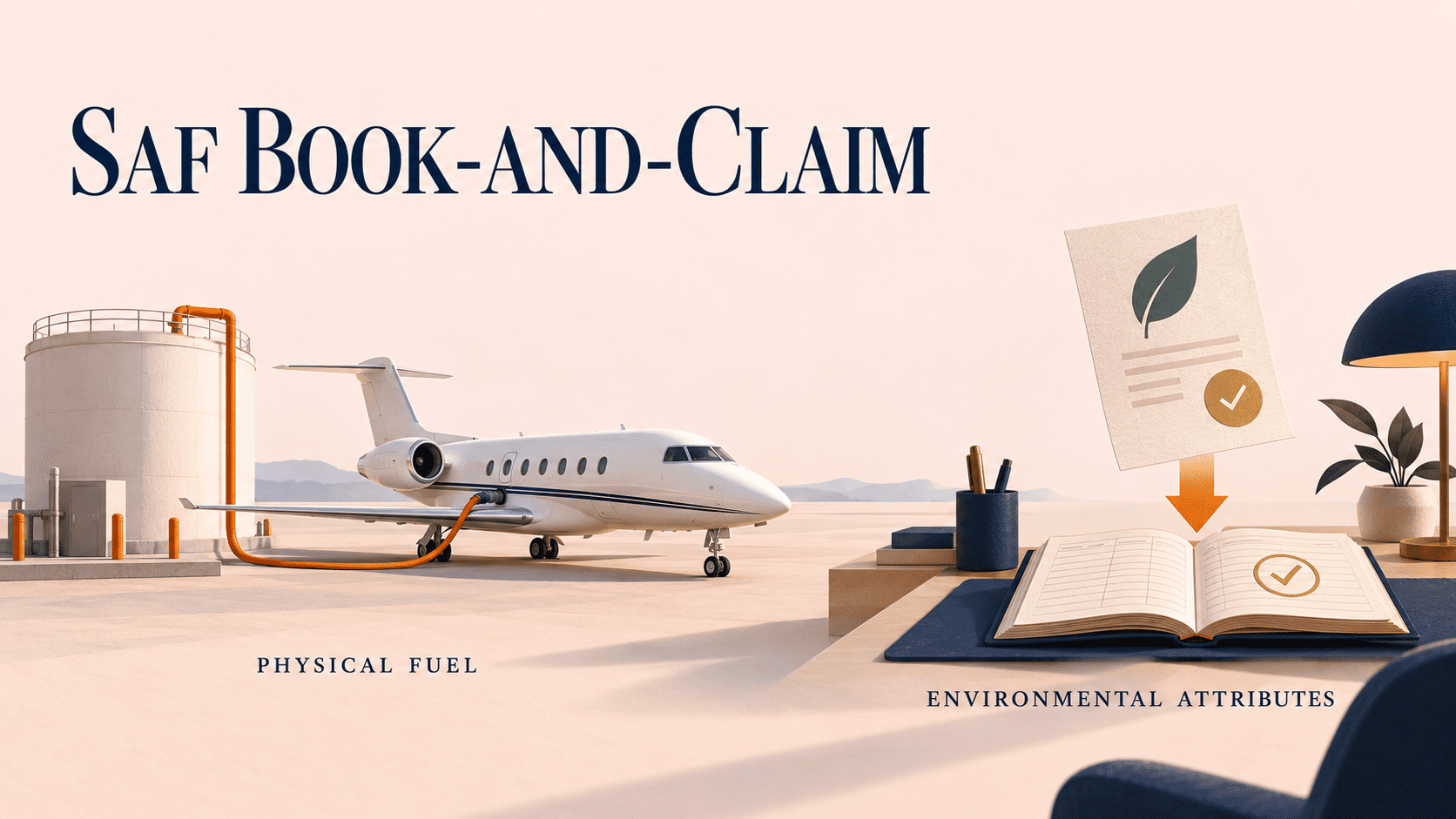
Book-and-claim separates specified environmental attributes from the physical fuel. An aircraft can receive conventional fuel at one location while its customer purchases qualifying attributes associated with SAF supplied elsewhere. That can broaden access, but it should not be described as proof that the buyer’s aircraft physically uplifted SAF.
Our guide to SAF book-and-claim explains issuance, transfer and retirement. The difference matters particularly when a charter quotation uses phrases such as “SAF included” without stating which mechanism is being sold.
What to ask before paying a SAF premium
The paperwork should allow the buyer to reconstruct the claim. Ask for:
The quantity, units and physical supply or certificate arrangement.
The relevant production pathway and sustainability certification.
The fuel’s documented lifecycle intensity and comparison baseline.
The blend or attributed share used in the calculation.
The chain-of-custody or registry evidence.
The beneficiary and reporting period for the attributes.
Any restrictions on voluntary, regulatory or corporate reporting claims.
A supplier may not include every technical document in a passenger-facing confirmation, but it should be able to explain the evidence behind the service. A percentage without a boundary, baseline and quantity is difficult to evaluate.
Where SAF fits in aviation’s future
SAF is attractive because it offers a route to address fuel-chain emissions while aircraft already in service continue flying. Electric and other propulsion technologies face different mission and infrastructure questions, discussed in our urban and regional air mobility guide.
Future plans should nevertheless be judged as plans. A net-zero target is a goal; an announced project is not delivered fuel; a demonstrated technical capability is not universal operating approval. Progress becomes credible when quantities, methods and outcomes are reported consistently.
Frequently asked questions
Does SAF eliminate aircraft exhaust emissions?
No. The aircraft still burns fuel and releases CO2. A supported SAF claim normally concerns a lower lifecycle emissions profile against a defined comparison, not the disappearance of exhaust.
Can every private jet use 100% SAF today?
No blanket assumption should be made. The fuel pathway, specification, blend requirements and aircraft approvals must be checked. A demonstration using 100% SAF does not authorize every aircraft and fuel combination.
Does a 30% blend mean a 30% emissions reduction?
No. The outcome also depends on the SAF component’s lifecycle intensity and the calculation basis. In the simplified example above, a 30% energy share and 70% component reduction produce a 21% blend-level reduction.
Is all SAF equally sustainable?
No. Inputs, production energy, land-use considerations and supply-chain integrity can affect the result. Examine the certified evidence for the fuel and claim being purchased rather than relying on the category name.
Tags
Learn how SAF book-and-claim separates physical fuel from environmental attributes, how certificates are retired and which claims buyers must verify.