
Sustainability Updates · guide
Contrails and Non-CO2 Effects: The Climate Impact Beyond Jet Fuel Emissions
Fuel use cannot describe every climate effect. Learn how contrails, weather, fuel chemistry and reporting assumptions affect a private flight’s climate assessment.

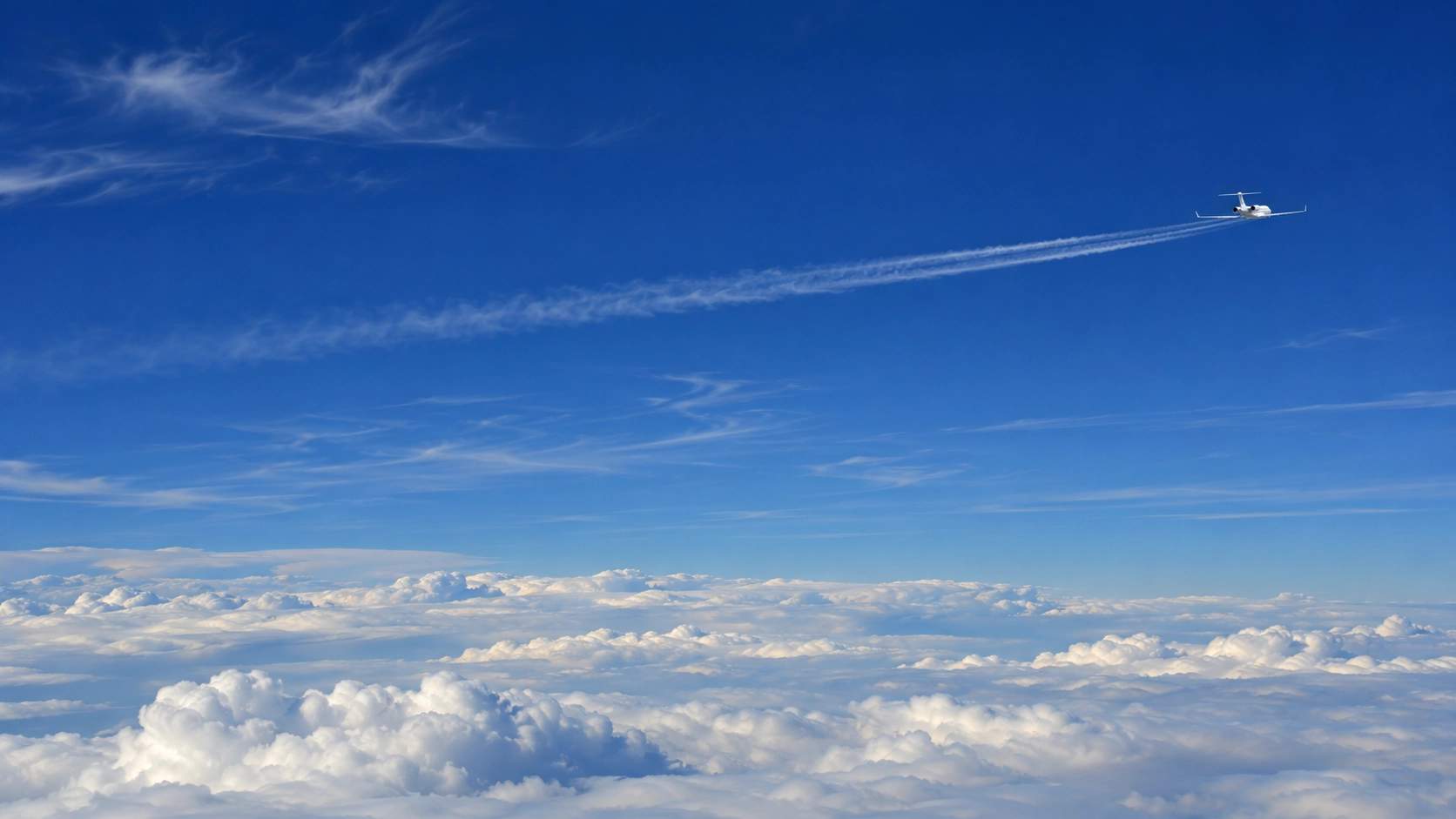
Two flights burning the same amount of fuel can have different near-term climate effects. One may cross air that supports a persistent contrail; the other may leave a trail that disappears quickly. The fuel total remains useful, but it cannot describe everything that happened above the aircraft.
For an owner or charter customer, the practical question is how to evaluate an operator's claim that a flight had a lower climate impact. You need to know what changed, what was measured and which effects the calculation includes. A reduction in visible contrails, a reduction in fuel consumption and a purchase of sustainable aviation fuel describe different things.
Why a fuel receipt cannot describe every climate effect
Carbon dioxide is one consequence of burning jet fuel. Aircraft also emit water vapor, nitrogen oxides and particles, with effects that depend on the atmosphere and chemical processes after release. Contrail cirrus is an additional cloud effect, rather than a quantity of CO2 coming out of the engine.
EASA's aviation climate assessment finds that non-CO2 effects account for more than half of aviation's estimated net warming effect in the historical assessment it summarizes. Its uncertainty is substantially greater than for CO2. That is a sector-wide finding; it does not say that every private flight has the same ratio of CO2 to non-CO2 impact.
Scientists use radiative forcing to describe a change in Earth's energy balance: whether an influence causes the planet to retain more energy or lose more energy. This is different from weighing an emitted gas. Translating an energy-balance effect into an equivalent amount of CO2 introduces a chosen comparison method and time horizon.
A practical report should therefore retain separate lines for fuel use, combustion CO2, lifecycle fuel emissions and estimated non-CO2 effects. Combining them may be useful for a stated decision, but keeping the components visible lets you see whether an apparent improvement came from flying more efficiently or from a model's assumptions.
When contrails persist and what they do
The FAA's explanation of contrails describes ice crystals forming when aircraft exhaust mixes with sufficiently cold, humid air. Many trails dissipate quickly. Others persist and spread into cirrus when the surrounding conditions support them. Humidity at the departure airport does not tell you whether those conditions exist at cruising altitude.
Ice-supersaturated air contains more water vapor than would be in equilibrium with ice at that temperature. It can allow contrail ice crystals to persist and grow rather than sublimate back into water vapor. A narrow, fresh trail and a broad cloud hours later are different stages of a possible development, not interchangeable measures of impact.
Contrails can both reflect incoming sunlight and reduce outgoing heat loss. Their net effect depends on circumstances, including time of day, cloud properties and the background atmosphere. Historical aggregate contrail effects are warming, but an individual contrail is not automatically a large warming event.
For purchasing decisions, that makes “we avoided ten contrails” an incomplete result. Ten short, weak trails and one extensive, persistent trail need not have comparable consequences. Ask whether a service estimates warming impact or merely counts visible trails. A photograph may establish that a trail existed; it cannot by itself establish the temperature effect attributable to your journey.
Why the time horizon changes the comparison
A short-lived atmospheric effect can be important without accumulating in the same way as CO2. EASA's 2026 ANCEN background notes distinguish the long-lasting consequences of CO2 from shorter-lived non-CO2 influences. The comparison changes when a model emphasizes the next few decades versus a longer period.
That distinction matters when somebody applies a single multiplier to your flight's fuel-based emissions. Such a factor may be a reporting convention or an aggregate approximation. It is not a measurement of the particular air masses your aircraft crossed.
| Component | What is being assessed | Why the timescale matters | Useful operator question |
|---|---|---|---|
| CO2 | Long-lived warming from emissions | Effects persist beyond the individual flight | What fuel quantity and emissions boundary were used? |
| Contrails | Cloud-related warming and cooling | Individual clouds are short-lived, but repeated flights repeatedly create effects | What route, weather and cloud lifetime were modeled? |
| Nitrogen oxides | Changes in atmospheric chemistry | Different chemical responses have different durations | Which chemistry effects are included? |
| Particles | Direct effects and interactions with clouds | Influence depends on composition and atmospheric processes | Is this a measured particle result or a modeled climate result? |
For a procurement comparison, use the same metric and time horizon for both options. Otherwise you may be comparing two different questions while reading two apparently comparable numbers. If the result changes substantially under another reasonable horizon, show that sensitivity instead of hiding it in a single headline percentage.
What avoidance can change—and what it costs
Contrail avoidance can involve changing altitude or routing to reduce exposure to forecast regions associated with warming contrails. The extra flying or different cruise conditions may increase fuel consumption. Whether the trade is beneficial depends on the estimated avoided impact as well as that additional fuel.
A published randomized feasibility trial reported a 64% reduction in satellite-visible contrails with a 2% fuel increase per adjusted flight. Those are trial results under its methods and operating circumstances. They are not a guaranteed reduction in total climate impact for a business jet.
Take an example of a flight with these illustrative assumptions:
| Planning measure | Baseline route | Avoidance route | Difference |
|---|---|---|---|
| Fuel consumed | 2,000 kg | 2,040 kg | +40 kg |
| Fuel change relative to baseline | — | — | +2% |
| Contrail climate benefit | Requires assessment | Requires assessment | Cannot be inferred from fuel alone |
The arithmetic is straightforward: 40 divided by 2,000 equals 2%. The climate conclusion requires more information. If the original route would not have produced a warming contrail, extra fuel has not purchased the expected benefit. If it would have produced a significant warming event, the trade may look different under the selected metric.
Operational acceptance is another step. Ask whether the flight-planning recommendation was actually flown, including air traffic control constraints and weather changes. A proposed route can be a good model result without becoming the aircraft's real trajectory. Keeping proposed, accepted and flown routes distinct prevents theoretical savings from becoming reported achievements.
Where fuel composition fits
Fuel chemistry can influence soot and the ice particles that form in an aircraft's wake. That is a different mechanism from the lifecycle CO2 savings associated with how a fuel is produced.
The ECLIF3 study measured 56% fewer ice particles per mass of fuel burned with 100% HEFA-SPK than with the comparison Jet A-1 under the studied cruise conditions. The measurements came from an Airbus A350 and its particular engines, fuels and atmospheric conditions. They establish an important research result, not a universal reduction percentage for all SAF blends or private jets.
For your flight, ask what fuel was physically uplifted, its blend and the basis for any claimed non-CO2 benefit. An allocation purchased through an accounting arrangement does not demonstrate that the aircraft carrying you burned that composition. Likewise, fewer measured particles should not silently become an identical percentage reduction in total warming.
The distinction complements our guide to sustainable aviation fuel for private jets. When comparing fuel purchases with other climate spending, SAF versus carbon offsets explains why the transaction and the claim need to match. Neither purchase makes a flight's non-CO2 effects disappear automatically.
Questions for an operator's climate report
A useful report should allow another qualified person to understand how its conclusion was reached. Ask for the model version, weather data, actual trajectory, fuel assumptions, comparison metric and uncertainty range. Also ask whether the baseline is the route that otherwise would have been flown or an artificially unfavorable alternative.
The March 2026 ANCEN report announcement identifies gaps in atmospheric information, observations, process understanding and climate models. Those uncertainties belong beside the estimate; they do not justify treating every estimate as equally uninformative.
For repeated purchases, request consistency. Track whether the method changed between reporting periods and whether earlier results were recalculated. A lower number after a software update may reflect a revised method rather than better operations. Your most useful record combines what the operator did, the estimated consequence and how confidently that consequence can be supported.
Frequently asked questions
Do all private jet contrails cause warming?
No. Their net effects depend on conditions, and many disappear quickly. The aggregate historical effect is warming, but a visible trail alone does not establish the magnitude or sign of one flight's contrail contribution.
Can a small route change reduce a flight's climate impact?
It can, if it avoids a sufficiently warming contrail and the benefit outweighs added emissions under the stated metric. The assessment should include forecast uncertainty, additional fuel and whether the revised route was actually flown.
Does sustainable aviation fuel prevent contrails?
Not necessarily. Certain fuel compositions have reduced soot and ice-particle numbers in research, but contrail formation still depends on atmospheric and engine conditions. A SAF purchase is not a promise of a contrail-free flight.