FBOs & Airports Guides · guide
Customs at Private Jet Airports: Why an International Arrival Needs More Than a Runway
A Dallas-area arrival shows why staffing, stairs and the location of the inspection facility can matter as much as the runway a private jet uses.

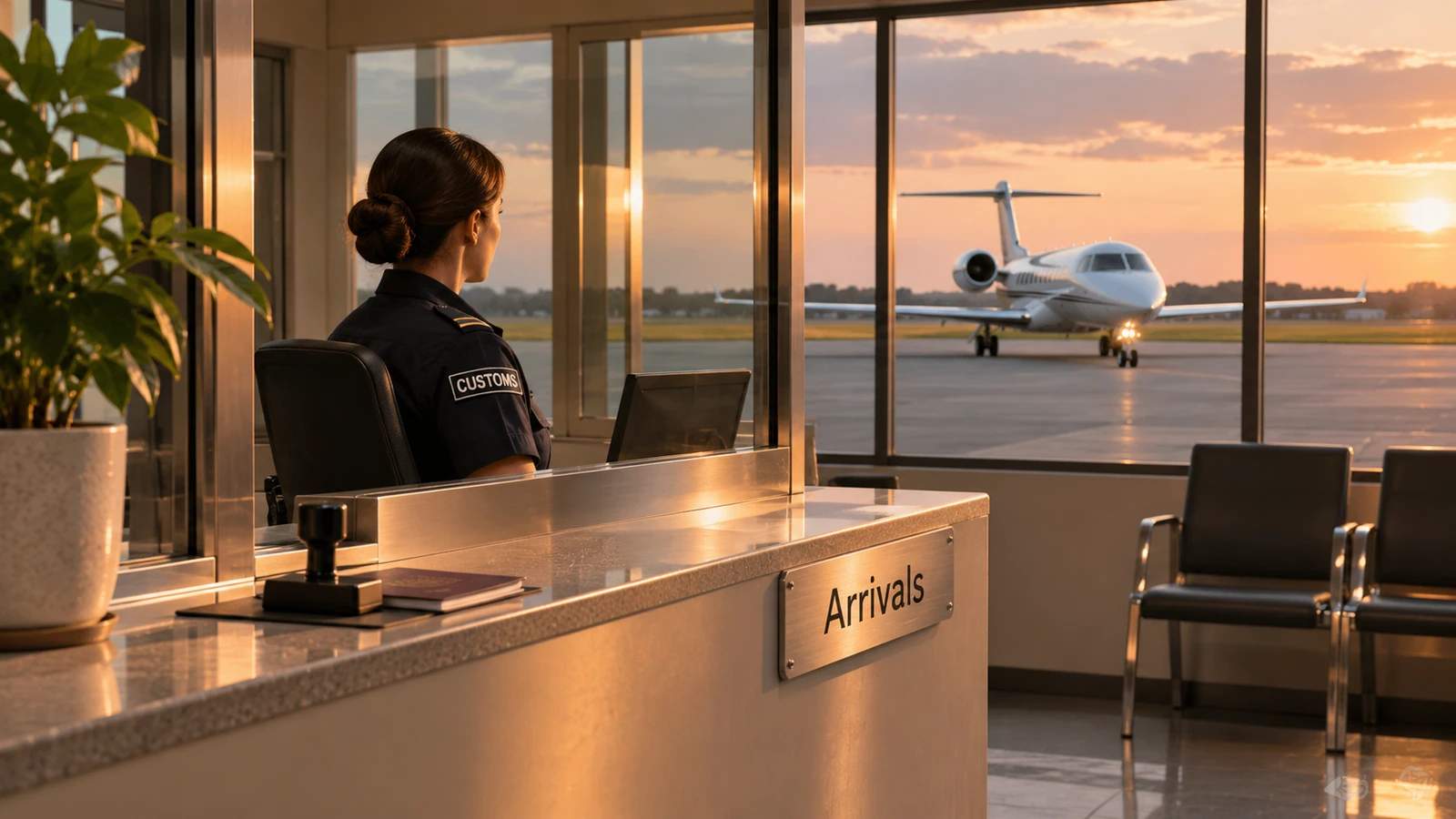
The flight to Dallas is booked. The aircraft has the runway performance it needs, and a driver knows the address of the private terminal. Then a question about one piece of ground equipment changes the arrival plan. If this aircraft needs external stairs to unload, Dallas Fort Worth International says its general aviation facility cannot routinely clear it there. The operator has to coordinate gate assistance with the airport and arrangements with U.S. Customs and Border Protection before arrival.
That small detail shows how customs at private jet airports can change the value of a seemingly convenient destination. For an international flight entering the United States and clearing on arrival, a suitable runway is only the first test. The port needs to accept the flight, have officers available and be able to process the passengers, crew, aircraft and goods at the place they actually arrive.
Why customs at private jet airports depends on the individual port
An airport can serve large numbers of international airline passengers through a terminal the private aircraft cannot use in the ordinary course. Elsewhere, the local general aviation inspection facility may be perfectly suited to a small business jet but staffed by an officer who travels there specifically to meet it. An airport name ending in “International” leaves these details unresolved.
CBP describes the sequence in its general aviation processing guidance. For an arrival, the operator submits advance passenger information and contacts the port of intended arrival to secure permission to land. The local conversation covers such matters as arrival-time tolerance, where the aircraft parks, the layout of the inspection facility and any unusual circumstances. A manifest receipt and a handler’s reservation each document something useful. The permission from CBP addresses a separate question.
The difference becomes visible within one metropolitan area. At McKinney National Airport, the CBP airport fact sheet explains that officers may travel from home or Dallas Fort Worth to meet flights after hours and on weekends. An accurate estimate affects whether an officer is physically there. At Fort Worth Meacham, the local CBP guidance says private vehicles may not approach an arriving aircraft during federal processing. A car service accustomed to collecting domestic passengers planeside has a different assignment on that arrival.
What a Dallas arrival actually looks like
At Dallas Fort Worth International, the published general aviation procedure directs an arriving aircraft to the customs ramp. An officer meets the aircraft. Crew and passengers are processed inside the general aviation facility. Once the aircraft and people have been processed, the aircraft can continue to the selected fixed-base operator, or FBO. The inspection point and the FBO are distinct stops even though both are inside the same airport fence.
Consider an illustrative arrival accepted for 2:30 p.m. local time. The Dallas Fort Worth fact sheet gives a tolerance of 30 minutes on either side of the agreed estimate. An updated arrival of 2:55 falls within that stated tolerance. Move the estimate to 3:05 and it is 35 minutes late. Under the published local procedure the previous permission is no longer valid, and the crew needs to contact the port to secure it again. It is the changed estimate that matters. Waiting to see what time the wheels touch down gives the port less opportunity to rearrange the inspection.
| Part of the trip | What it determines |
|---|---|
| CBP accepts the arrival | Whether the port has agreed to receive this flight under stated conditions |
| Updated estimate reaches the port | Whether the accepted time still works or a new permission is needed |
| Aircraft parks at the designated inspection point | Where the arriving party presents itself and its baggage |
| CBP completes processing | When passengers and aircraft can proceed as directed |
| Driver meets the cleared party | The beginning of the onward journey, potentially at a different location |
The half-hour tolerance is a Dallas Fort Worth example. It is not a nationwide grace period and says nothing about the length of the inspection. A request for a weekend arrival at that airport also works to a different clock. Dallas Fort Worth’s published instructions require Saturday and Sunday arrivals to be requested and approved by 4 p.m. on Friday. A quotation for a Sunday trip sent on Saturday morning needs more than an entry showing the airport is open on Sundays.
Stairs, baggage and the ride to the meeting
A passenger who uses a mobility aid may be able to board comfortably at the home airport and still face an awkward transfer at the inspection point. The operator needs to match the actual aircraft door, the assistance available to disembark, the route inside and the route from inspection to the ground vehicle. A larger replacement aircraft can change these answers late in the booking even if it is an upgrade in cabin terms.
Baggage belongs in the same conversation. The driver’s promise to collect cases from the aircraft has to fit the port’s inspection process. Regulated international garbage can require an approved disposal arrangement, and a trip carrying an animal or special goods can introduce further requirements. At Meacham the local fact sheet specifically says the facility does not process inbound or outbound cargo. Suitcases accompanying a traveling party and a proposed shipment for a customer are materially different requests.
A simple timing comparison shows why passengers should care. Assume one airport offers a 25-minute drive after processing. Another is 45 minutes from the same office. If the closer field can receive the flight only 50 minutes later than the other, the more distant field puts the party at the meeting 30 minutes earlier, assuming equal taxi and inspection times. Neither drive nor inspection time is guaranteed. The calculation identifies which piece of information could reverse the choice before anyone books the car.
When an intermediate customs stop is worth the extra landing
A business jet can sometimes enter at an accepted port and then continue domestically to an airport nearer the final destination after clearance. That adds another landing, a ground interval, a departure and potentially more crew duty or charter cost. It can still be preferable when the desired airport cannot accept the international arrival, or when a direct car ride from the available port would be long.
Compare the choices from the moment the party completes its first inspection. In an illustrative case, driving directly takes 95 minutes. Continuing by jet takes 25 minutes to prepare and depart, 25 minutes in flight, 10 minutes to reach the waiting car and 15 minutes on the road. The airborne option saves 20 minutes on those assumptions. Add a 25-minute departure delay and the car reaches the destination five minutes sooner. The second flight may serve another purpose, such as leaving the aircraft in position for the following morning. That benefit belongs in the comparison explicitly.
Frequently asked questions
Can any private terminal arrange U.S. customs on request?
A terminal can help coordinate an arrival, but the port has to offer an arrangement applicable to that flight and grant permission. Staffing, hours, the aircraft configuration and what is being carried can all affect suitability.
Can the driver meet an international private jet planeside?
Local inspection procedures control where vehicles and people may go. Some ports explicitly restrict access during processing. The operator or handler can give the driver the pickup point for the cleared party, which may differ from the customs ramp or the usual domestic pickup address.
Is there a standard customs clearance time for a private jet?
No uniform processing time follows from the flight being private. The officer’s availability, the facility, the people and goods aboard, and whether documents need additional review can affect the interval. An agreed arrival-time tolerance is separate from the time required after landing.
Does switching to another airport in the same city preserve permission?
Permission is obtained from the port for the intended arrival under its conditions. For a planned destination change the operator needs to coordinate the revised arrival and notify the original port as applicable. An in-flight emergency is handled by the crew in light of the circumstances, with the authorities notified as soon as practicable.