

FBOs & Airports Guides · guide
What Is De-icing and How Does It Work for Private Jets?
Learn when a private jet needs deicing, how long anti-icing protection lasts, and how to read a winter charter bill using actual airport rates.

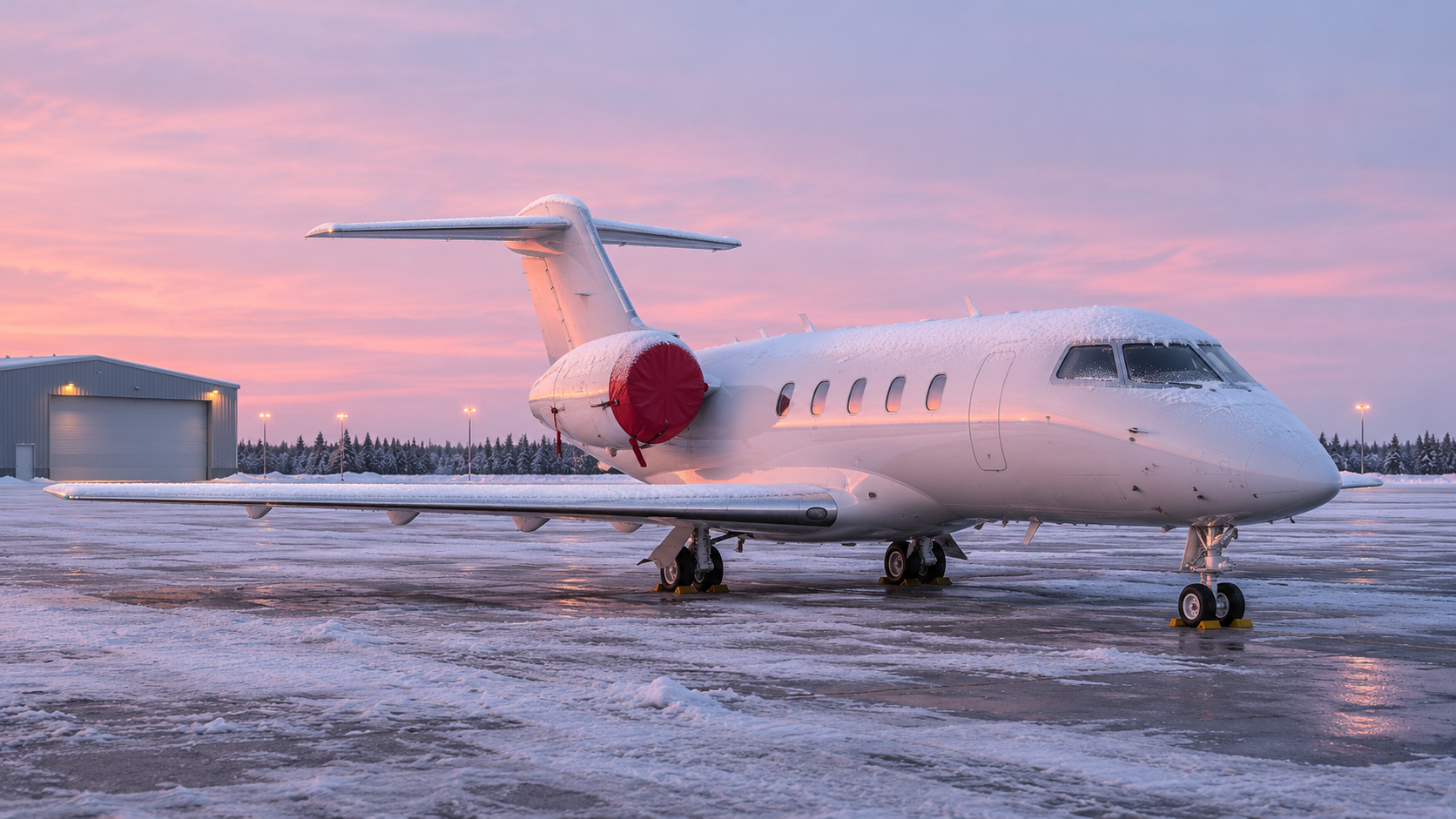
The runway can be clear when you arrive at the private terminal and the pilots can still be waiting for a deicing truck. The airport has cleared the pavement. The pilots need to know what spent the night on the wings.
Deicing removes frost, ice, snow or slush already on the aircraft. Anti-icing does a different job: it protects a clean surface against fresh contamination for a limited time before takeoff. On a clear morning after a frost, removal may be enough. If snow is still falling, the ground crew may need to do both.
For you as a passenger, that distinction helps explain three things: why two jets on the same ramp can need different treatment, why departure time can change after the truck leaves, and why a winter charter quote may leave the final deicing charge open.
Why does a thin layer of frost matter?
The issue is what frost does to airflow, even when it hardly changes the shape of the wing to your eye. Roughness can cause air to separate from the upper surface earlier than it should. The wing produces less lift, drag increases, and the aircraft can stall at a lower angle of attack than the pilots would expect from a clean wing.
The FAA’s Aviation Weather Handbook describes tests in which contamination about as rough as coarse sandpaper reduced lift by 30% and increased drag by up to 40%. Those are test results, not performance figures for every jet. They explain why the crew cares about a surface that might look almost clean from the cabin.
A charter flight at Montrose, Colorado, illustrates the consequence. In November 2004, a Challenger attempted to take off in falling snow after spending time on the ground. The National Transportation Safety Board found that the crew had failed to ensure the wings were clear and that contamination on the upper surfaces induced the stall during takeoff.
Does a private jet need deicing if it isn’t snowing?
Yes, it can. Frost can form overnight under clear skies. There’s also a less obvious case: a jet lands after a long flight with very cold fuel still in its wing tanks. The fuel can keep the wing skin below freezing even when the air at the airport is warmer. Moisture that touches the cold surface can freeze into a layer of clear ice.
Transport Canada calls this cold soaking. It’s one reason the outside temperature or a glance through the terminal window can’t settle the question. A jet just in from cruise and one coming out of a heated hangar can be parked side by side in the same weather with quite different wing surfaces.
What happens when the deicing truck arrives?
The flight crew and trained ground personnel assess the aircraft and the weather. The service may be provided by the local fixed-base operator (FBO), a ground handler or a dedicated deicing team. At some airports the truck comes to the parking stand. At others, the aircraft taxis to a designated pad; Toronto Pearson’s central deicing facility is one example. Your departure may therefore start with a short taxi and a stop before you ever see a runway.
When fluid is needed to clear contamination, a common first step is a heated mixture containing Type I fluid. Heat and the action of the spray loosen and remove the deposit. A qualified team treats the areas specified for that aircraft. A clean-looking strip along the front of a wing doesn’t tell you whether its upper surface, the tail or the flight controls are clear.
If the weather calls for protection against further buildup, the team applies an approved anti-icing fluid to the clean surfaces. This is the second step in a two-step treatment. There are also approved one-step procedures; seeing only one application doesn’t mean anyone skipped a step. After treatment, ground personnel complete the required checks and communicate treatment details to the flight crew, including the start time of the final application when relevant.
What is the difference between Type I and Type IV fluid?
Type I is a thin fluid commonly used hot for removal. Type IV is a thickened fluid intended to stay on a clean surface longer on the ground and flow off as the aircraft accelerates. The right choice depends on the aircraft as well as the weather. A fluid that works for a large jet may be unsuitable for a smaller aircraft that lifts off at a lower speed.
| Fluid | Typical role before takeoff |
|---|---|
| Type I | Removes contamination when used in a heated deicing treatment. It can also provide short-lived protection in some conditions. |
| Type II | A thickened fluid used for longer ground protection on aircraft approved to use it. |
| Type III | Designed to flow off at lower speeds than typical Type II or IV fluids. It can suit certain aircraft with lower rotation speeds. |
| Type IV | A thickened anti-icing fluid often used as the final step during continuing precipitation on compatible aircraft. |
The FAA’s winter 2026–27 guidance distinguishes between specific fluids, aircraft applications and weather conditions. Fluid type alone doesn’t tell you how many minutes the aircraft has before takeoff.
What is holdover time, and when does it start?
Holdover time is the estimated period for which fluid protects the treated surfaces against the formation or accumulation of frost, ice or snow. It starts when the final application begins, not when the spray stops or when the pilot receives a taxi clearance.
Take an example of a flight on a snowy morning. The final anti-icing application starts at 8:10 a.m. and the truck clears the jet at 8:16. Six minutes have already elapsed. If air traffic control then asks the crew to wait another ten minutes, 16 minutes will have passed since that application started. You still can’t infer how much protection remains without knowing the fluid, temperature and precipitation.
That’s why a crew may leave the takeoff queue. If snow intensifies, the original estimate may no longer apply. If the applicable time expires, the operator’s approved procedures and the conditions determine whether a pre-takeoff contamination inspection is available or fresh treatment is needed. An inspection doesn’t restart the original clock. Transport Canada’s current holdover guidance sets out that distinction, and the FAA issues guidance for each winter season.
The spraying time is only one part of the delay. For context, Magellan Jets describes 30 to 60 minutes for the entire process, depending on the circumstances. The estimate that matters for your trip is the one the crew can give you at that airport: is the aircraft waiting for a truck, being treated, or waiting for a departure slot after treatment? Those are three different waits.
Why can’t the jet use its own ice protection on the ground?
A jet’s onboard systems protect particular areas. Depending on the design, engine bleed air may heat the wing leading edges or engine inlets, while electrical heating protects items such as probes or windshields. Those systems don’t clear an entire upper wing covered in overnight snow. Ground treatment, in turn, doesn’t protect the aircraft from icing in flight.
For U.S. on-demand charter, 14 CFR § 135.227 addresses contamination on specified aircraft surfaces and the procedures an operator must follow when frost, ice or snow can reasonably be expected to adhere. Your contract determines who pays for the treatment. The flight crew decides whether the aircraft is fit to take off under the applicable rules and procedures.
How much does it cost to deice a private jet?
Start with the airport and the service provider, rather than a price for a “light jet” or a “heavy jet.” Aircraft size affects how much surface needs treatment. So do the condition of those surfaces, the weather during departure and whether the aircraft needs a second treatment. The invoice can also include a setup or service fee before the first gallon is counted.
At Sheboygan County Memorial International Airport in Wisconsin, Lake Breeze Aviation’s published rates list Type I at $24 per gallon and Type IV at $29, plus a $65 service charge and a waivable $100 setup fee. Suppose your service ticket shows 40 gallons of Type I and 10 gallons of Type IV. Here’s how you would check the bill using the rates listed on November 3, 2026.
| Line item | Calculation | Amount |
|---|---|---|
| Type I fluid | 40 gallons × $24 | $960 |
| Type IV fluid | 10 gallons × $29 | $290 |
| Deicing service charge | Flat charge | $65 |
| Setup fee | If charged | $100 |
| Subtotal | Before any other applicable charges or taxes | $1,415 |
If the FBO waives the setup fee, the same example comes to $1,315. The two volumes are example invoice entries, not prescribed amounts for an aircraft. Most of the bill here—$1,250—is fluid, which is why actual usage matters more than a blanket estimate.
In Switzerland, St. Gallen–Altenrhein Airport’s tariff effective April 1, 2026 uses a different formula. For an aircraft with a maximum takeoff weight of 10 metric tons, the deicing flat fee is CHF 378, plus CHF 10.40 per liter of Type I or Type II sprayed. A ticket for 100 liters would therefore total CHF 1,418 before any applicable VAT or other charges. When comparing quotes, check which currency and unit are on the page: a price per liter is very different from a price per gallon.
Who pays on a charter or jet card flight?
The charter agreement answers that question. Jet Connections’ terms list aircraft deicing among the costs billed separately from the charter price. Under an arrangement like that, the operator can establish the amount once the handler records what was used, and the customer can receive a separate invoice.
A jet card can work differently. Privé Jets advertises standard deicing as included in its fixed-rate card, subject to the program terms. For a winter booking, ask whether the quoted trip includes both deicing and any necessary anti-icing, who pays if treatment must be repeated, and whether hangar use is charged separately. Those details are also covered in our guide to jet card add-on charges.
Does keeping the aircraft in a hangar help?
It can. An aircraft that spends a snowy night in a hangar may roll out with clean wings while one parked outside needs substantial treatment. But ask when the jet will come out. If snow is still falling while the aircraft is being loaded or waiting to depart, the crew must assess its condition again. Paying for hangar space does not automatically eliminate a deicing bill.
When booking, ask your broker where the aircraft will spend the night, whether the departure airport can provide the treatment that aircraft needs at your planned time, and how the operator handles an unexpected charge. Knowing who handles ground services and what is included in the FBO’s fees does more for your winter budget than assuming the weather forecast can settle the bill in advance.
Frequently asked questions
Is every private jet sprayed before a winter flight?
No. The condition of the aircraft and the weather determine what is needed. A clean aircraft leaving a hangar on a dry morning is a different case from one that sat outside in freezing fog.
Can passengers be onboard during deicing?
Yes. At airports that use a centralized deicing pad, passengers can already be seated when the aircraft taxis there for treatment. Other operations may arrange some work at the stand before boarding. Your crew will tell you when to board.
Can the holdover time run out while the aircraft is in line?
Yes. Time spent waiting for the runway counts from the start of the final fluid application. If that interval is exceeded or conditions change, the crew follows its procedures for inspection or re-treatment before takeoff.
Does a deicing charge mean the aircraft was poorly maintained?
No. Deicing deals with the weather and the condition of the aircraft’s surfaces before departure. A well-maintained jet can accumulate frost overnight or need anti-icing protection after it leaves a hangar in falling snow.
Can I get a firm deicing price when I book?
You can ask for the local rates, a fixed fee if offered, or written confirmation that standard treatment is included. When the service is billed by actual fluid volume, the rate can be known in advance even though the final number of gallons or liters cannot.