

Aircraft Comparisons · guide
Payload-Range Explained: Why a Full Cabin Can Mean a Fuel Stop
Seat capacity and nonstop capability are different questions. A transparent passenger-weight example explains full-fuel payload, range assumptions and the choices between a stop, a different aircraft and a lighter load.

A jet can have enough seats for your group while lacking the weight allowance to carry everyone, all the baggage and maximum fuel together. That is why advertised range and maximum passenger capacity may describe different missions.
The practical question is whether the particular aircraft can fly your route with your load on your travel date. Seat count answers only the accommodation part. Payload-range analysis connects the weight of the travelers and their belongings with the fuel needed for the journey.
Understanding the trade-off helps you ask for a useful comparison: a nonstop flight on the proposed aircraft, a planned fuel stop or a different aircraft. It also prevents a brochure figure from becoming a promise that the operator never made.
Seats and payload measure different things
Seats describe places for occupants. Payload describes weight carried for the mission, commonly passengers, baggage and cargo within the stated definition. Two groups occupying the same number of seats can create different loads because their body weights, luggage and equipment differ.
Basic operating weight is the aircraft's operating baseline under the applicable definition, including specified crew and operating items. Useful load represents the remaining allowance under the stated weight convention. Published definitions can differ, so check whether a comparison starts from empty weight or operating weight and whether it uses ramp or takeoff weight.
The FAA's Weight & Balance Handbook explains these weight distinctions. Its broader lesson for a buyer is to compare figures built on matching assumptions. Mixing an aircraft weight that includes crew with another that does not can create an apparent payload advantage that is partly accounting.
For a traveler, provide the load information the operator requests. A group with golf bags, samples or ski equipment presents a different planning problem from the same group carrying small overnight bags. Volume, shape and loading location can matter alongside the total pounds.
If the itinerary changes from a short overnight visit to a week away, update the baggage estimate. The aircraft choice may have been made around the original mission, and a reasonable change in travel plans can still require a fresh assessment.
Fuel and payload share a weight allowance
The aircraft has several relevant weight limits. Maximum ramp weight concerns the aircraft on the ground before taxi. Maximum takeoff weight concerns the start of the takeoff. Maximum zero-fuel weight limits the aircraft and load with usable fuel excluded. They are related boundaries, not interchangeable labels.
Fuel used before takeoff is one reason a ramp calculation and a takeoff calculation differ. A headline useful-load figure cannot be inserted into every flight calculation without checking its basis.
Textron publishes these Citation Latitude specifications:
| Published measure | Weight |
|---|---|
| Maximum ramp weight | 31,050 lb |
| Basic operating weight | 18,656 lb |
| Usable fuel weight | 11,394 lb |
| Full-fuel payload | 1,000 lb |
| Maximum payload | 2,774 lb |
The published ramp arithmetic is 31,050 minus 18,656, leaving 12,394 lb; subtracting 11,394 lb of fuel leaves 1,000 lb. Maximum payload is a different loading case and cannot simply be added to maximum fuel.
Think of this as a shared allowance, with additional structural and performance limits that the operator must respect. Unused seats do not create more fuel-tank capacity, and empty space in the baggage compartment does not establish that additional weight is acceptable.
Nor is total weight the only loading question. The FAA's Pilot's Handbook chapter on weight and balance explains why the distribution of weight and the aircraft's current records also matter. A passenger should not assume that moving a bag into the cabin resolves an overall loading limitation.
Work through a passenger-load example
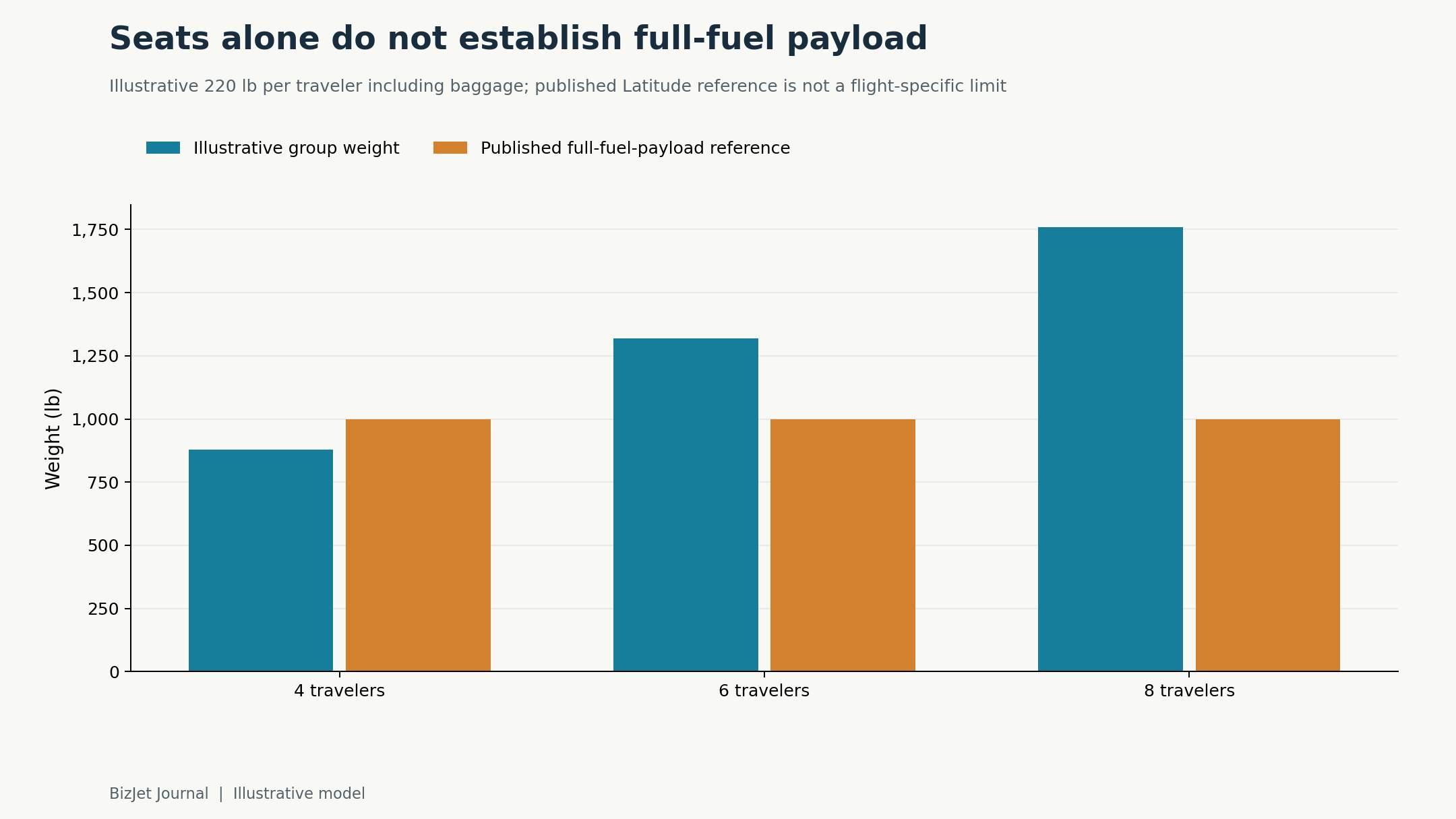
Take an example of a flight with eight travelers. Using illustrative assumptions of 220 lb per traveler including baggage, the group totals 1,760 lb. Against the Latitude's published 1,000-lb full-fuel-payload reference, that is 760 lb more. This identifies a loading trade-off, not the fuel reduction or range of a specific flight.
| Illustrative travelers | Assumed weight per traveler including baggage | Total group weight | Amount above the 1,000-lb reference |
|---|---|---|---|
| 4 | 220 lb | 880 lb | 0 lb |
| 6 | 220 lb | 1,320 lb | 320 lb |
| 8 | 220 lb | 1,760 lb | 760 lb |
These assumptions are deliberately simple. They are not a direction to use 220 lb as an operational passenger-weight standard. The operator applies its appropriate process and the actual aircraft's data.
The example answers one narrow question: why can adding people create a fuel-versus-load decision before all seats are occupied? It does not answer whether the route needs full tanks. On a shorter mission, the aircraft may require less fuel than it can hold, leaving a different loading picture.
This distinction prevents two opposite errors. The first is assuming a full cabin can always achieve the advertised maximum distance. The second is assuming every group above a full-fuel-payload reference must stop. Both skip the amount of fuel actually required for the mission.
Ask for the trip assessment before changing the group. Removing a bag might help a marginal case, but there is little point in asking several people to repack if the proposed itinerary needs a different aircraft regardless.
Read the assumptions behind the range figure
The Citation Latitude product card labels its 2,700-nautical-mile range as a four-passenger mission at high-speed cruise, in standard conditions with zero wind and NBAA IFR reserves. Those assumptions are part of the figure, not incidental small print.
The same card lists maximum cruise speed separately. A maximum-speed number and a range number should not be combined into a new mission claim unless the published conditions support doing so. “Maximum” can describe different test or planning cases within the same brochure.
When comparing two aircraft, create a matching brief. Give each provider the same route, passenger and baggage requirement, date or season, and desired arrival time. Ask it to explain whether a stop is expected and which assumptions could change that result.
You are then comparing answers to the same travel problem. Without that common brief, one aircraft may be described with four passengers and generous flexibility while another is evaluated with eight travelers and a demanding departure time.
Our guide to comparing business jets by range, cabin, payload and cost places the range figure in that wider context. Cabin space and speed remain relevant, but they are useful only when the complete aircraft matches the mission.
Why actual trips move inside the brochure boundary
A brochure condition is a reference point. Actual winds, routing, departure conditions and required reserves shape the flight that can be offered. The specific aircraft's equipment and interior also affect its current weight, so two examples of the same model need not produce identical loading results.
A headwind can increase the time needed to cover a ground distance. A route can be longer than the direct distance between airports. Departure performance can constrain the usable takeoff weight. These factors can interact, so a route that works comfortably in one direction or season can be more demanding in another.
Reducing fuel by a percentage does not establish an equal percentage reduction in range. Some fuel supports portions of the mission other than cruise, and the flight's weight changes as fuel is consumed. The relationship needs aircraft performance analysis, not a proportional haircut applied to the brochure number.
For travel planning, ask where the uncertainty sits. Is a stop already expected? Is the nonstop option sensitive to the final load? Does the operator need a closer weather assessment? Those answers are more useful than a broad claim that the model “normally does that route.”
If nonstop travel is essential to your schedule, say so before the quote is finalized. The provider can then compare an aircraft with greater mission margin against one that relies on more favorable conditions. You are choosing the service outcome you need, not merely buying a longer published range.
Compare a stop with a different aircraft
A planned stop can be a sensible solution when it makes the selected aircraft fit your group and route. Its cost is not only the time spent refueling. The comparison should include the added landing and departure, ground turnaround and any change to the onward schedule.
A different aircraft may offer a workable nonstop mission but have a different quote, cabin or departure position. Compare the complete proposals rather than assuming the larger category is automatically better value.
| Option | What to compare | What to confirm |
|---|---|---|
| Proposed aircraft with a stop | Total journey time and complete quote | Stop location, expected turnaround and onward plan |
| Different aircraft assessed for nonstop travel | Time saved, cabin fit and price difference | Assessment uses the same travelers, baggage and route |
| Reduced baggage or shipped equipment | Convenience and any shipping cost | The revised load actually changes mission feasibility |
| Changed timing or airport | Effect on the complete journey | Operator has reassessed the amended plan |
For an owner selecting a jet, evaluate how often the demanding mission occurs. A fuel stop on an occasional long trip may be an acceptable trade-off if the aircraft suits the rest of the year. A repeated stop on the core business route may point toward a different choice. That frequency-based decision is central to choosing a business jet for your real missions.
FAQs
Can a jet carry maximum passengers and maximum fuel together?
Sometimes, depending on the aircraft, configuration and actual load, but seat count does not establish that capability. Compare the required passenger and baggage weight with the applicable loading limits and have the operator assess the mission.
Does maximum range include fuel reserves?
It depends on the published definition. The Latitude example explicitly includes NBAA IFR reserves. Check each aircraft's stated assumptions rather than assuming reserves are always included or always excluded, and avoid subtracting an allowance twice.
Will more baggage always require a fuel stop?
No. The route may need less than maximum fuel, or the aircraft may have sufficient loading margin. More baggage matters when it changes the feasible combination of load and fuel for that mission. Tell the operator about it before relying on a nonstop plan.
Can I estimate range from the fuel weight alone?
Not reliably. Fuel weight is one input among mission profile, aircraft weight, conditions and reserve requirements. A percentage change in fuel does not translate directly into the same percentage change in distance. Ask for an aircraft-specific trip assessment.