Jet Cards · guide
Fixed-Rate vs Dynamic-Pricing Jet Cards: What Changes on the Same Trip?
A jet card can win six of eight bookings and still finish the year tied with its rival. The difference is what you pay on the two expensive dates.


Eight trips, six cheaper quotes and no saving for the year. That is a possible outcome for a traveler who compares a fixed-rate jet card with a dynamically priced one. The discount on six ordinary departures can disappear in the premium on two dates when aircraft are scarce. For someone free to move those departures, the calculation changes again.
The useful comparison begins with the flights that actually go ahead. A price for Tuesday afternoon is of limited interest to a buyer whose board meets Tuesday morning. Likewise, a published fixed rate has little bearing on a holiday departure if the agreement excludes that date. The rate determines the bill only after the trip qualifies for it.
Fixed-rate vs dynamic-pricing jet cards on the same route
Take an example of a flight from northern New Jersey to an Atlanta-area airport with four passengers. For comparison, assume a midsize cabin and exactly two billed hours, including any applicable taxi allowance. Provider A commits to $8,000 an hour for eligible trips. Provider B prices each requested flight when the member books. On a quiet Tuesday, B quotes $14,200 for the trip. On a busy Friday, B quotes $21,400 for the same aircraft category, airports and billable time.
Those are illustrative prices, before taxes, with fuel and ordinary positioning included in all three amounts. Both travelers can leave at the requested time under the example terms. The Tuesday discount is $1,800 against A’s $16,000. The Friday premium is $5,400. It takes three Tuesdays at the lower rate to offset one such Friday.
A fixed rate transfers some price risk to the provider for the flights covered by the promise. The provider can plan across bookings or absorb a higher aircraft sourcing cost on a particular day. A dynamic quote exposes the member to that variation, including the upside when a suitable aircraft is close to the departure airport and its next assignment fits the route. A market price is no guarantee that the member receives the operator’s cost or its entire saving on an efficient pairing.
Eight departures reveal which card costs less
Suppose the company will take eight of these trips and each falls into one of the two pricing conditions. For now there are no annual fees. The fixed option costs $128,000. The dynamic option starts at $113,600 if all eight book at $14,200. Each busy trip replacing a quiet one adds $7,200, the difference between B’s two quotes.
| Trips at the busy price | Trips at the quiet price | Fixed-rate total | Dynamic total |
|---|---|---|---|
| 0 | 8 | $128,000 | $113,600 |
| 1 | 7 | $128,000 | $120,800 |
| 2 | 6 | $128,000 | $128,000 |
| 3 | 5 | $128,000 | $135,200 |
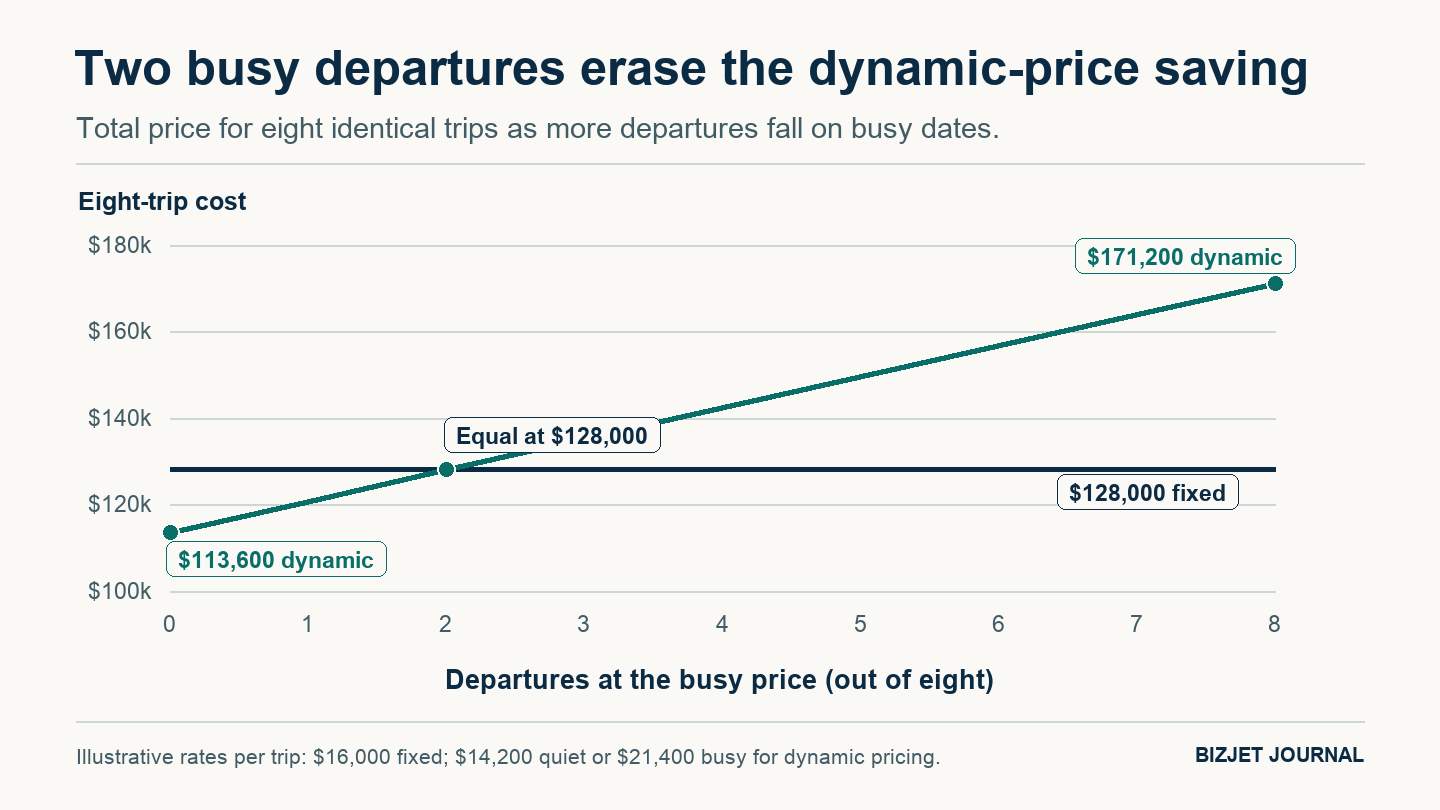
The break-even point is two busy trips out of eight under these terms. It moves if the fixed program charges an annual fee. A $4,000 fee takes the fixed total to $132,000. Dynamic pricing now comes in $4,000 lower with two busy trips, while fixed pricing leads by $3,200 with three. A refundable card deposit would belong in a separate cash commitment comparison. Counting the full deposit as a fee and then counting the flights paid from it would count the same dollars twice.
Trip length matters just as much as frequency. If the most expensive date also happens to be the longest flight of the year, eight equally weighted hourly quotes will give the wrong answer. Price that date for the entire trip, on the cabin and notice period you need, then add its dollar cost to the annual total.
What the fixed rate actually holds still
A price schedule can fix an hourly rate while leaving the number of billed hours or a fuel adjustment open. If A applies a 2.5-hour minimum to the Atlanta trip, A’s bill becomes $20,000. The dynamic Friday premium shrinks to $1,400 and its Tuesday discount grows to $5,800. The aircraft and timetable stayed the same. Changing the billing rule overturned the original break-even calculation.
A capped card occupies the middle ground. The provider may quote the market price up to a stated ceiling when the flight qualifies. A cap of $8,500 per hour for two billed hours puts a $17,000 ceiling on the covered flight charge. An excluded airport fee could still put the final invoice above $17,000. A cap also needs an applicable service area, an aircraft category and a date range before it can be priced into a travel budget.
For an account funded in hours, a change can appear as an additional debit or a cash invoice. A deposit-funded account might deduct the whole quote as dollars. The payment method tells you how to read the statement. The agreement’s pricing schedule determines what the trip cost.
A confirmed quote and a guaranteed departure solve different problems
A dynamic quote may expire before the member accepts it. Imagine a traveler receives the $14,200 offer at 10 a.m. and the provider can hold it for one hour. Moving a meeting to accommodate that flight at noon does little good if the aircraft has since taken another job. The meaningful price is the one the traveler can accept under the approval process the company actually uses.
The same care applies to guaranteed availability on a fixed card. Its booking notice, peak calendar and permitted departure window determine whether the provider owes the traveler an aircraft at the contracted rate. If a guaranteed flight can move three hours in either direction, that flexibility has a cost when the passengers need to attend a 10 a.m. closing. A $1,800 saving on the flight can be irrelevant if the only workable option requires flying the night before.
The itinerary is also a whole-aircraft purchase for a typical company charter. The U.S. Department of Transportation describes this as a single-entity charter. Leaving one employee at home generally leaves the party buying the aircraft with the same trip bill under the example terms. Comparing prices per passenger before settling the cabin, flight time and number traveling can disguise which quote costs the company less.
Frequently asked questions
Is a fixed-rate jet card always more expensive on quiet days?
No. A dynamic quote can be higher on an otherwise quiet day if an aircraft must position a long way to collect you. The rate comparison needs the same route, acceptable departure window, aircraft category and included charges.
Can a dynamic jet card still have a price cap?
Yes, if the agreement provides one for the requested trip. The ceiling can apply to an hourly component while leaving a minimum debit or specific extras outside it. The terms also determine whether the member receives a lower available price.
Which pricing method suits someone who travels on fixed dates?
The stronger fit depends on how many of those dates qualify for the fixed rate and whether the promised departure window works. A frequent traveler on eligible high-demand days may value predictable pricing. Someone whose fixed dates fall outside the card’s guarantee may still need a market quote for the most important flights.