Market & Finance · guide
Fixed vs Floating Aircraft Loans: What a Rate Reset Does to Payments
A $4 million aircraft loan illustrates how a floating rate can raise the monthly payment while a prepayment fee changes the economics of an early sale.

The initially cheaper loan on a $4 million aircraft purchase can become the more expensive one to service just as the owner starts the second year of flying. It takes only one scheduled rate reset. The owner may still have paid less interest when the time comes to sell.
Comparing fixed and floating aircraft loans means answering two questions. The monthly payment determines how much cash to provide. The interest, fees and balance due at sale determine what the financing actually cost. A useful comparison starts by giving both lenders the same principal, amortization and expected payoff date.
Fixed vs floating aircraft loans on the same $4 million balance
Consider two illustrative U.S. dollar loans. Each advances $4 million, amortizes over ten years and matures in five. Both require monthly principal-and-interest payments. The fixed rate is 6.5%. The floating loan starts at 6%, comprising an assumed benchmark of 4% and a lender margin of two percentage points. For this example it resets annually, and the lender recalculates the monthly payment over the remaining amortization. The figures illustrate loan mechanics and do not represent a quote.
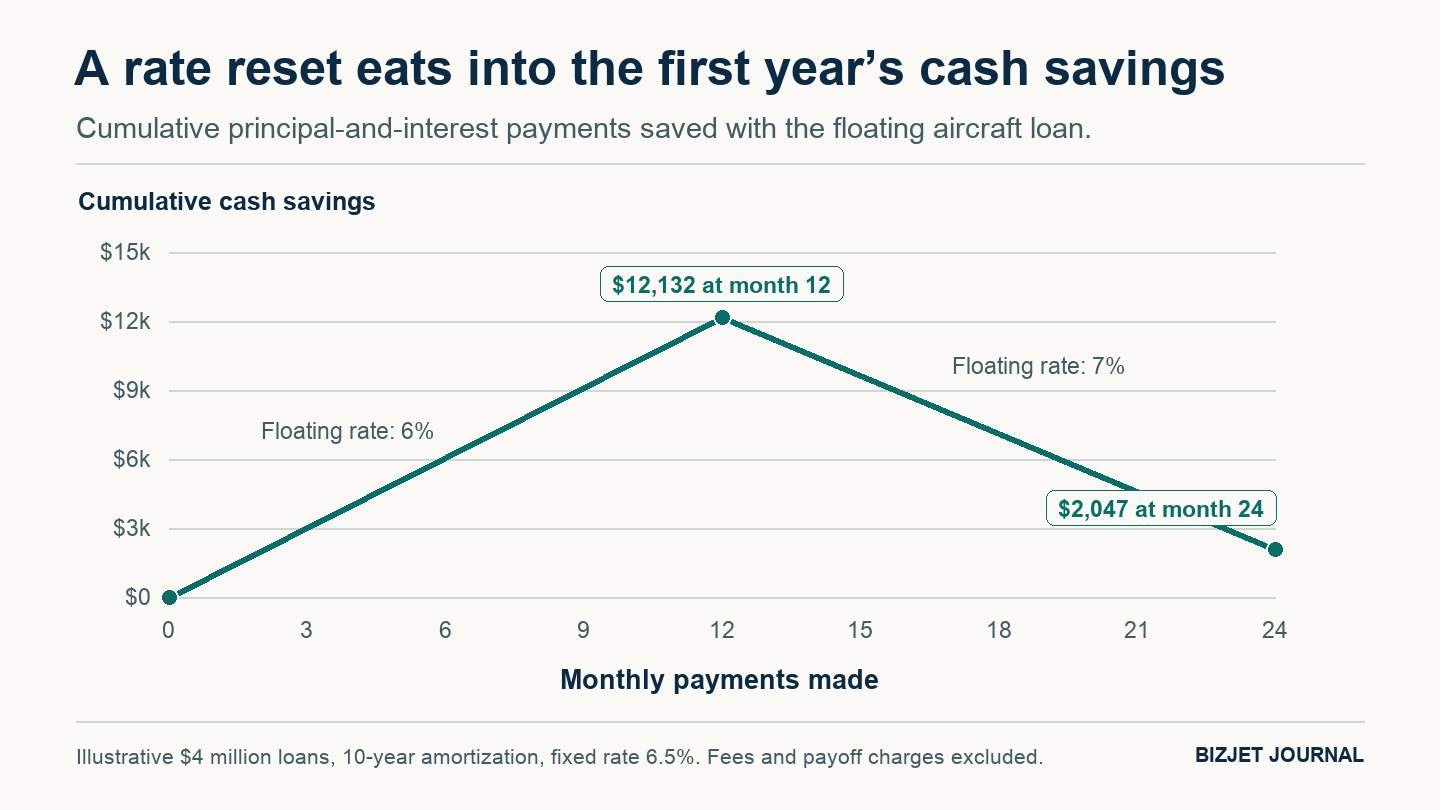
During the first year, the fixed loan costs about $45,419 a month. The floating loan calls for $44,408. The difference leaves roughly $12,132 more cash in the owner's account over those first 12 payments. Some of that apparent saving reflects the different way the two schedules divide the payments between principal and interest.
The floating benchmark then rises from 4% to 5%. With the margin unchanged, the contractual rate becomes 7%. The lender applies that rate to the unpaid balance of about $3.699 million over the remaining 108 months. It produces a monthly payment of $46,260. The owner now needs about $841 more a month than under the fixed loan.
| Illustrative loan measure | Fixed at 6.5% | Floating, 6% then 7% |
|---|---|---|
| Monthly payment in year one | $45,419 | $44,408 |
| Principal after payment 12 | $3,706,323 | $3,698,911 |
| Monthly payment in year two | $45,419 | $46,260 |
| Principal after payment 24 | $3,392,978 | $3,393,030 |
| Interest paid across the first 24 payments | $483,038 | $481,043 |
Calculations use a monthly rate equal to the annual rate divided by 12, with payments at month-end and no financed fees. The table rounds the results after calculation. A note with daily interest accrual, a different day-count convention or another reset schedule can produce a different cash demand even at the same advertised rate.
What determines an aircraft loan's reset rate?
The lender margin is the amount added to the benchmark. The benchmark has its own definition, observation date and term. The New York Federal Reserve's overnight SOFR measures the cost of borrowing cash overnight against Treasury collateral. A contract that references an average of overnight observations or a forward-looking term rate needs its particular convention to calculate the borrower's coupon. Seeing one overnight figure in a market report is insufficient to reproduce the next invoice.
The next question is when a change reaches the borrower. Under the example's annual reset, the borrower pays 6% for the first year even if benchmark rates begin rising in month two. A monthly reset would bring that increase into the cash forecast sooner. A floating loan that recalculates interest but holds principal installments constant also behaves differently from the amortizing-payment example above. Its payment changes because of the interest on that month's balance.
A rate floor matters on the way down. Suppose the contract floors the benchmark at 3% before the two-point margin is added. If the observed benchmark falls to 2.5%, the note still carries 5%. If the floor applies to the total coupon instead, the same number in the term sheet can yield a different payment. A ceiling has a similar drafting question. A limit on a single reset and a limit on the lifetime rate protect the cash budget in different ways.
Selling the jet early changes the cost comparison
After 24 payments the two principal balances differ by only about $52. The owner has paid about $1,995 less interest on the floating loan, despite spending the second year at a higher rate. That small difference makes the fees material.
Assume the fixed loan charged $20,000 at origination and the floating loan charged $30,000, both paid in cash. Interest plus those fees comes to about $503,038 fixed and $511,043 floating. If the owner could pay both off at par on the sale date, the fixed choice would have cost about $8,005 less through closing.
Now give the fixed note a prepayment charge of 1% of outstanding principal on that date and assume the floating note allows repayment at par. The fixed payoff charge would be about $33,930. Its two-year interest and fee bill becomes about $536,968, against $511,043 floating. That one term changes which loan costs less by the expected sale date. A real fixed-rate contract can use a different formula or allow a penalty-free period. The percentage here is simply an assumption that can be replaced with each lender's written term.
The $3.393 million in principal due at sale belongs on the closing statement as a cash requirement. Adding it to interest as a financing expense would count repayment of borrowed money as a cost of borrowing. The owner needs both figures for different reasons. The sale proceeds must cover the payoff before any remaining equity is available to purchase another aircraft.
The five-year balloon belongs in the aircraft budget
Ten-year amortization spreads repayment out long enough to reduce each installment. Five-year maturity obligates the borrower to settle the balance earlier. If the floating rate remains 7% after year one, the example leaves about $2.336 million due after the 60th payment. The fixed loan leaves about $2.321 million. Both figures exclude payoff costs and assume every installment arrived on schedule.
An owner planning to keep the airplane faces a new financing decision at that point. A lender may value the aircraft differently, and the aircraft itself will be five years older. A fixed coupon provides certainty about scheduled payments during the current loan term. Extending that certainty beyond maturity requires a new commitment or enough cash to discharge the balloon. For an owner expecting to trade the aircraft after two summers, the prepayment clause may matter more than that distant refinancing. For an owner planning a decade of use, the maturity date can matter more than the first year's discount.
Frequently asked questions
Does a one-point aircraft loan rate increase raise the payment by 1%?
The new rate applies to the outstanding principal under the note's payment formula. In this example the coupon rises one percentage point, from 6% to 7%, and the monthly payment rises by about $1,851, a little over 4%. The remaining amortization and reset method determine the result.
Is a fixed aircraft loan always cheaper when rates rise?
The timing and size of each change matter. Twelve months at 6% gave the floating borrower an early interest advantage here. A later sale, higher subsequent resets or different fees could reverse the result. Comparing the projected cash flows to the intended ownership period captures those differences.
Can an aircraft loan have a fixed rate and a balloon?
Yes. A fixed rate governs how interest accrues during its term. A balloon results when the payment schedule leaves principal outstanding at maturity. An owner can face a sizable final payment even if every monthly installment was predictable.