
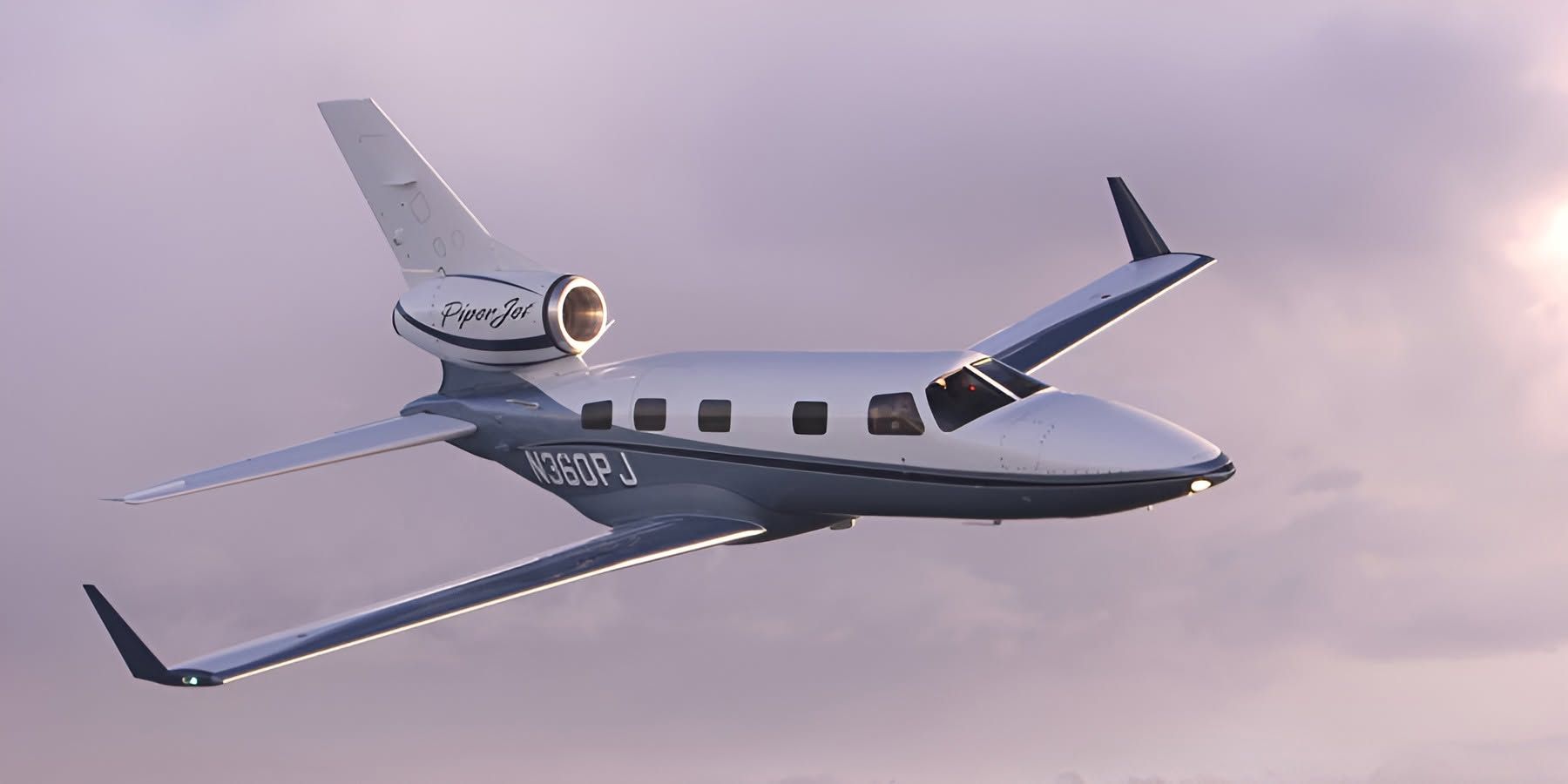
On July 30, 2008, an unusual aircraft lifted off from Piper Aircraft’s headquarters in Vero Beach, Florida. It had a narrow cabin, a single turbofan mounted high on its tail, and an ambitious promise: bring jet travel within reach of more owner-pilots and small businesses.
This was the Piper PA-47 PiperJet. It flew, accumulated hundreds of test hours, and attracted enough interest for Piper to plan a production aircraft. Yet no customer ever took delivery. Piper redesigned the concept as the PiperJet Altaire in 2010, then indefinitely suspended the program in October 2011.
The PiperJet’s story is about more than one cancelled airplane. It captures the excitement surrounding very light jets, or VLJs, in the late 1990s and 2000s, and the difficulty of building an affordable jet when the market, financing, and cost of development change beneath a manufacturer’s feet.
The VLJ dream: a jet for the owner-pilot
For decades, buying a business jet generally meant entering a world of substantial acquisition costs and professional flight operations. Advances in small turbofan engines, digital avionics, and aircraft manufacturing encouraged a different proposition: a compact jet that a properly trained owner could fly for business or personal travel.
The intended customers included successful entrepreneurs, affluent pilots moving up from piston aircraft or turboprops, and companies that needed fast regional travel but did not maintain a traditional flight department. The aircraft would still need certified maintenance, insurance, training, and support. The appeal was that an owner might operate one without employing a dedicated full-time flight crew or in-house maintenance team.
There was also an air-taxi vision. Some entrepreneurs believed fleets of small jets could connect cities that airlines served poorly, offering on-demand trips at a price below that of conventional private aviation. The market was therefore expected to come from several directions: owner-pilots, small companies, charter and air-taxi operators, and established flight departments seeking a smaller aircraft.
The field became crowded. Concepts from Adam, Diamond, Eclipse, Embraer, Cessna, Honda, Cirrus, Piper, and others appeared during the 2000s. Some were supported by established aircraft manufacturers; others depended on start-up funding and forecasts of demand that had yet to be tested.
Piper saw an opportunity within its own customer base. A pilot who had moved through the company’s piston aircraft to a pressurized Meridian turboprop might want jet speed next. A single-engine jet could offer Piper a route into business aviation while building on its experience with owner-flown aircraft.
Which VLJs actually reached customers?
It is easy to remember the VLJ era as a collection of prototypes and cancelled projects. Several aircraft did make it into service, although they had very different commercial outcomes.
The Cessna Citation Mustang reached customers in 2006 and became one of the defining entry-level jets of its era. The Eclipse 500 also entered production. Its original manufacturer later failed, but the airplane itself was certified and delivered: GAMA recorded 161 Eclipse 500 shipments in 2008 alone. The Embraer Phenom 100 began deliveries in 2008. The HondaJet followed in 2015, and the Cirrus Vision Jet began deliveries in 2016. GAMA’s 2008 shipment report records Mustang, Eclipse 500, and Phenom 100 deliveries; Honda and Cirrus documented their later first deliveries. HondaJet · Cirrus
That distinction matters. The VLJ idea was not an outright failure. The market proved smaller and more difficult than some of its most enthusiastic early forecasts suggested, and success depended heavily on the manufacturer’s resources, pricing, support network, and ability to survive a long certification program.
The PiperJet belongs among the serious projects that flew but never crossed the final gap to customer deliveries.
What made the PA-47 PiperJet distinctive?
Piper announced the PiperJet in 2006. Its original proof-of-concept aircraft used a cabin cross-section related to the company’s PA-46 family, stretched to suit the jet design. It had one Williams International FJ44-3AP turbofan mounted on the aircraft’s centerline above the rear fuselage.
That engine gave the PiperJet its unmistakable appearance. The single-engine layout promised savings in fuel consumption and maintenance relative to operating two engines, although no production fleet existed to verify a real-world cost advantage. It also avoided the asymmetric thrust a pilot must manage following an engine failure in a twin-engine jet.
Piper published an introductory price of about $2.199 million and targeted a maximum cruise speed of 360 knots, a maximum range of 1,300 nautical miles, and operation up to 35,000 feet. These were program targets, not certified performance figures for an aircraft customers could buy.
The high engine placement created an engineering problem. Because the thrust line sat above the aircraft’s center of gravity, adding power could produce a nose-down pitching moment, while reducing power could produce a nose-up moment. Piper and Williams developed a nozzle intended to counter the effect. The redesigned Altaire incorporated the EXACT exhaust-nozzle concept, short for exhaust angle control technology.
That design challenge should not, by itself, be treated as the reason the airplane was cancelled. Development programs are built around finding, testing, and solving problems. When Piper ultimately suspended the jet, its publicly stated reason centered on the economics of finishing it in a weak market.
The first flight and what it proved
The PA-47 proof of concept first flew on July 30, 2008, from Vero Beach. It was Piper’s first pure turbofan-powered aircraft design to take flight. The event proved that the basic configuration could fly and began the process of collecting handling and performance data. It did not mean that a production PiperJet had been certified.
Piper kept testing. By October 2010, the company said the prototype had logged more than 375 flight-test hours and completed more than 350 takeoffs and landings. Engineers could use those results to refine the aircraft’s systems and the next design.
The limitation is equally important. The aircraft doing that flying was a proof of concept. Certification and customer delivery would require a settled production design, conforming test aircraft, structural and systems testing, approved documentation, and a manufacturing process able to build the same safe aircraft repeatedly. Piper still had much of that work ahead.
PiperJet specifications: targets versus results
Many summaries list the PiperJet’s proposed specifications as though they were established operating figures. Because the PA-47 never entered service, the headline numbers are best described as Piper’s development targets.
| Item | Published PiperJet or Altaire plan |
|---|---|
| Engine | One Williams International FJ44-3AP turbofan |
| Maximum cruise speed | About 360 knots |
| Maximum range | About 1,300 nautical miles |
| Maximum operating altitude | 35,000 feet |
| Full-fuel payload target | About 800 pounds |
| Operating concept | Single-pilot-capable personal and business jet |
Payload and range need to be read together. More passengers and baggage can reduce the fuel an aircraft is able to carry, shortening its range. For the later Altaire, Piper separately projected 1,200 nautical miles with an 800-pound payload. Neither that figure nor the headline maximum range became a certified customer specification.
The proposed cockpit also evolved. While the earlier article described Garmin G1000 avionics, Piper’s published production plan for the Altaire specified the Garmin G3000, with three displays and two touchscreens.
Why the PiperJet became the Altaire
Piper’s initial concept appealed most directly to an owner-pilot moving into a jet. As the company researched potential business customers, it concluded that the cabin needed to offer more space and flexibility.
In October 2010, Piper introduced the PiperJet Altaire. The redesign replaced the narrower, PA-46-derived cabin shape with a larger round fuselage. Piper said the new cabin would be nine inches taller and four inches wider than the earlier design.
Plans also called for a recessed aisle, a three-foot-wide entry door, a revised wing and tail, and conventional control yokes instead of the proof-of-concept aircraft’s side-stick controls. Buyers could choose an optional seating arrangement or use that space for a lavatory, storage, or entertainment equipment.
The redesign addressed a real sales question: could Piper offer a cabin that businesses would find competitive with other small jets? It also added work. A substantially changed fuselage and wing required further design, tooling, testing, and certification investment.
Piper set the Altaire’s proposed base price at $2.5 million, with a typically equipped aircraft at about $2.6 million. It promoted lower hourly operating costs than comparable production VLJs. Those operating-cost estimates remained projections because no Altaire entered customer service.
How close was the Altaire to production?
Piper went beyond sketches and advertisements. It built a cabin mockup, began fabricating parts for a conforming flight-test aircraft, and prepared its Vero Beach facilities for production. In July 2011, the company reported nearly 200 engineering and production personnel assigned to the program and $5.6 million in building improvements. At that point, Piper expected a conforming Altaire to fly in 2013, followed by certification and first deliveries in 2014.
Piper was still marketing the jet at the National Business Aviation Association convention in October 2011. It displayed the Altaire mockup and offered incentives intended to help existing Piper M-Class buyers move into the jet. Its customer deposit schedule linked later payments to milestones including the conforming aircraft’s first flight and certification or delivery.
The crucial distinction remains: the original PA-47 proof of concept flew; a conforming Altaire did not fly before the program was suspended.
What the 2008 crash changed
The PiperJet was conceived during an optimistic period for business aviation. A growing number of wealthy individuals and successful small-business owners appeared to offer a market for smaller, owner-flown jets. Some forecasts also assumed that air-taxi operators would buy large fleets.
The global financial crisis damaged that proposition. Credit tightened, companies cut spending, and aircraft buyers became more cautious. GAMA reported that worldwide business jet shipments fell from 1,313 aircraft in 2008 to 870 in 2009, a 33.7% decline. Piston aircraft shipments fell even more sharply.
It would be too broad to say that the upper middle class simply disappeared. The relevant change for Piper was narrower and more concrete: the pool of buyers willing and able to commit millions of dollars to a new entry-level jet became less dependable, while completing and supporting that jet still required major investment.
The effects were uneven across business aviation. In early 2010, GAMA observed that deliveries of large-cabin, long-range aircraft were supporting industry billings because those customers were generally less dependent on outside financing than buyers elsewhere in the market. That contrast helps explain why an affordable-jet strategy could become harder to finance even while expensive aircraft continued to sell.
Why Piper suspended the program
On October 24, 2011, Piper announced that it was indefinitely suspending the Altaire. Management said the light jet market was recovering too slowly to justify continuing development under the economic conditions the company faced. The decision followed a review of the investment still needed and the sales Piper could reasonably expect.
This is a more useful explanation than blaming one supposed design flaw. The engine installation, larger Altaire cabin, and certification requirements all made for a demanding program. Yet Piper’s stated final decision was about whether future sales could recover the remaining cost. Contemporary reporting said the company described the project as meeting its schedule and performance targets when management chose to stop it.
The decision affected the people building the aircraft. AOPA reported expected layoffs of about 150 employees, mostly engineers, and the release of another 55 contract engineers. Customers who had placed orders were to receive refunds of their deposits. Piper retained the program’s intellectual property, but development did not restart.
Did the PiperJet inspire the Cirrus Vision Jet?
The resemblance makes the question understandable. Both aircraft addressed the owner-flown, single-engine jet market, and both placed one turbofan high on the aircraft’s centerline. Piper announced its project in 2006; Cirrus says it unveiled plans for its personal jet in 2007. It is possible that the companies watched each other’s work as competitors in a crowded new field.
There is, however, no established public evidence that Cirrus based the Vision Jet on the PiperJet. Their flight timelines also prevent the PiperJet prototype from being described as the model for Cirrus’s first flying aircraft. Cirrus says its Vision Jet prototype flew on July 3, 2008 which was 27 days before the PA-47’s first flight. The two programs developed in parallel, seeking different answers to a similar customer need.
The final designs differed in major ways. Cirrus used a V-tail, a different Williams engine, a composite airframe, and a whole-aircraft parachute system. Piper’s proof of concept used a conventional tail and pursued a larger business-oriented cabin with the Altaire. The fairest conclusion is that the PiperJet may have been part of the competitive landscape that informed Cirrus, but a direct design influence remains speculation.
Cirrus ultimately crossed the line Piper could not: the Vision Jet received FAA certification in 2016 and began customer deliveries that year. That proved a single-engine personal jet could reach the market. It does not tell us whether the Altaire would have succeeded under Piper’s circumstances.
Did private jets simply get bigger after 2008?
There is a real shift behind that observation. Large-cabin and long-range aircraft command a substantial share of business aviation spending. Honeywell’s 2024 industry outlook expected large jets to account for roughly two-thirds of new business jet expenditures over the following five years.
These aircraft serve a different mission from the original VLJ promise: carrying more people farther, often across continents, at prices far above those once advertised for personal jets.
Yet the small-jet market did not vanish. Honda continues to develop the HondaJet, and Cirrus introduced a new G3 Vision Jet in 2026. Larger and more expensive jets dominate many spending headlines, while smaller, owner-oriented aircraft continue to serve customers with shorter routes and different budgets.
That mixed outcome is more revealing than a simple story of small jets being replaced by giant ones. The entry-level dream survived, but fewer of the original contenders brought a certified aircraft to market than the early enthusiasm suggested.
Where is the PiperJet now?
The sole flying PA-47 proof-of-concept aircraft survived. In 2025, the Piper Aviation Museum in Lock Haven, Pennsylvania, unveiled it as part of its collection. Visitors can now see the aircraft that tested Piper’s single-engine jet idea, even though the larger Altaire it inspired never flew.
The PiperJet’s lasting lesson
The PA-47 was a serious engineering project, not merely a rendering of an aircraft that might someday exist. It flew, generated hundreds of hours of test data, and led Piper to design an aircraft with a roomier cabin and a clearer business mission.
Its cancellation illustrates the gap between an airplane that works and a product that can be certified, manufactured, supported, and sold profitably. Piper had to fund the remaining work just as demand for entry-level jets and access to credit were under pressure. The company concluded that the sales it could foresee no longer justified the investment.
The PiperJet therefore remains one of aviation’s most compelling “what if” stories. It was part of a genuine attempt to make jet ownership more accessible. Some of its contemporaries reached customers; others, like the PA-47, became reminders that timing and financial endurance matter as much as an inventive design.
Frequently asked questions
Did the Piper PA-47 PiperJet ever fly?
Yes. The original proof-of-concept aircraft first flew on July 30, 2008. Piper later reported more than 375 flight-test hours. The redesigned Altaire did not make its planned conforming first flight.
Was the PiperJet ever certified or delivered?
No. Neither the original PA-47 nor the Altaire entered customer service. Their published speed, range, altitude, and operating-cost figures were program targets.
Why did Piper cancel the PiperJet Altaire?
Piper indefinitely suspended the program in October 2011 after reviewing the remaining development investment against forecasts for a weak light jet market.
Could the PiperJet have influenced the Cirrus Vision Jet?
Possibly as a competitor in the same emerging market, but direct influence is unproven. Cirrus had announced its own jet by 2007, and its prototype flew before Piper’s in July 2008.
Which VLJs from that era reached customers?
The Citation Mustang, Eclipse 500, Embraer Phenom 100, HondaJet, and Cirrus Vision Jet all reached customer delivery, though on different timelines and with different commercial outcomes.