
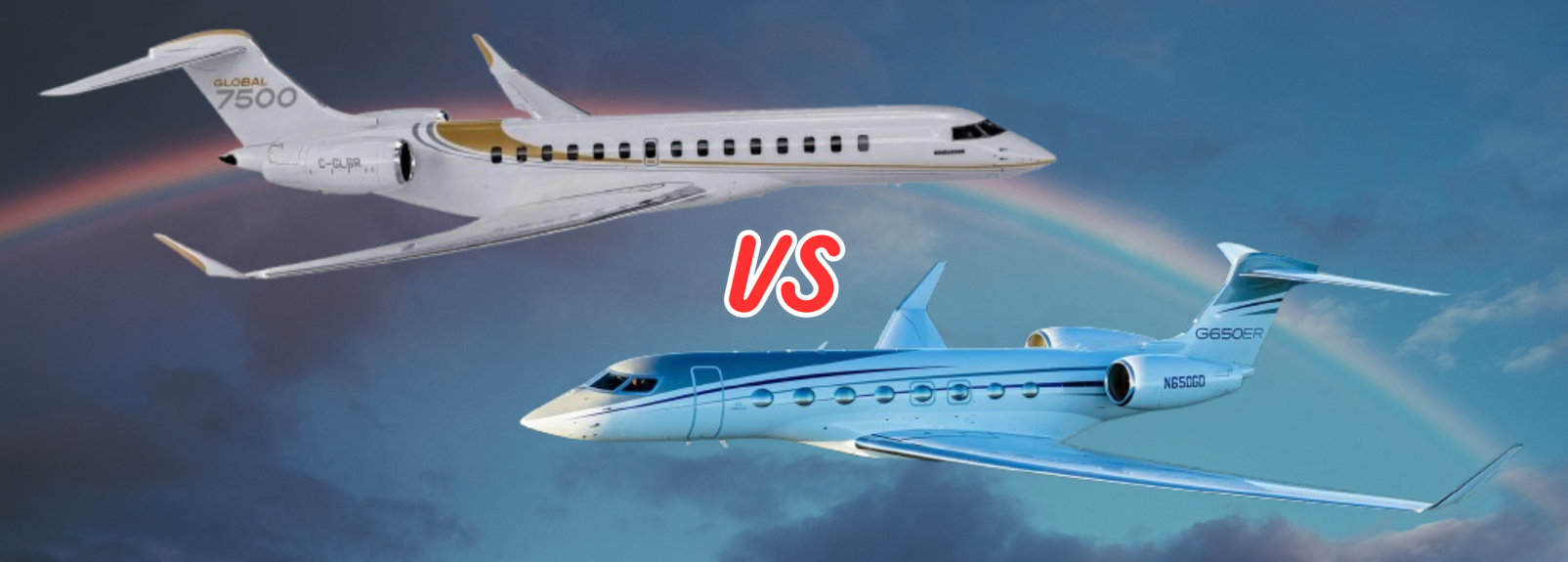
For years, the Bombardier Global 7500 and Gulfstream G650ER represented two compelling answers to the same question: how far can a private aircraft take its passengers without giving up speed, comfort or access to useful airports?
The Global 7500 has the stronger range and takeoff figures. Bombardier lists a maximum range of 7,700 nautical miles, compared with 7,500 nautical miles for the G650ER. It also publishes a takeoff distance of 5,760 feet at maximum takeoff weight, versus 6,299 feet for the Gulfstream. Both aircraft have a maximum operating speed of Mach 0.925.
The cabin decision is more personal. The Global 7500 offers a notably long passenger cabin, four living spaces and a separate crew suite. The G650ER counters with a slightly wider and taller cabin, 16 panoramic oval windows, and a layout that can be configured for up to four living areas. Both have 195 cubic feet of baggage space and can seat up to 19 passengers.
Today, the buying context has changed as well: Gulfstream’s G800 has replaced the G650ER in its new-aircraft lineup.
How the Global 7500 and G650ER reached the top of the market
Gulfstream established the G650 as a benchmark for fast, long-distance business travel when it entered service in 2012. The company announced the G650ER in 2014, extending the family’s advertised range by 500 nautical miles to 7,500 nautical miles at Mach 0.85.
Existing G650 owners were offered an upgrade route to the ER configuration, giving the longer-range model a foundation in an aircraft family already flying worldwide.
Bombardier took a different route. Its aircraft began as the Global 7000 program, launched in 2010. During development, Bombardier increased its range target and renamed it the Global 7500 in 2018.
The aircraft received Transport Canada certification that September and its first customer delivery followed in December. Its design emphasized a long, flexible cabin, a dedicated crew area and a wing developed for both long-range efficiency and airfield performance.
That history explains why the two jets remain natural rivals. Both were created for owners who wanted to cross continents and oceans non-stop while carrying a substantial private cabin.
Yet they express that goal differently: the Global 7500 puts more emphasis on cabin length and runway performance, while the G650ER combines long range with Gulfstream’s distinctive cabin shape, windows and established aircraft family.
Global 7500 vs G650ER specifications
| Specification | Bombardier Global 7500 | Gulfstream G650ER |
|---|---|---|
| Maximum range at Mach 0.85 | 7,700 nm | 7,500 nm |
| High-speed cruise | Mach 0.90 | Mach 0.90 |
| Maximum operating speed | Mach 0.925 | Mach 0.925 |
| Takeoff distance at maximum takeoff weight | 5,760 ft | 6,299 ft |
| Maximum operating altitude | 51,000 ft | 51,000 ft |
| Passenger cabin length, excluding baggage | 54 ft 5 in | 46 ft 10 in |
| Cabin width | 8 ft | 8 ft 2 in |
| Cabin height | 6 ft 2 in | 6 ft 3 in |
| Baggage volume | 195 cu ft | 195 cu ft |
| Maximum passenger seating | 19 | 19 |
Range: the Global 7500 leads by 200 nautical miles
Range is the clearest numerical win for Bombardier. At the manufacturers’ Mach 0.85 long-range cruise setting, the Global 7500’s 7,700-nautical-mile figure exceeds the G650ER’s 7,500 nautical miles by 200 nautical miles, or about 2.7%.
That extra reach is most interesting to operators whose regular trips sit close to the limits of either aircraft.
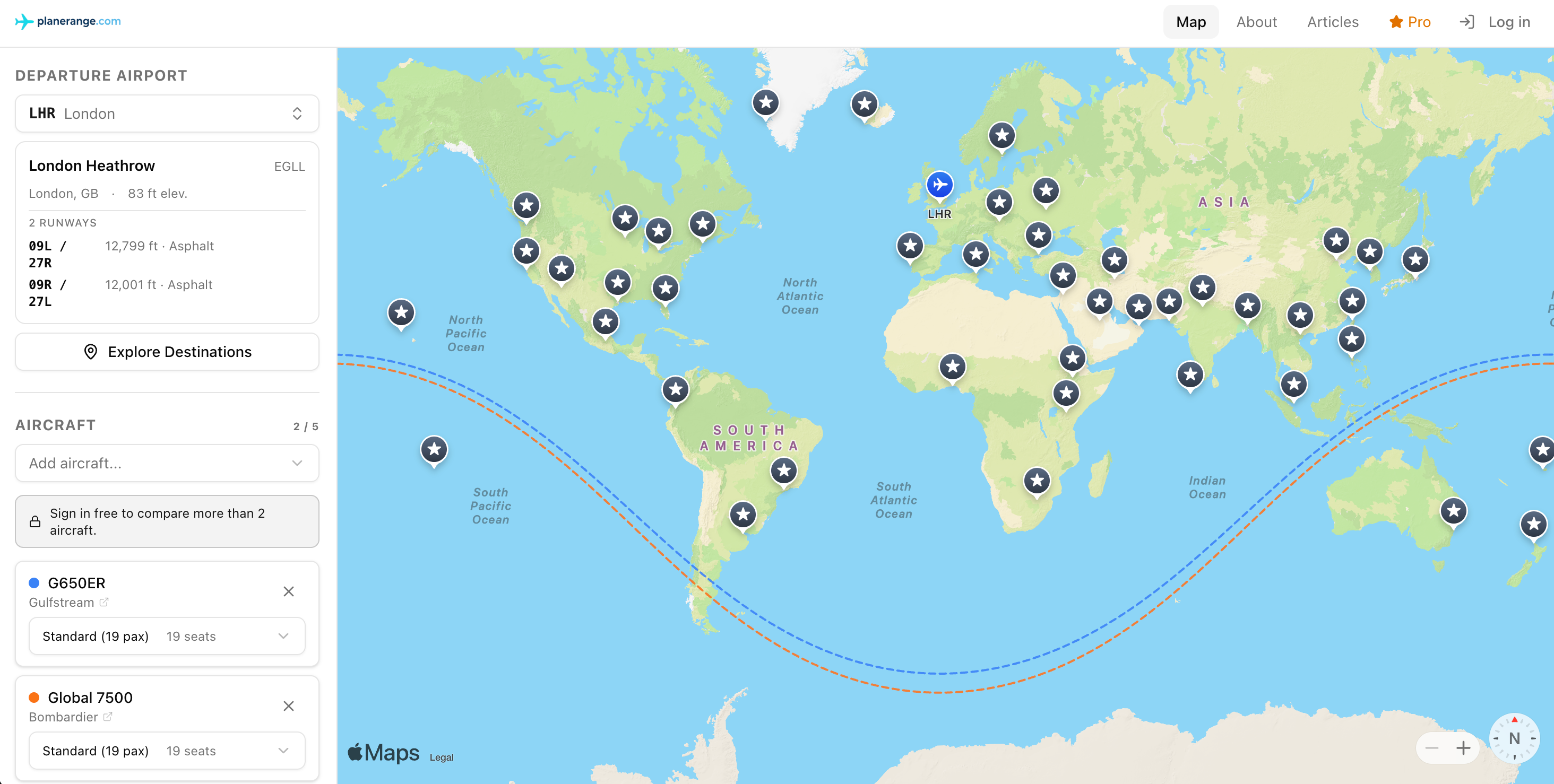
The G650ER nevertheless earned its reputation through ambitious long-distance flying. At launch, Gulfstream identified nonstop routes such as New York to Hong Kong and San Francisco to Delhi among the city pairs opened by its extended range.
Its original announcement also stated a 6,400-nautical-mile range at Mach 0.90, showing how Gulfstream positioned the aircraft for owners who wanted to cover substantial distances at a higher cruise speed.
For many missions, either jet reaches the destination nonstop. The Global 7500 becomes particularly attractive when an owner repeatedly flies the longest transcontinental or transoceanic routes and wants the greatest reach available between these two models.
Speed: closer than their reputations suggest
The G650ER is often associated with speed, and for good reason: the G650 family helped make Mach 0.90 cruise a defining feature of top-tier business aviation. But the Global 7500 matches the G650ER on two headline speed figures. Both list Mach 0.90 high-speed cruise and Mach 0.925 maximum operating speed. The specification therefore give neither aircraft a top-speed victory in this direct comparison.
The more meaningful question is how each aircraft fits the operator’s preferred trips. A flight department that values maximum nonstop reach will focus on long-range cruise.
An owner who often prioritizes time on shorter intercontinental sectors may choose to fly faster. Both jets were built to offer that choice, which is why neither can be judged by its maximum Mach number alone.
Airport access: Bombardier’s takeoff advantage
The Global 7500’s takeoff figure is 539 feet shorter than the G650ER’s when both are compared at maximum takeoff weight under the manufacturers’ sea-level standard conditions.
For an aircraft capable of carrying passengers across oceans, that is a meaningful airfield-performance advantage. It can make the Bombardier especially appealing to owners who regularly use airports where available runway length shapes their aircraft choice.
The G650ER has an airport-access strength of its own. Gulfstream obtained steep-approach certification for the G650 family in 2019, opening access to airports including London City, whose approach requirements are unusually demanding.
The comparison is therefore richer than a single runway number: the Global 7500 leads on the published maximum-weight takeoff distance, while the G650ER also has a demonstrated capability at specialized steep-approach airports.
Cabin space: length versus width and light
The Global 7500’s cabin is designed around separation. Bombardier presents four living spaces — a club suite, conference suite, entertainment suite and principal suite—alongside a full-size kitchen and dedicated crew suite.
That arrangement gives passengers distinct places to work, dine, relax and sleep during a long flight. The principal suite can include a permanent bed, while the aft area provides access to the baggage compartment.
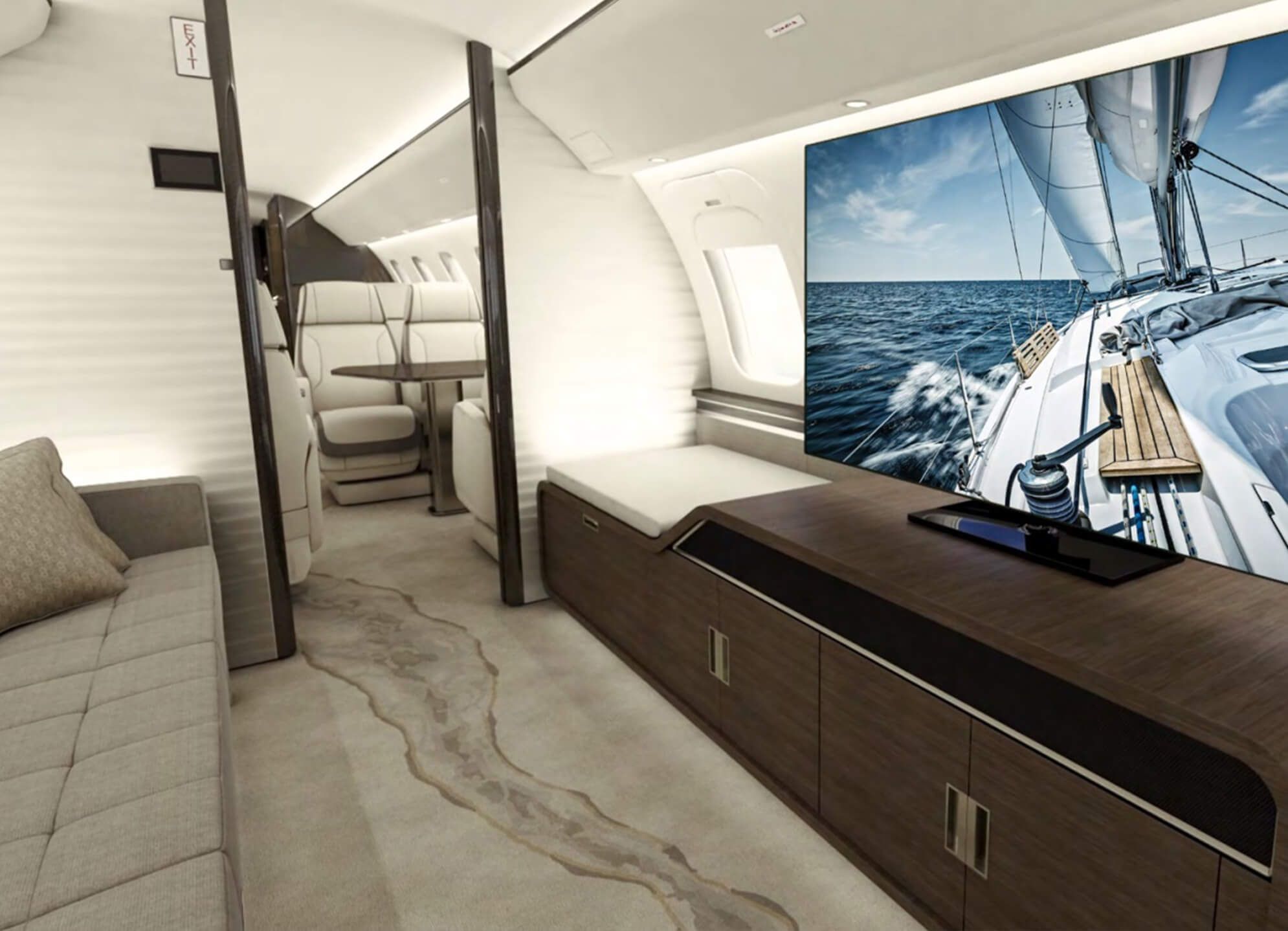
This layout matters most when several passengers want to use the aircraft differently at the same time. A meeting can continue in one area while another traveler sleeps farther aft. A family group can spread out without turning the entire cabin into one shared lounge. The separate crew suite also recognizes the demands of the aircraft’s longest missions.
The G650ER approaches comfort from another angle. Its cabin is two inches wider and one inch taller than the Global 7500’s published dimensions. Gulfstream offers flexible configurations with up to four living areas, 16 large panoramic oval windows, forward or aft galley choices, and forward and aft lavatories. The windows are a particularly visible part of the G650ER experience: they bring daylight and broad outside views into a cabin intended for flights that can last much of a day.
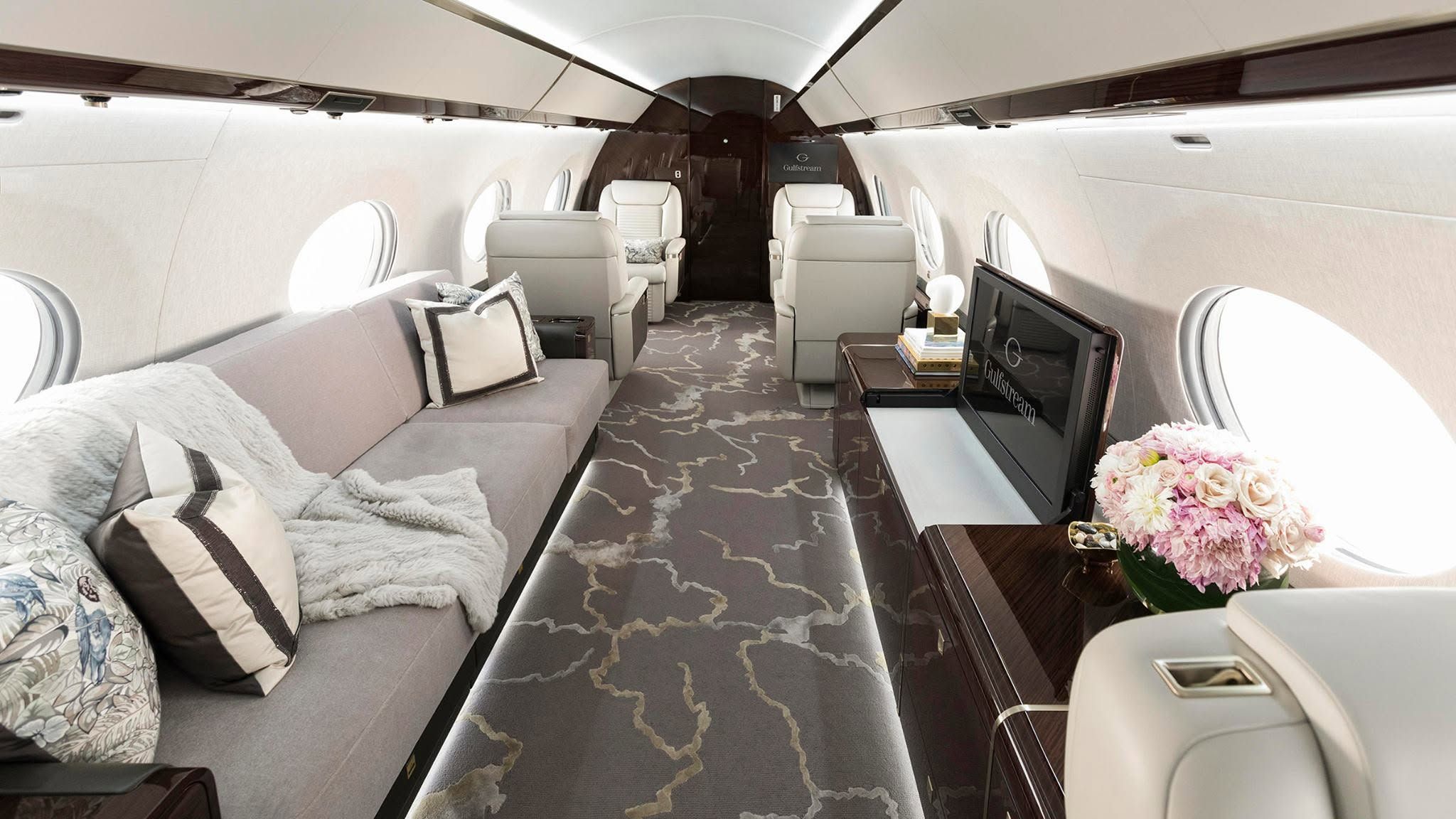
Both aircraft provide the same baggage volume of 195 cubic feet. A buyer choosing between them should therefore look beyond the baggage number to the actual cabin plan: where the beds are, how private the aft suite feels, how the galley serves passengers, and whether the seating arrangement suits the people who regularly travel together.
Air, lighting and long-flight comfort
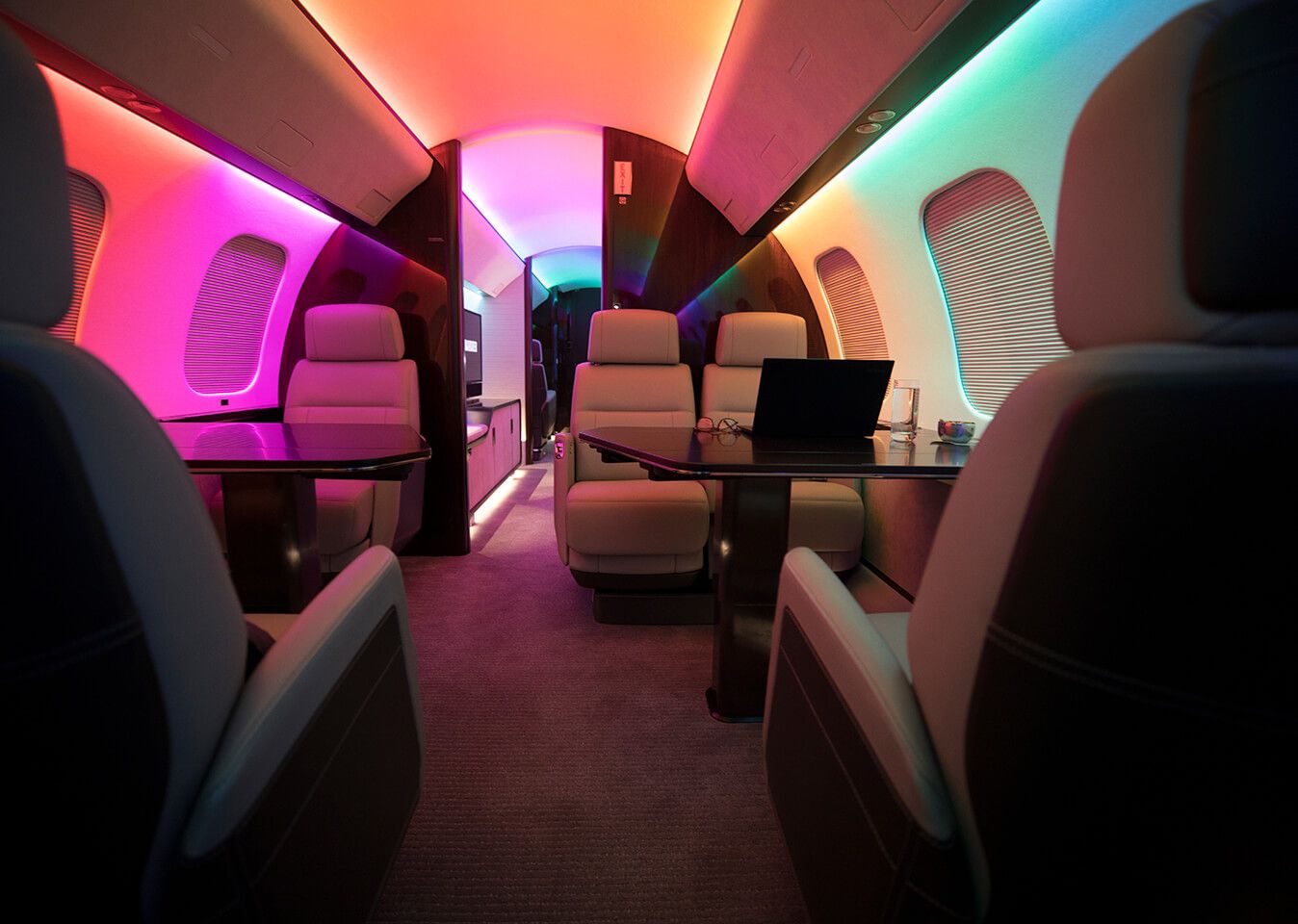
Bombardier equips the Global 7500 cabin with its Pũr Air system and Soleil lighting. Pũr Air incorporates HEPA filtration, while Soleil uses changing light patterns designed around passengers’ daily rhythms. The aircraft’s Nuage seating and four-space layout add to Bombardier’s emphasis on making a very long flight feel manageable as well as luxurious.
Gulfstream emphasizes 100% fresh cabin air in the G650ER, along with its optimized cabin altitude and large windows. Its product sheet lists a cabin altitude of 3,290 feet while the aircraft flies at 41,000 feet. The combination of air management, pressurization and natural light has long been central to Gulfstream’s cabin proposition.
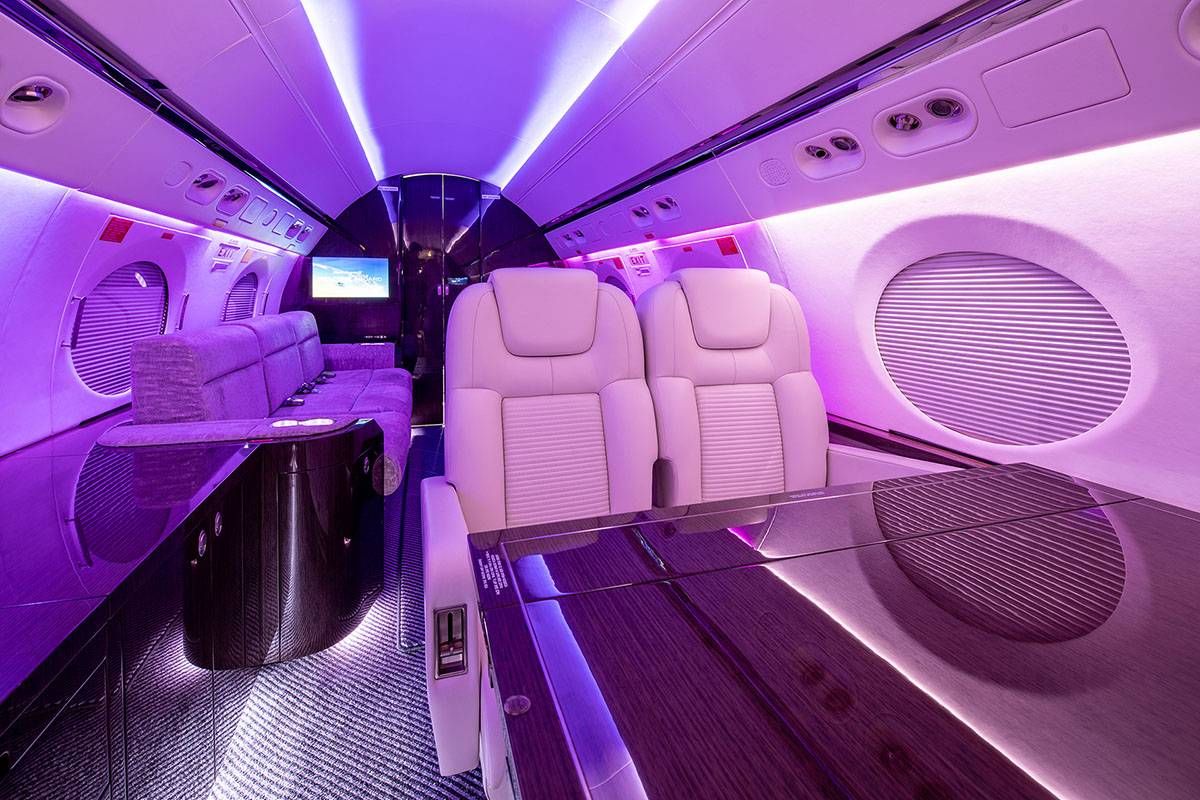
Neither cabin is simply a set of dimensions. For someone flying overnight or arriving directly at a meeting, the placement of a bed, the privacy of a work area, the quality of the air and the ability to adjust lighting may matter more than a few inches of width.
Cockpit and engines: two distinct approaches
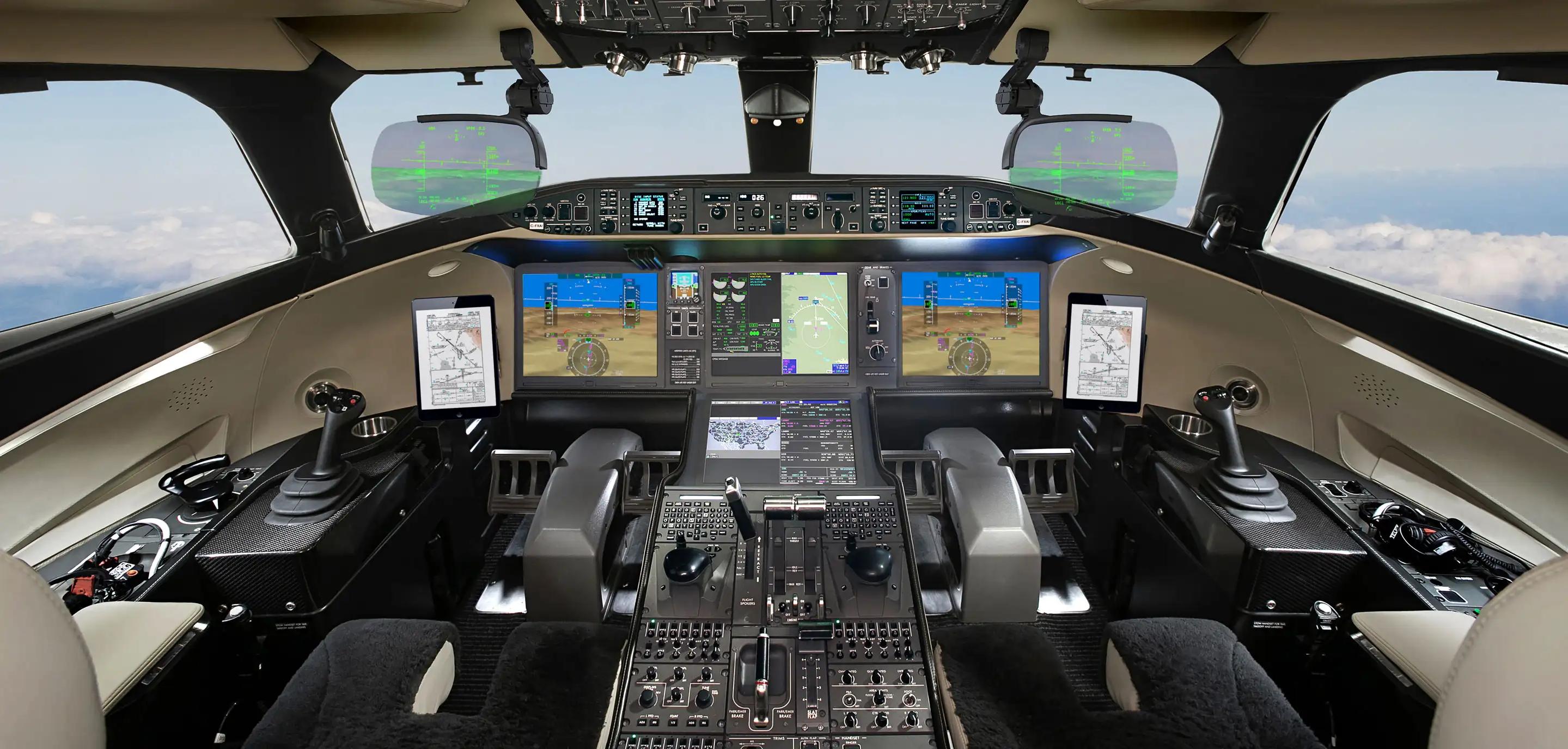
The Global 7500 uses GE Aerospace Passport engines and Bombardier’s Vision flight deck. Bombardier’s published flight-deck description includes fly-by-wire controls, four large displays, a head-up display, enhanced vision and synthetic vision. GE developed the Passport specifically for the large, long-range business-jet mission.
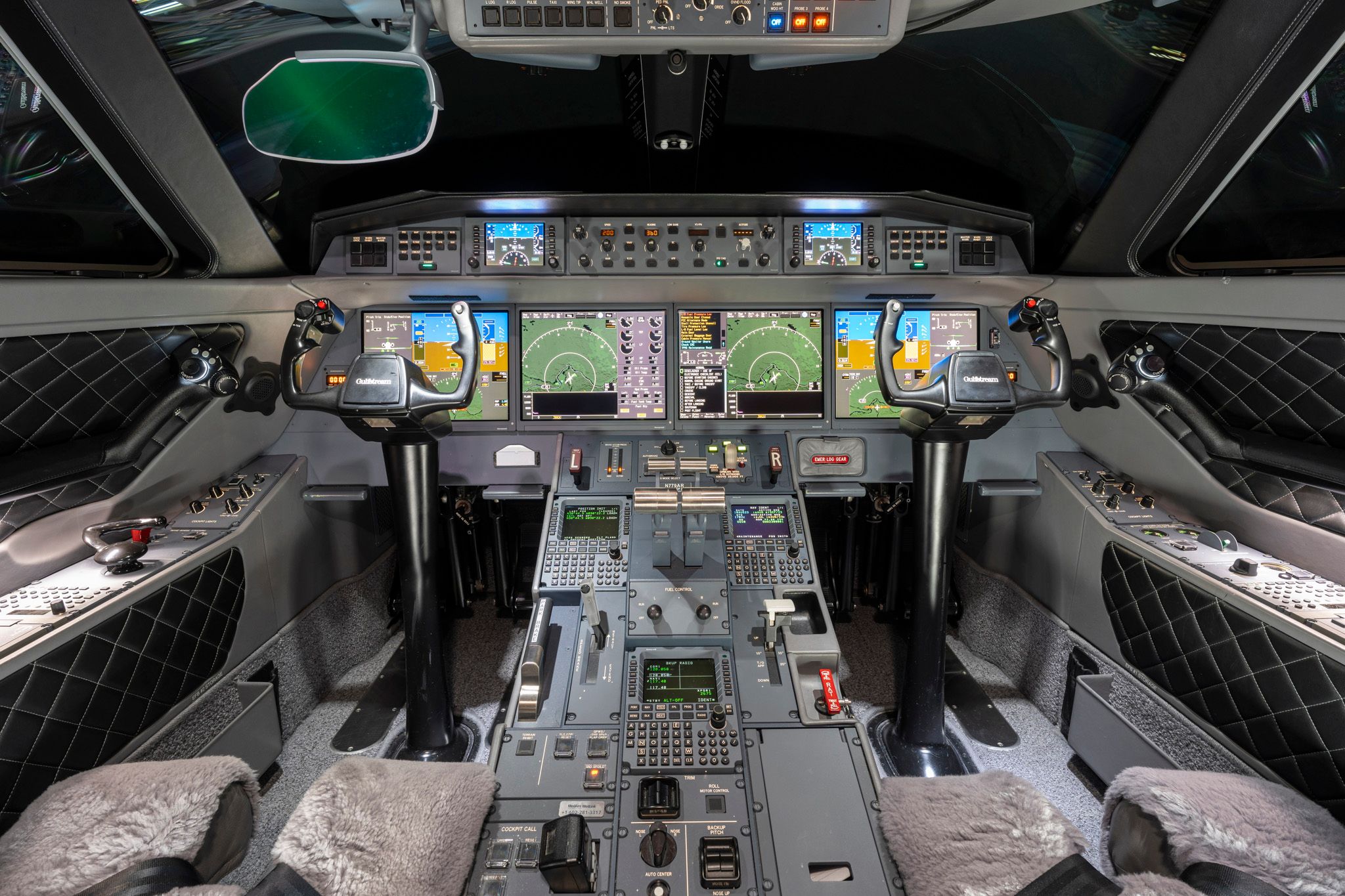
The G650ER uses two Rolls-Royce BR725 engines and Gulfstream’s PlaneView II avionics. Gulfstream lists 16,900 pounds of rated takeoff thrust per engine. The aircraft also incorporates enhanced flight vision capabilities that support its airport-access story. Rolls-Royce offers its CorporateCare engine-support program for the BR725, while GE offers OnPoint support for Passport operators.
For an owner with an existing flight department, the practical decision also involves pilot experience, maintenance arrangements and the aircraft systems already familiar to the team. Those operational preferences can weigh as heavily as a modest difference in published range.
What changed after the G650ER?
The G650ER remains an important aircraft, but it is now part of a different buying conversation. General Dynamics, Gulfstream’s parent company, says the G800 replaced the G650 and G650ER. Its 2025 filing reported more than 595 G650-family aircraft in service across 55 countries — a figure covering the family, rather than the G650ER alone.
Gulfstream’s current lineup separates two priorities that the G650ER once combined. The G700 offers the company’s largest cabin, up to five living areas and a published range of 7,750 nautical miles. The G800 succeeds the G650ER as Gulfstream’s longest-range model, with a published 8,200-nautical-mile range.
Bombardier has moved forward too. The Global 8000 entered service in December 2025, bringing a published 8,000-nautical-mile range and Mach 0.95 maximum speed. Bombardier delivered the first Global 8000 to fleet launch customer NetJets in March 2026 and said NetJets plans to upgrade its in-service Global 7500 fleet. The Global 7500 versus G650ER comparison remains highly relevant to buyers assessing these established aircraft, while a new-aircraft shortlist now includes their successors.
Which jet should you choose?
Choose the Global 7500 if maximum range between these two aircraft, a shorter published takeoff distance and a long cabin with four distinct living spaces are your leading priorities. Its separate crew suite and flexible passenger areas make a strong case for frequent, very long missions.
Choose the G650ER if you value the Gulfstream cabin’s extra width and height, panoramic windows, flexible interior layouts and membership in a large, well-established aircraft family. It remains a capable 7,500-nautical-mile business jet, with the added appeal of steep-approach certification.
For a purchase decision, the individual aircraft matters as much as the model. Cabin layout, equipment, maintenance status, engine coverage and the routes flown most often will determine which of these two exceptional jets delivers greater value to its next owner.
Frequently asked questions
Does the Global 7500 fly farther than the G650ER?
Yes. Bombardier publishes a maximum range of 7,700 nautical miles for the Global 7500, while Gulfstream publishes 7,500 nautical miles for the G650ER. That gives the Bombardier a 200-nautical-mile advantage at Mach 0.85 long-range cruise.
Is the G650ER faster than the Global 7500?
Their published high-speed cruise and maximum operating speeds are the same: Mach 0.90 and Mach 0.925, respectively.
Which aircraft has the larger cabin?
The Global 7500 has the longer passenger cabin. The G650ER is slightly wider and taller. Both can seat up to 19 people and provide 195 cubic feet of baggage space.
Can you still buy a new G650ER?
The G650ER has been replaced in Gulfstream’s current lineup by the G800. Buyers interested in a G650ER are therefore looking at existing aircraft, while the G800 is Gulfstream’s current long-range successor.