By Joash Koech | Updated September 5, 2026
Advanced air mobility promises a future of shorter journeys, quieter aircraft and electric air taxis connecting cities, airports and regional destinations.
The engineering progress deserves attention. Aircraft are flying, manufacturers are expanding test programmes, and regulators are developing pathways for new operations. But the commercial questions remain demanding: who will use these services, what will they pay, and can manufacturers and operators survive financially long enough to build sustainable businesses?
Joby Aviation, Archer Aviation, Vertical Aerospace and Lilium illustrate different aspects of that challenge. Joby is building an operating network around its aircraft. Archer is pursuing initial services while expanding into a broader aerospace business. Vertical demonstrates how certification funding can reshape ownership. Lilium’s insolvency shows the consequences when financing fails before commercialisation.
The future of advanced air mobility will depend on aircraft performance, certification, capital, infrastructure and repeat customers working together.
What Is Advanced Air Mobility?
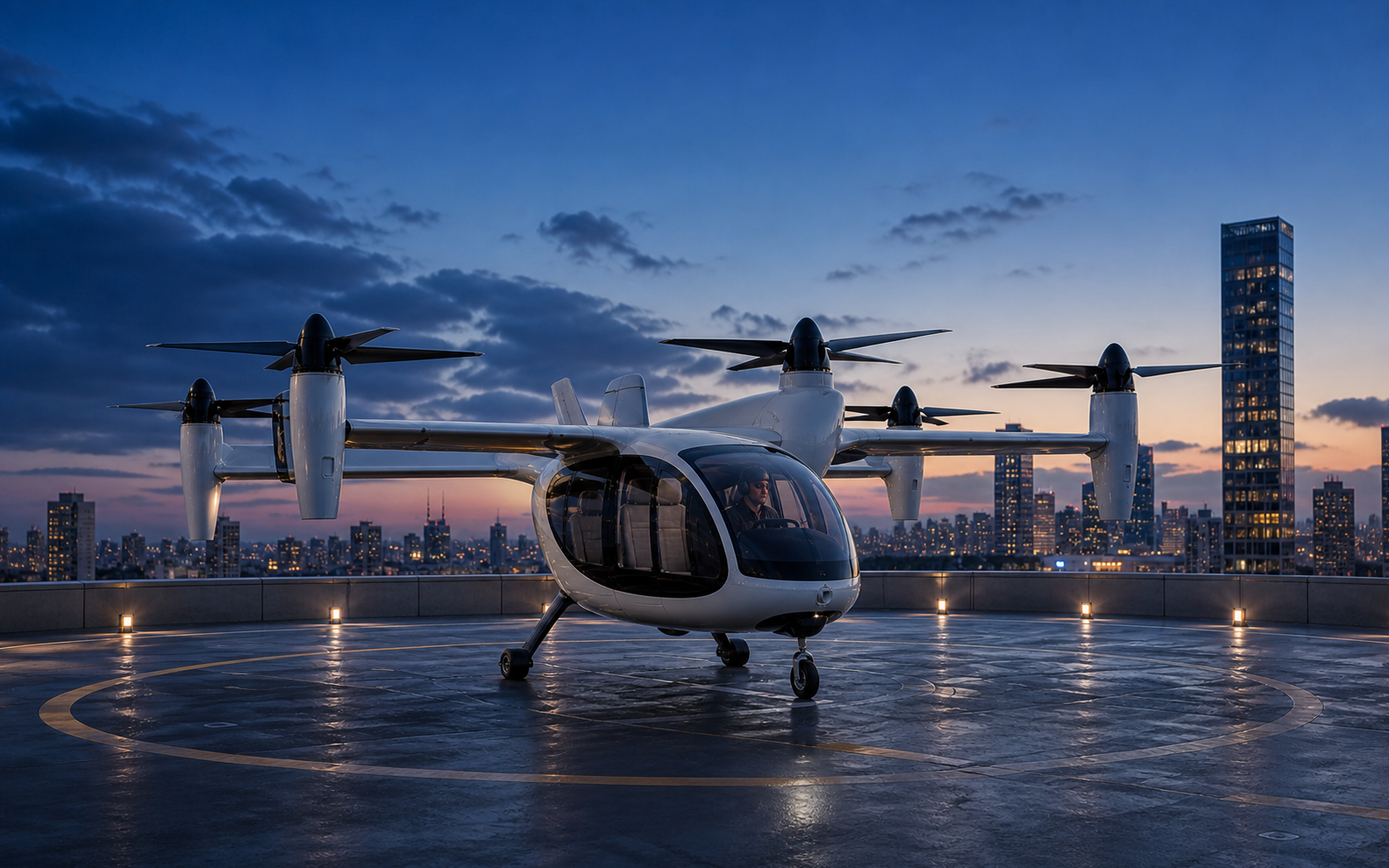
Advanced air mobility, or AAM, includes emerging aviation services for transporting people and goods across urban and regional environments. Electric vertical takeoff and landing aircraft(eVTOLs) are a prominent part of that market.
These aircraft use electric propulsion to take off and land vertically. Winged designs can transition into forward flight, using their wings to support the aircraft during cruise.
The wider AAM opportunity includes passenger transport, cargo delivery and services connecting smaller communities. The FAA’s framework explicitly extends beyond metropolitan air taxis. FAA advanced air mobility overview
That distinction matters. A sightseeing flight, an airport shuttle and a regional business connection face different customers, competitors and operating requirements.
An aircraft suitable for one mission may have poor economics on another. The sector should therefore be assessed by business model and route, rather than treated as a single market with one adoption timeline.
Joby, Archer, Vertical Aerospace and Lilium: Four Different Tests
The principal companies provide a useful framework for examining the industry.
Company
Central proposition
Commercial question
Joby Aviation
Develop an electric aircraft alongside a passenger-service network
Can existing infrastructure and customer relationships support profitable eVTOL operations?
Archer Aviation
Introduce Midnight services while expanding its aerospace portfolio
Can certification, manufacturing and operational execution advance together?
Vertical Aerospace
Develop the Valo platform with industrial and operating partners
Can the programme secure sufficient capital on workable terms through certification?
Lilium
Develop a premium regional electric aircraft
What happens when the funding needed to complete development fails to arrive?
These are different financial and operational situations. Their lessons are relevant across the sector, but their outcomes should not be assumed to be identical.
Joby Aviation: Building the Aircraft and the Passenger Business
Joby’s strategy recognises that an aircraft needs a functioning service around it.
Its announced August 2025 acquisition of Blade’s passenger business, valued at up to $125 million, included $35 million of conditional holdbacks. The transaction offered access to customer relationships, terminal infrastructure and operating experience in the United States and Europe. Joby’s Blade acquisition announcement
That infrastructure could reduce the work required to introduce electric aircraft on established routes. It also gives Joby an opportunity to learn from actual passenger behaviour before its eVTOL service reaches scale.
By the second quarter of 2026, Joby reported:
- Approximately $2.3 billion in cash and short-term investments.
- $36.2 million in quarterly Blade revenue.
- Expected second-half 2026 cash usage of $385 million–$415 million.
- Continuing progress in the fifth and final stage of its FAA type-certification programme.
These figures show substantial resources alongside substantial expenditure. Joby Q2 2026 results
Joby should consequently no longer be described simply as a company without revenue. Its acquired passenger business generates revenue; profitable electric-air-taxi operations remain a separate proposition to demonstrate.
There is also an important correction to the airport-market discussion. Joby’s acquisition announcement cited more than 50,000 passengers in 2024 across a network of 12 urban terminals. That was not a disclosed Manhattan–JFK-only passenger count. Dividing it by JFK’s annual airport traffic does not establish a valid corridor capture rate.
The test for Joby is whether its aircraft can improve the economics and customer experience of that existing network while supporting expansion. Operational experience provides a useful starting point. Sustainable margins will depend on the cost and reliability of the complete service.
Archer Aviation: Turning Test Progress Into an Operating Business
Archer’s Midnight is designed around a pilot and four passengers. Its commercial proposition depends on frequent short flights that provide useful time savings over congested ground journeys. Archer’s Midnight announcement
In August 2026, Archer reported piloted city-to-city flights between Salinas and Monterey. Such flights help develop operational experience beyond a single test location, but demonstration performance still needs to translate into repeatable passenger service. Archer’s city-to-city flight announcement
Its second-quarter 2026 financial results provide another perspective:
- $1.56 billion in cash, cash equivalents and short-term investments.
- $156.4 million of cash used in operating activities during the quarter.
- $5 million in quarterly revenue, associated with expanding operations at Hawthorne Airport.
Revenue from airport operations should be distinguished from revenue generated by Midnight passenger flights. Archer Q2 2026 results
Regulatory pathways also need precise descriptions. In May 2026, Archer announced that the UAE’s General Civil Aviation Authority had moved Midnight into a Restricted Type Certificate programme intended to support initial limited commercial operations. Entering that programme is a step towards approval; it is not the certificate itself. Archer’s UAE certification update
Archer is also broadening its strategy. Its August results announced planned acquisitions of Boeing’s Wisk, Insitu and SkyGrid businesses, subject to closing conditions. These would expand its exposure to autonomy, defence and airspace technology.
That broader portfolio could create additional opportunities. It also adds execution demands.
For Archer, the central question is whether certification, manufacturing, infrastructure and organisational expansion can progress together without placing excessive pressure on capital or management capacity.
Vertical Aerospace: Funding Progress and the Cost of Capital
Vertical Aerospace’s public flights at Farnborough in 2026 demonstrated genuine technical progress. Its financing arrangements show how expensive the path beyond those demonstrations can become.
The company’s August financing announcement described an approximately $100 million package, comprising Mudrick convertible-note funding, an underwritten equity-and-warrant offering, and Yorkville preferred equity. Vertical’s financing announcement
Vertical subsequently disclosed an executed amendment reducing Mudrick’s note conversion price from $3.50 to $1.30 per ordinary share. Vertical’s August financing filing
For the same convertible principal, that produces approximately 2.69 times as many shares on conversion, excluding interest and other adjustments. It is an illustration of the conversion effect, rather than a calculation of total shareholder dilution.
The company reported approximately $134 million in cash and cash equivalents on August 13, alongside expected net cash outflows of approximately $150 million over the following 12 months. Its runway expectation also incorporated remaining financing proceeds and anticipated facility draws. Vertical H1 2026 update
Meanwhile, the company’s AGM circular identifies 2029 as its certification target and schedules governance proposals for September 11, 2026. The meeting date does not itself establish a stock-exchange deficiency or delisting deadline. Vertical’s AGM circular
Vertical’s case illustrates a distinction that applies throughout aerospace development: securing enough money to continue can improve the programme’s prospects while reducing existing shareholders’ ownership.
Its commercial test is whether technical progress can unlock sufficient funding, certification and customer deliveries. Predictions about inevitable delisting, privatisation or a particular investor’s intentions go beyond what these disclosed facts establish.
Lilium: When Financing Fails Before Commercialisation
Lilium pursued a different proposition: premium regional electric aviation using a ducted-fan aircraft architecture. Its intended market extended beyond the short urban journeys commonly associated with air taxis. Lilium’s regional-aircraft positioning
That distinction is important when interpreting its failure. Lilium was pursuing its own combination of aircraft design, mission requirements and commercial strategy.
The insolvency record provides the clearest evidence of what happened financially.
In a January 2025 SEC filing, Lilium N.V. confirmed that regular insolvency proceedings had opened on December 30, 2024. It stated that it did not expect distributions to holders of its Class A ordinary shares. The filing also distinguished the listed parent from the proposed transfer of its subsidiaries’ operating assets. Lilium insolvency disclosure
An attempted continuation did not resolve the funding problem. In February 2025, restructuring adviser GÖRG reported that successor company Lilium Aerospace had also filed for insolvency after required financing failed to arrive in time. Its account states that approximately 775 jobs had initially been preserved through the attempted rescue. GÖRG’s restructuring update
The sector-wide lesson is that investor interest, an asset-sale agreement and cash available to pay employees and suppliers are different things.
Lilium’s insolvency does not establish that every eVTOL architecture is technically unworkable. Nor does it prove that Joby, Archer or Vertical must follow the same path.
It demonstrates that development can end before commercial performance is established. It also shows why preserving technology or transferring assets does not necessarily preserve the value of the original public shares.
Eve and EHang Show Why the Sector Needs a Wider Lens
Other manufacturers reinforce the importance of distinguishing business models and jurisdictions.
Eve Air Mobility combines aircraft development with services, support and urban air-traffic-management products, drawing on its relationship with Embraer. At the end of Q2 2026, it reported $403.3 million in cash, cash equivalents and financial investments. Its broader liquidity figure of $531.3 million included undrawn credit lines and a grant. Those measures should not be treated as interchangeable cash balances. Eve Q2 2026 results
EHang provides a different regulatory example. In March 2025, it announced that two EH216-S operators had received Chinese air operator certificates for civil passenger-carrying pilotless aircraft, supporting operations including sightseeing services. EHang operator-certification announcement
Those approvals matter. They should be assessed within their aircraft, jurisdiction and operating scope, rather than assumed to authorise equivalent services elsewhere.
There will be multiple routes into advanced air mobility. Their technical requirements, capital needs and early customer markets will differ.
The Financial Reality: Funding Announcements Need Context
Across AAM, the amount announced is only the beginning of the financial analysis.
Cash already received differs from an undrawn facility. An equity commitment differs from a customer deposit. A convertible note introduces obligations and potential dilution that ordinary equity does not have on the same terms.
Reported cash consumption also requires care. Operating cash outflow, capital expenditure, acquisitions and accounting losses measure different things.
Joby’s forecast cash usage, Archer’s quarterly operating cash outflow and Vertical’s expected net outflows should therefore not be placed in a ranking as though they were identical measures.
The useful questions are consistent:
- How much unrestricted cash is available?
- What conditions apply to additional funding?
- What expenditure is required before the next meaningful milestone?
- What happens if that milestone takes longer than expected?
- How will further financing affect ownership and contractual priority?
Lilium demonstrates why funding certainty matters. The surviving developers demonstrate how much capital remains necessary even after years of technical work.
The Airport-Transfer Business Case: A Logical Starting Point With Difficult Economics
Airport transfers attract attention because they connect identifiable destinations and serve travellers with deadlines.
However, airport traffic is not equivalent to air-taxi demand.
The addressable passenger must be travelling along a served corridor, at the right time, with suitable baggage, sufficient willingness to pay and a meaningful advantage over ground transport.
Connecting passengers who remain inside the airport may need no city transfer. Families may prefer a car whose price is shared across several people. Business travellers may value a direct journey more than a shorter airborne segment.
The commercial market is the number of eligible customers on a particular route—not everyone passing through the terminal.
What does $3 per seat-mile produce?
Joby’s 2021 investor presentation assumed $3 per seat-mile, an average 24-mile trip, 2.3 passengers per trip and approximately seven flight hours per day. These were historical planning assumptions, not current fare guarantees or demonstrated operating results. Joby’s original investor presentation
Applied to a hypothetical 10-mile flight, that price generates:
Paying passengers
Revenue per flight
2
$60
2.3 on average
$69
3
$90
4
$120
The original 24-mile assumption would produce $72 per passenger.
A 10-mile example should not be treated as the definitive Manhattan–JFK flight distance. Actual mileage depends on the departure location and permitted routing.
The broader challenge applies to all short-flight operators: distance-based revenue falls with shorter journeys, while many costs remain associated with each departure, arrival and operating day.
eVTOL Operating Costs: Use Scenarios, Then Demand Evidence
A credible cost model includes aircraft ownership, pilots, maintenance, battery replacement, electricity, insurance, terminal charges and ground operations.
It must also account for repositioning and downtime without double-counting costs already included elsewhere.
Fethi Chebil’s airport-transfer analysis presents an estimated $817–$1,423 per flight. That range can illustrate the consequences of a high-cost operation. It should not be presented as a verified universal cost for Joby, Archer, Vertical or other aircraft.
Using the range strictly as a scenario gives:
Average paying passengers
Required fare at $817 flight cost
Required fare at $1,423 flight cost
2.3
$355
$619
3
$272
$474
4
$204
$356
Author’s calculations, rounded. Required fare equals assumed allocated flight cost divided by paying passengers. No additional profit margin is included.
The result demonstrates sensitivity to occupancy. It does not establish what a mature eVTOL service will necessarily cost.
That requires actual evidence on aircraft utilisation, maintenance, battery life and network performance.
An aircraft can depart full and still perform poorly economically if it returns empty. If four passengers each pay $150 outbound, revenue is $600. At an illustrative $300 cost per leg, an empty return consumes the entire round-trip revenue before any costs excluded from the assumption.
The relevant unit is the complete operating pattern.
New York, London, Dubai and São Paulo Offer Different Markets
Existing services show why route selection matters.
Service or market
Published benchmark
Implication
BLADE airport transfers
From $195 per seat
Premium demand exists, but advertised fares do not establish profitability
Heathrow Express
£26 standard single; advance fares from £10
Fast rail creates strong price and convenience competition
Dubai transport using a nol Silver card
AED 3–7.50 according to zones
Air services must justify a substantial premium over public transport
Revo, Faria Lima–Guarulhos
Shared seats from R$2,750
Severe congestion can support a valuable premium-transfer proposition
Sources: BLADE, Heathrow Express, Dubai RTA, and Revo.
These are different products, currencies and markets. Their prices are reference points rather than directly comparable operating costs.
Heathrow Express’s approximately 15-minute journey between Paddington and Heathrow Central is station-to-station. An air-taxi comparison must include equivalent access, waiting and terminal-transfer time. Heathrow Express journey information
Dubai International handled 95.2 million passengers in 2025. That creates a large pool of potential journeys, but the commercial case still needs corridor-level demand analysis. Dubai Airports’ traffic results
Revo describes an approximately eight-minute Faria Lima–Guarulhos flight, compared with ground journeys that can take up to two hours. Its offering includes ground transfers and baggage management. Revo’s service description
That is a useful lesson for every AAM developer and operator: customers buy a complete journey. Services that preserve the time advantage can strengthen demand, but their costs must appear in the financial model.
Baggage, Weather and Reliability Shape the Product
A premium traveller’s willingness to pay does not remove practical requirements.
Baggage capacity, payload limits, vertiport access and disruption arrangements influence whether an air taxi works for the journey. Assertions such as “zero checked luggage” need an actual aircraft specification and operating policy before being presented as fact.
Weather capability also requires aircraft-specific evidence. The FAA’s published 2024 criteria describe Joby’s intended JAS4-1 operations under visual flight rules. That describes the basis in that document; it does not establish an immutable limit on future development. FAA Joby airworthiness criteria
Equivalent claims about Archer, Vertical or other manufacturers should be checked against their own approvals.
For customers, the practical measures are completion rates, predictability and recovery quality. One cancellation does not establish permanent customer loss. Repeated disruption or poor alternatives can undermine repeat bookings.
A credible commercial plan therefore needs both a flight operation and a workable response when flying is unavailable.
Batteries and Infrastructure Set the Pace of Expansion
Battery energy density attracts headlines, but it is only one constraint.
eVTOL batteries must combine energy storage, high power, fast charging, thermal management, useful life and safety. Research in Joule explains why those requirements must be evaluated together. Research on eVTOL battery requirements
Faster charging may improve utilisation, but operators must understand its effect on battery life. Greater reserves support safe operations while reducing energy available for the planned mission. Battery replacement creates both expense and potential downtime.
The relevant commercial measure is the cost of reliably completing missions over the battery’s useful life.
Infrastructure imposes additional limits. Vertiports need adequate load-bearing capacity, safe passenger movement and protection from downwash and outwash. These issues feature in the FAA’s infrastructure guidance. FAA AAM infrastructure guidance
Charging capacity, aircraft parking, maintenance access and ground transport must support the planned flight frequency.
A manufacturer may design an aircraft for frequent departures. Achieving them requires the entire operation to function at that pace.
Certification Is Progressively Enabling AAM
The FAA’s October 2024 powered-lift rule established pilot-training and operating provisions, including a ten-year Special Federal Aviation Regulation. It created an important framework for introducing these aircraft. FAA powered-lift rule
Individual programmes still require the applicable aircraft, production, airworthiness and operating approvals.
The distinction matters when comparing manufacturers. A company’s certification milestone, entry into a restricted programme, or participation in an integration pilot programme should be described according to what it actually permits.
China, the United States, the United Kingdom and the UAE also operate within different regulatory systems. Progress in one jurisdiction does not automatically establish approval in another.
The question is not simply which company announces “commercialisation” first. It is what operation has been authorised, under which limitations, and how well that operation performs.
Environmental Benefits Depend on the Mission
Battery-electric aircraft avoid onboard combustion during flight. Their wider environmental performance depends on electricity generation, manufacturing, battery replacement, occupancy and the alternative journey.
A 2019 Nature Communications study modelled a 100-kilometre, one-occupant VTOL journey. Estimated energy-chain emissions were 35% lower than a comparable petrol-car journey but 28% higher than a battery-electric-car journey. Higher VTOL occupancy improved the comparison. VTOL energy and emissions research
Those are modelled results under specified assumptions, not measurements of current commercial fleets or a complete manufacturing-inclusive lifecycle assessment.
They show why load factor matters environmentally as well as financially.
Noise also needs operational context. NASA has examined eVTOL acoustics across flight conditions. Community acceptance will depend on the sound of individual flights alongside frequency, routing and the concentration of movements near vertiports. NASA’s AAM noise research
What Would Commercial Success Look Like?
My assessment is that early success is most plausible where a valuable journey, a weak existing alternative and manageable operating conditions overlap.
Potential applications include premium transfers across severe congestion, geographically constrained connections, selected regional routes and specialised logistics where time has measurable value.
Each requires its own evidence.
The sector’s progress should increasingly be judged through operating measures:
Measure
What it establishes
Net fare after discounts
What customers actually pay
Occupancy across all flights
Whether demand survives return legs and repositioning
Completion and cancellation rates
How dependable the service is
Aircraft utilisation
Whether fixed costs are spread across enough productive activity
Maintenance and battery costs
Whether technical performance supports sustainable economics
Repeat bookings
Whether the service retains customers
Funding available through key milestones
Whether the programme can continue through delays
Joby must demonstrate that its operating network can support attractive electric-aircraft economics. Archer must translate technical and regulatory progress into dependable services while managing expansion. Vertical must finance the remaining development journey on workable terms. Lilium’s insolvency remains evidence of what can happen when the funding chain breaks.
Eve and EHang show that other business models and regulatory routes are developing alongside them.
Advanced air mobility has a credible future. Its scale will be determined by demonstrated performance, reliable journeys and sustainable economics. Those are the results that will turn interest in the aircraft into lasting demand for the service.
Frequently Asked Questions
Are Joby, Archer and Vertical Aerospace pursuing the same strategy?
They share an interest in electric vertical flight, but their aircraft programmes, commercial partnerships, operating models and broader business portfolios differ. They should be compared using clearly defined financial and operational measures.
Why did Lilium become insolvent?
Lilium’s filings and restructuring advisers document insolvency proceedings and failures to secure necessary financing. The successor company also filed for insolvency in February 2025 after required funding failed to arrive. That financial outcome should not be reduced to an unsupported claim about a single technical cause.
Will eVTOL air taxis become affordable?
Costs could decline with manufacturing scale, better utilisation and operational improvements. Mass-market affordability remains an outcome to demonstrate. Electricity is only one component of the fare.
Does certification guarantee a successful air-taxi business?
Certification establishes compliance with the applicable requirements. Commercial success also requires sufficient demand, dependable operations, suitable infrastructure and revenue that covers the full cost of service.
Frequently asked questions
What is Advanced Air Mobility?
Advanced Air Mobility describes new aircraft and operating networks intended to move people or cargo using technologies such as electric vertical takeoff and landing aircraft.
What is the biggest near-term challenge for eVTOL services?
Certification, battery capability, operating economics and supporting infrastructure must all mature together; no single breakthrough resolves the whole system.
Will eVTOLs replace private jets?
They are designed for different missions. Early eVTOL services focus on short regional or urban trips, while business jets serve longer and more flexible routes.